
Table of Contents
1. What is Money Laundering?
Money laundering is the process of disguising illegally obtained money (from fraud, corruption, trafficking, tax evasion, bribery, etc.) so it appears legitimate.
It usually involves three stages:
- Placement – Introducing illicit funds into the financial system (e.g., cash deposits, buying assets).
- Layering – Creating complex layers of transactions to hide the source (e.g., transfers between accounts, across borders, investments).
- Integration – Reintroducing “cleaned” money into the economy (e.g., real estate, luxury goods, business investments).
2. What are Shell Companies?
A shell company is a legal entity that exists only on paper, with no significant assets or active operations.
- Legitimate use: Sometimes used for tax planning, mergers, or holding assets.
- Illicit use: Criminals exploit shell companies to hide ownership, move money across borders, and launder funds.
3. How Shell Companies Help in Money Laundering
- Anonymous Ownership: Criminals register companies in jurisdictions with weak disclosure rules (tax havens, secrecy jurisdictions).
- Layering: Funds are transferred through multiple shell companies to make tracing difficult.
- Trade-Based Laundering: Fake invoices, over/under invoicing via shell firms.
- Round-Tripping: Illicit money sent abroad via shells and reinvested back into the home country as “foreign investment.”
- Tax Evasion: Profits are shifted to shell companies in low-tax countries.
The Story of Raj Malhotra: Shell Companies
The Beginning: A Fortune Too Dirty to Spend
Raj Malhotra was not born rich. He grew up in a small Indian town but, by his thirties, he had become a man of immense “hidden wealth.”
Not from innovation, not from hard work—his fortune came from rigged government contracts, inflated bills, and under-the-table deals.
By 2010, Raj had ₹500 crore in black money sitting in safes, warehouses, and secret lockers.
It was useless.
If he spent it directly, questions would come: Where did the money come from? Why wasn’t it declared?
Raj’s problem was not making money.
His problem was making it look clean.
The Fixer’s Advice
One evening in a Dubai hotel, Raj met an old acquaintance—Sameer, a corporate lawyer who specialized in “offshore structuring.”
“Raj,” Sameer said, sipping his drink,
“Why hold onto dirty cash? Let me introduce you to the world of shell companies. Paper firms. No offices. No employees. Just names. With them, your money can travel the world and come back cleaner than ever.”
Raj leaned in. “And no one will know?”
Sameer smiled. “That’s the beauty. On paper, these companies are separate from you. In reality, they’re your laundromats.”
Act 1: The Birth of Paper Firms
Within weeks, Raj had a dozen companies registered in British Virgin Islands, Panama, and Hong Kong.
Each had a fancy name: Emerald Holdings Ltd., Blue Ocean Trading FZE, Sunrise Gems Inc.
But behind the paperwork, they were empty shells.
- No factories.
- No employees.
- Just a PO box address and nominee directors who had never met Raj.
- On paper: Raj is not the direct owner.
- He uses nominee directors/shareholders (often locals or professional agents who lend their names).
- His name might not appear anywhere in official filings.
- In reality: Raj is the beneficial owner—he controls the company’s decisions, its bank accounts, and the flow of funds.
👉 That’s why regulators worldwide now push for Beneficial Ownership Registries—to unmask who actually controls a company.
Raj wired his black money through hawala channels, and suddenly these shells had “capital.”
Act 2: The Magic of Layering
Now came the real trick—layering.
- Blue Ocean Trading “sold” gemstones to Sunrise Gems.
- Emerald Holdings “loaned” money to a Dubai-based shell.
- The Dubai firm then “invested” in a Singapore subsidiary.
On paper, these were international business deals.
In reality, it was Raj’s money chasing its own tail—crossing borders, changing currencies, and leaving behind a smoke screen.
Why Raj’s Name Disappears:
Here’s the key trick: Hawala money doesn’t show up as “Raj’s money” when it lands in Singapore.
- Raj gives cash to a hawala broker in India.
- The broker’s partner in Dubai/Singapore transfers equivalent funds into Sunrise Gems’ bank account.
- To the Singapore bank, it looks like:
- A trade payment from another company, OR
- A loan from another offshore entity, OR
- Capital infusion by its shareholder (but the shareholder might be another shell, not Raj).
So the books of Sunrise Gems don’t say: “Loan from Raj Malhotra.”
Instead, they say: “Loan from Blue Ocean Trading FZE (Dubai)” or “Invoice payment from Emerald Holdings Ltd (BVI).”
By the time money reached his Swiss bank account, it looked like legitimate business revenue.
Act 3: Integration — Clean Money Returns
Re-Entry into India (Round-Tripping)
- Now, Sunrise Gems Pte Ltd “invests” in Raj’s Indian company as Foreign Direct Investment (FDI).
- Since FDI is encouraged, Indian regulators (like RBI and SEBI) see this as legal foreign capital inflow.
- Banks record it officially as an inbound investment from Singapore.
Six months later, Raj proudly walked into an Indian bank branch.
He wired in $50 million—not as black money, but as foreign investment from his Singapore company.
The same dirty cash he once hid in lockers now wore a respectable suit.
It was officially recorded as FDI (Foreign Direct Investment).
Raj used it to buy luxury real estate in Mumbai, invest in startups, and even fund political campaigns.
His dirty wealth was now indistinguishable from honest money.
The Illusion of Legitimacy
To the world, Raj became a success story:
- A “self-made investor.”
- A man whose companies had “global operations.”
- A tycoon who appeared in glossy magazines.
But those who looked closer saw the cracks:
- His firms had no employees.
- Their addresses led to empty offices.
- Transactions didn’t match real trade volumes.
It was a mirage built on shells.
The Fall
Raj’s empire might have lasted forever—if not for a whistleblower.
A disgruntled employee leaked documents to investigative journalists.
Raj’s name surfaced in a global leak alongside others who used offshore shells to move billions.
Forensic auditors traced his maze of transactions.
- Fake invoices.
- Circular transfers.
- Round-tripping disguised as FDI.
The illusion collapsed. Raj’s assets were frozen. His luxury homes were raided. And overnight, the tycoon became a fugitive.
The Lesson of Raj Malhotra
Raj’s story isn’t unique.
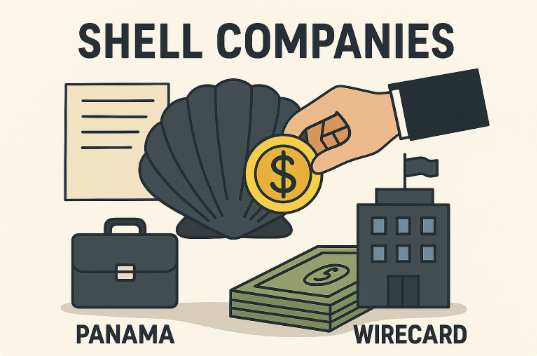
It mirrors the Panama Papers, Wirecard’s collapse, and Nirav Modi’s scam.
Shell companies are not evil in themselves—many are used legally.
But in the wrong hands, they become the world’s most dangerous laundromats.
They allow criminals to:
- Hide true ownership.
- Layer transactions across borders.
- Bring back dirty money as clean investments.
And until regulators, auditors, and banks dig beneath the paper façade, more men like Raj will rise, shine, and fall.
Final Thought
So the next time you read about a sudden billionaire, ask:
👉 Is he really a visionary? Or just another Raj Malhotra playing the shell game?
4. Real-World Examples
- Panama Papers (2016) – Revealed how Mossack Fonseca set up shell companies for politicians, criminals, and celebrities to hide assets.
- Wirecard (2020) – Used a network of shell companies in Asia and the Middle East to fake revenues.
- Nirav Modi Scam (India, 2018) – Multiple shell companies were used to move money abroad through fraudulent LoUs (letters of undertaking).
5. Red Flags for Shell Companies
- No physical office or employees.
- Complex ownership structure (layered through multiple jurisdictions).
- Registered in offshore tax havens.
- Frequent, high-value cross-border transfers without clear business purpose.
- Discrepancies between financial statements and actual business operations.
6. How Regulators & Forensic Experts Detect This
- Beneficial Ownership Registries – Identifying the real individuals behind companies.
- KYC (Know Your Customer) & AML (Anti-Money Laundering) rules – Banks required to report suspicious activity.
- Forensic Accounting & Data Analytics – Network analysis of transactions to find hidden links.
- International Cooperation – FATF (Financial Action Task Force) sets global AML standards.
🗂️ Case Study: The Panama Papers & Shell Companies
1. Introduction
The Panama Papers were one of the largest financial data leaks in history, exposing how the world’s elite used shell companies to hide assets, evade taxes, and launder money. In April 2016, the International Consortium of Investigative Journalists (ICIJ) published findings based on 11.5 million documents leaked from Mossack Fonseca, a Panama-based law firm specializing in offshore structures.
This scandal revealed systemic misuse of offshore shell entities by politicians, billionaires, criminals, and corporations across 200+ countries.
2. Background
- Mossack Fonseca: A Panamanian law firm founded in 1977, specialized in creating and managing offshore companies.
- Offshore shell companies: Entities with little or no real business activity, often used for asset protection, secrecy, and—at times—illegal activities.
- The Leak: ~2.6 terabytes of data (emails, contracts, PDFs, images, and database records) covering nearly 40 years (1977–2015).
3. How Shell Companies Were Used
The leak showed multiple tactics, including:
- Asset concealment – Wealthy individuals created offshore shells to hide ownership of yachts, mansions, and bank accounts.
- Tax evasion – Profits were shifted to tax havens with little or no taxation (Panama, British Virgin Islands, Seychelles, etc.).
- Money laundering – Criminal groups funneled illicit funds through layered shell entities to make them appear legitimate.
- Sanctions evasion – Companies linked to sanctioned countries (e.g., Iran, North Korea) used shells to access global banking.
4. Key Revelations
- Heads of State Implicated:
- Sigmundur Davíð Gunnlaugsson, Iceland’s Prime Minister, resigned after his offshore dealings were revealed.
- Associates of Vladimir Putin moved ~$2 billion through offshore networks.
- Family of Xi Jinping (China’s president) linked to offshore holdings.
- Relatives of Nawaz Sharif (Pakistan PM) used offshore shells to buy London luxury properties.
- Corporates and Banks:
- Global banks (HSBC, UBS, Deutsche Bank) helped clients set up offshore shells.
- FIFA officials linked to bribery and corruption through offshore structures.
- Criminal Networks:
- Drug cartels, arms dealers, and corrupt politicians used Mossack Fonseca’s shells to mask dirty money.
5. Impact & Consequences
- Political Fallout
- Resignation of Iceland’s PM.
- Pressure on political figures worldwide (Pakistan’s PM Sharif was disqualified by the Supreme Court).
- Legal & Regulatory Action
- Mossack Fonseca shut down in 2018.
- Multiple investigations opened globally, leading to arrests and asset seizures.
- Public Pressure & Reforms
- Greater demand for transparency in offshore finance.
- Push for Beneficial Ownership Registers (UK, EU).
- OECD and FATF strengthened compliance standards.
6. Ethical & Governance Issues
- Transparency vs. Privacy: Offshore structures aren’t always illegal—sometimes used for asset protection—but secrecy enables misuse.
- Accountability Gaps: Weak regulations allowed intermediaries (law firms, banks) to operate with little oversight.
- Global Inequality: The leak highlighted how the ultra-rich could legally exploit loopholes, while ordinary citizens faced stricter taxation.
7. Lessons Learned
- Due Diligence Matters: Financial institutions need robust KYC/AML frameworks.
- Technology in Detection: AI and forensic accounting tools can help detect unusual shell-company networks.
- International Cooperation: Money laundering is cross-border; regulators must coordinate globally.
- Corporate Governance: Boards and auditors must ensure transparency in related-party dealings and offshore investments.
8. Conclusion
The Panama Papers were a turning point in exposing how shell companies are abused. They forced governments, regulators, and institutions to rethink financial secrecy and demand transparency. While not all offshore companies are illegal, the scandal proved that without oversight, shell structures can be powerful tools for corruption, tax evasion, and laundering.
9. External References
- ICIJ Panama Papers Project
- The Guardian – Panama Papers coverage
- OECD – Beneficial Ownership Transparency
- FBI Testimony on Shell Companies
Read our blogs on Corporate Governance here.
External reference 4 Money Laundering Cases link. Panama Papers link.
✅ When Shell Companies Are Legal
A shell company is just a legal entity with little or no operations or assets. It becomes shady only when used for fraud or laundering. Many shells exist for perfectly legitimate reasons:
1. Holding Assets
- Companies often use shells to hold intellectual property, real estate, or trademarks separately from the operating business.
- Example: Google shifted its patents into a separate entity for better management and licensing.
2. Mergers & Acquisitions (M&A)
- In corporate deals, shells can act as special-purpose vehicles (SPVs) to complete acquisitions or spin-offs without disturbing the parent company’s operations.
- Example: A big company buying a startup may first create a shell SPV to handle the transaction.
3. Raising Capital (SPACs)
- Special Purpose Acquisition Companies (SPACs) are shells listed on stock markets with no operations. They exist only to raise money and later merge with a real business.
- This is 100% legal, regulated, and often used in Wall Street deals.
4. Joint Ventures
- Two companies from different countries may form a shell in a neutral jurisdiction to share profits and risks fairly.
5. Tax & Estate Planning
- Some shells are created in low-tax jurisdictions for legitimate tax optimization (not evasion).
- Wealthy families sometimes use shells for succession planning, making inheritance smoother.
Legitimate Shells – Allowed ✅
- If a company is registered properly under the Registrar of Companies (RoC), maintains books, pays taxes, and discloses ownership, it can legally exist—even if it has no operations.
- Example: A startup founder may incorporate a company to hold IP or raise funds later. Until then, it’s a shell but still legal.
⚠️ When It Crosses the Line
A legal shell becomes illegal when it’s used to:
- Hide the true owner (beneficial ownership)
- Move illicit money (hawala, fake invoices, round-tripping)
- Evade taxes beyond what’s allowed under law
- Create fake revenues or inflate valuations
Illegitimate Shells – Illegal ❌
- When shells are used for money laundering, round-tripping (sending Indian black money abroad and bringing it back as FDI), or tax evasion, they break several laws:
- Prevention of Money Laundering Act (PMLA)
- Benami Transactions Act
- Foreign Exchange Management Act (FEMA)
- Income Tax Act
✅ So, Is It Legal?
- Yes, registering and owning a shell company is legal in India, as long as it’s transparent, compliant, and not used for illegal purposes.
- No, if it’s just a dummy vehicle for laundering, tax evasion, or hiding black money.
🚨 Call to Action
Shell companies aren’t always villains—they can be legal tools. But when misused, they become weapons that rob the economy, cheat investors, and fuel corruption.
💡 As an entrepreneur, keep your company records clean and transparent.
💡 As an investor, always check for red flags—unusual related-party transactions, zero revenues, or offshore entities without clear purpose.
💡 As a citizen, demand stronger disclosure norms and support governance reforms.
👉 The future of Indian business depends on trust and transparency. Let’s build companies that create value in the open, not hide in the shadows.