
Table of Contents
🧭 Introduction: What Is Corporate Governance & Why It Matters
Imagine investing your hard-earned money in a company. You trust that the leaders will use it wisely, report honestly, and make decisions that ensure growth without crossing ethical lines. This trust is not built overnight — it’s the result of strong corporate governance.
Corporate governance is the framework that ensures accountability, transparency, fairness, and ethical leadership in an organization. It is not just about ticking compliance boxes — it’s about how companies earn and retain public trust in the long term.
⚠️ Real-World Example: Enron – When Share Prices Soared on Lies and Collapsed in Ashes
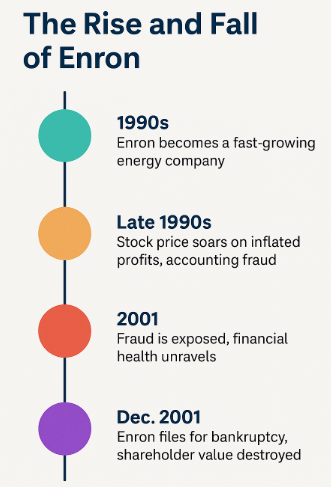
In the late 1990s, Enron was America’s crown jewel.
Lauded as an innovative energy giant, its stock soared to nearly $90, and it was hailed as a Wall Street success story. Investors poured in. Employees bought stock options. Financial media couldn’t stop praising its rapid growth and visionary leadership.
But it was all a house of cards.
Behind the glowing balance sheets were fabricated profits, hidden debts, and unethical accounting tricks. The board of directors turned a blind eye. Auditors from Arthur Andersen signed off on manipulated reports. Executives reaped millions in bonuses while concealing the company’s true health.
Then, the truth broke.
Enron filed for bankruptcy in 2001 — the largest corporate failure in U.S. history at the time. Over $60 billion in shareholder value was wiped out. Thousands of employees lost their retirement savings. Trust in corporate America was shattered.
💡 What really failed?
Not the business potential.
Not the economy.
But the very foundation of corporate governance — accountability, transparency, ethical oversight, and independent checks.
🚀 In This Blog:
You’ll uncover the 8 powerful principles of corporate governance that companies must follow to build trust, protect investors, and ensure long-term success — without shortcuts or scandals.
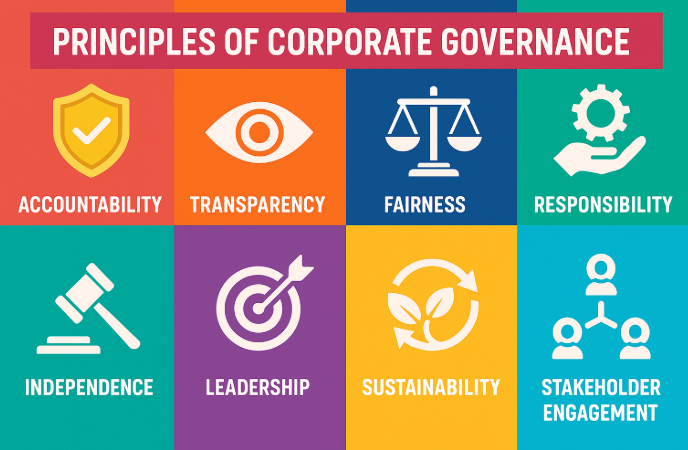
Corporate Governance Principles
Let’s dive deep into the eight core principles of corporate governance, and how they show up in the real world.
🔑 1. Accountability: The Backbone of Responsible Leadership
Corporate governance starts with accountability. The board of directors, CEOs, and managers must be accountable for their decisions — not just to shareholders, but to regulators, employees, and the public.
Real-World Example:
HDFC Bank is known for its clear role definitions and strict performance reporting. When leadership transitions took place (from Aditya Puri to Sashidhar Jagdishan), the process was transparent, stable, and accountable to stakeholders.
✅ Key Practices:
- Defined roles for board members
- Performance monitoring
- Internal audits and reporting mechanisms
👁️ 2. Transparency: Letting the Truth Shine Through
Transparency means companies share relevant, timely, and accurate information. It minimizes information asymmetry and allows all stakeholders to make informed decisions.
Real-World Example:
Tata Steel goes beyond legal disclosure by publishing detailed sustainability reports, ESG risks, and operational data — creating confidence in investors and regulators.
✅ Key Practices:
- Open financial reporting
- Transparent risk disclosures
- Equal information access for all shareholders
⚖️ 3. Fairness: Equal Treatment for All Stakeholders
Whether you own 1 share or 1 lakh shares — you deserve the same respect and rights. Fairness ensures equal access, protection of minority interests, and non-biased decision-making.
Real-World Example:
Nestlé India offers all investors — large and small — equal opportunity to participate in annual meetings and access reports. No backroom deals, no selective disclosures.
✅ Key Practices:
- Protection of minority shareholders
- Avoidance of insider favoritism
- Equal voting and dividend rights
🛡️ 4. Responsibility: Ethical Business Is Smart Business
Responsibility means acting with integrity and legal compliance. But it also means doing the right thing even when the law is silent — showing moral responsibility to people, planet, and purpose.
Real-World Example:
Mahindra Group embeds responsibility in its DNA — from fair labor practices to rural education programs. Their focus is not just on “how much profit,” but “how the profit is made.”
✅ Key Practices:
- Strong code of conduct
- Legal and ethical compliance
- Internal ethics training and audits
🧑⚖️ 5. Independence: The Power of Objective Oversight
Independent directors help prevent conflicts of interest and ensure unbiased governance. They bring fresh perspectives and check internal power dynamics.
Real-World Example:
Infosys, despite past controversies, maintains a strong structure of independent audit and risk committees to oversee executive decisions without bias.
✅ Key Practices:
- Independent audit, remuneration, and nomination committees
- Separation of CEO and Chair roles (where possible)
- Conflict of interest policies
🎯 6. Strategic Leadership: Governance with a Vision
The board is not just a watchdog — it’s a guide. Strategic governance means directing the company’s vision, mission, risk appetite, and values.
Real-World Example:
Under Ratan Tata, the Tata Group expanded globally while retaining its ethical, stakeholder-first values — blending vision with vigilance.
✅ Key Practices:
- Long-term strategy planning
- Performance review of CEO and leadership
- Risk management and scenario planning
🌱 7. Sustainability & ESG: Beyond Profits
Modern governance integrates Environmental, Social, and Governance (ESG) factors into boardroom decisions. It ensures long-term value creation for people and planet — not just shareholders.
Real-World Example:
Unilever ties executive compensation to ESG targets. They publish an integrated report showing carbon footprint, gender diversity, and ethical sourcing results.
✅ Key Practices:
- ESG targets in strategy and pay
- Climate risk disclosures
- Inclusive and ethical supply chains
🧩 8. Stakeholder Engagement: Governance for Everyone
Good governance involves more than shareholders. It considers employees, customers, suppliers, communities, and even future generations.
Real-World Example:
ITC’s e-Choupal program empowers rural farmers with market access, while also strengthening ITC’s procurement. This win-win approach reflects inclusive governance.
✅ Key Practices:
- Active stakeholder dialogue
- Grievance redressal mechanisms
- CSR and community outreach
📊 Summary Table: 8 Corporate Governance Principles
| 🏷️ Principle | 💡 Focus Area | ✅ Key Outcome |
|---|---|---|
| Accountability | Roles, Reporting, Audits | Responsible leadership |
| Transparency | Disclosures, Honesty | Investor confidence |
| Fairness | Equal Rights | Protection of minority stakeholders |
| Responsibility | Ethics, Law | Social legitimacy, risk control |
| Independence | Unbiased Oversight | Balanced decision-making |
| Strategic Leadership | Vision & Execution | Sustainable business growth |
| Sustainability & ESG | Long-term Planet & People Impact | Trust and brand reputation |
| Stakeholder Engagement | Inclusive Governance | Loyalty and social license to operate |
Ethical vs Broken Governance
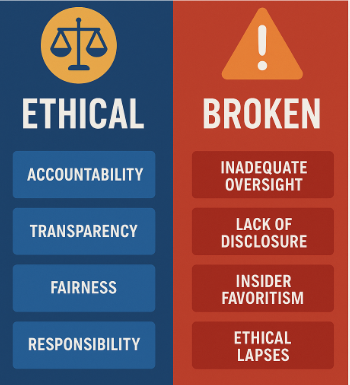
| Ethical Governance | Broken Governance |
|---|---|
| Transparency in reporting and decisions 🧾 | Hidden deals, opaque disclosures 🤐 |
| Accountability from top leadership 🎯 | Blame-shifting and denial ⛔ |
| Inclusive stakeholder engagement 🤝 | Self-serving decisions for select few 🙄 |
| Strong, independent boards 🧠 | Conflict-ridden, rubber-stamp boards ⚠️ |
| Long-term vision with values 🌱 | Short-term greed for profits 💰 |
Lessons every business leader must learn:
10 Essential Lessons from Corporate Governance Principles that every Business Leader Must Learn from the principles of corporate governance — drawn from real-world stories of success and failure:
💡 1. Trust is Earned Through Transparency
Your stakeholders — employees, customers, investors — watch how you act, not just what you promise.
📌 Lesson: Be open with your books, your challenges, and your plans. Secrecy breeds suspicion.
🧭 2. Ethical Leadership Isn’t Optional
The tone at the top determines the behavior at every level.
📌 Lesson: Uphold integrity in all actions — even when it’s hard. People will follow the example you set.
⚖️ 3. Fairness Is a Strategic Advantage
Discrimination, favoritism, and unequal treatment damage internal culture and external image.
📌 Lesson: Build equity into governance, hiring, promotions, and shareholder rights.
🧠 4. An Independent Board is Your Best Defense
A board that challenges leadership constructively can prevent disasters.
📌 Lesson: Surround yourself with diverse, empowered directors — not “yes men.”
📉 5. Soaring Share Price Can Be a Mirage
Enron, Theranos, Yes Bank — all rose fast. And all crashed harder.
📌 Lesson: Don’t mistake hype for health. Solid governance matters more than stock spikes.
🧩 6. Accountability Must Start at the Top
When leaders pass the blame, trust collapses.
📌 Lesson: Own outcomes. Apologize when needed. Fix mistakes swiftly.
📊 7. Risk Management is Daily, Not Yearly
Ignoring small risks creates giant disasters.
📌 Lesson: Regularly audit operations, culture, and finances. Prevention is cheaper than crisis response.
🌱 8. Purpose Beyond Profit Drives Longevity
Companies with purpose outperform in trust, talent, and customer loyalty.
📌 Lesson: Balance profit with planet and people — the triple bottom line.
🤝 9. Listen to All Stakeholders
Employees, customers, regulators — not just investors — have a say in your success.
📌 Lesson: Create channels for dialogue and feedback from all key groups.
🔄 10. Governance is Not a One-Time Setup
Markets, laws, expectations evolve — so must your governance.
📌 Lesson: Regularly review and refresh your governance practices.
📌 Final Thought:
“Corporate governance is not about compliance. It’s about character, conscience, and continuity.”
🔔 Conclusion: Governance Is the Soul of Business
In an age of public scrutiny, data leaks, greenwashing, and activist investors — governance is more than a legal obligation. It’s how companies build legacy, loyalty, and leadership.
“Corporate governance is not just about preventing failure. It’s about enabling success — the right way.”
📣 Call to Action:
Are you an entrepreneur, student, investor, or board member?
✅ Start asking the hard questions:
- Is your business transparent?
- Are you protecting stakeholder interests?
- Are ethics as important as profits?
Because governance is not a checkbox — it’s a compass.
Read about United Nations 17 Sustainability Development Goals here.
Reference: OECD Principles of Corporate Governance
2 thoughts on “🏛️ Corporate Governance Principles: The 8 Pillars That Build Trust & Sustainability”
Comments are closed.