Financial Modeling: What It Is, How to Build It, and a Case Study

Financial Modeling

What is Financial Modeling?

Imagine being able to predict the future of your business, make smarter investment decisions, and turn raw numbers into a clear roadmap for growth. That’s exactly what financial modeling does—it transforms complex financial data into actionable insights, helping entrepreneurs, investors, and professionals make decisions with confidence. Whether you’re planning a startup, evaluating a new project, or managing an existing business, mastering financial modeling can be your ultimate game-changer.

Financial modeling is a critical tool in corporate finance, investment analysis, and strategic decision-making. It allows analysts, investors, and business leaders to forecast a company’s financial performance, evaluate investment opportunities, and make informed decisions.

Financial modeling is the process of creating a mathematical representation of a company’s financial performance. Typically built in Excel or other spreadsheet tools, a financial model uses historical data and assumptions about the future to predict revenue, expenses, cash flows, and profitability.

Key purposes of financial modeling include:

  • Valuation: Estimating a company’s worth for M&A, IPOs, or investment decisions.
  • Decision-making: Assessing the impact of strategic initiatives such as new projects or cost-cutting measures.
  • Fundraising & budgeting: Helping companies plan capital requirements and allocations.
  • Scenario analysis: Evaluating “what if” scenarios, like changes in sales growth, interest rates, or market conditions.

How to Build a Financial Model

Financial Modeling

Building a financial model requires both financial knowledge and technical skills in Excel or similar tools. Here’s a step-by-step approach:

1. Gather Historical Data

Collect at least 3–5 years of financial statements, including:

  • Income Statement
  • Balance Sheet
  • Cash Flow Statement

2. Identify Key Drivers

Determine the main variables that influence the company’s financial performance, such as:

  • Revenue growth rate
  • Gross margin
  • Operating expenses
  • Capital expenditures
  • Debt levels

3. Build Assumptions

Assumptions are the foundation of your model. For example:

  • Sales will grow 10% annually
  • Gross margin will remain 45%
  • Debt repayment schedule and interest rates

4. Forecast Financial Statements

Using historical data and assumptions, project:

  • Income Statement: Revenues, expenses, EBITDA, net income
  • Balance Sheet: Assets, liabilities, equity
  • Cash Flow Statement: Cash inflows and outflows, free cash flow

5. Conduct Scenario Analysis

Evaluate different situations such as:

  • Optimistic case (higher sales, lower costs)
  • Base case (expected performance)
  • Pessimistic case (lower sales, higher costs)

6. Perform Valuation

Use methods like:

  • Discounted Cash Flow (DCF) analysis
  • Comparable company analysis
  • Precedent transactions

7. Make Decisions

  • Evaluates Feasibility – Tests if new projects or expansions (like going online) are financially viable.
  • Forecasts Performance – Projects revenues, costs, and cash flows to anticipate future results.
  • Assesses Value – Helps determine enterprise value (EV) and shareholder returns.
  • Compares Scenarios – Runs “what-if” analyses to see outcomes under different assumptions.
  • Supports Investors & Lenders – Builds confidence by showing structured, data-driven decisions.

TrendMart’s Journey: How Financial Modeling Guided a Smart Online Expansion

Financial Modeling

Meet Rohit, a passionate entrepreneur running TrendMart, a small retail store in his hometown. For years, Rohit had a loyal local customer base, but he wanted to expand online to tap into a larger market. The big question:

“Is going online financially feasible, or will it drain my resources?”

To answer this, Rohit turned to financial modeling.


Step 1: Looking Back – Understanding the Past

Rohit started by analyzing TrendMart’s historical performance:

YearRevenue (₹M)Net Profit (₹M)
2022505
2023606
2024707

Revenue grew steadily, and net profit hovered around 10% of revenue. This gave Rohit a solid base for future projections.


Step 2: Identifying Key Drivers

Next, Rohit worked with a financial analyst to identify key drivers for his online expansion:

  • Revenue growth: How quickly online sales could increase
  • Gross margin: Ensuring products remain profitable after platform fees
  • Operating expenses: Marketing, logistics, and technology costs
  • Expansion cost: Initial setup investment for online operations

How Key Drivers Are Determined

Drivers are the variables that directly affect financial performance. Analysts identify them by studying the business model, industry, and past data.

For TrendMart (a retail business going online), the key drivers were:

  • Revenue growth rate
    • Determined from historical trends (2022–2024 revenue grew ~15–20%).
    • Benchmarked against industry growth rates (e.g., online retail sector in India might be growing 15–25% per year).
    • Adjusted for company’s capacity (Rohit can’t grow faster than logistics/marketing allows).
  • Gross margin (profit after direct costs)
    • Historical gross margin (in local retail ~40%).
    • Industry benchmarks for online retail margins.
    • Impact of platform commissions (e.g., Amazon, Flipkart might take 8–15%).
  • Operating expenses (marketing, logistics, salaries, rent, IT)
    • Historical expense ratio ~20% of revenue.
    • Online expansion typically increases marketing costs, so assumption tested at 20–25%.
  • Capital expenditures (CapEx)
    • One-time expansion cost (₹10M) estimated from tech platform setup, warehouse, delivery tie-ups, and digital marketing campaigns.
    • Cross-checked with vendor quotations or benchmarks.
  • Discount rate (12%)
    • Based on cost of capital (Rohit could borrow at ~10–12%, investors would also expect ~12–15%).

Step 3: Making Realistic Assumptions

Together, they agreed on the following assumptions:

  • Revenue growth: 15% per year
  • Gross margin: 40%
  • Operating expenses: 20% of revenue
  • One-time online expansion cost: ₹10M in Year 1
  • Discount rate for valuation: 12%

These assumptions became the backbone of TrendMart’s financial model.

The strength of a financial model lies in how realistic and justifiable the assumptions are. A smart analyst:

  • Uses data + industry research + judgment
  • Tests multiple scenarios (best, worst, base)
  • Documents the rationale, so investors and managers know why those numbers were used

Step 4: Forecasting the Future

Using the model, Rohit projected revenues, profits, and cash flow for the next 3 years.

YearRevenue (₹M)Gross Profit (₹M)Operating Expenses (₹M)Expansion Cost (₹M)Net Profit (₹M)
2025803216106
20269236.818.4018.4
202710642.421.2021.2

Step-by-step calculations for 2025:

  • Revenue = 70 × 1.15 = 80.5 ≈ 80
  • Gross Profit = 80 × 0.40 = 32
  • Operating Expenses = 80 × 0.20 = 16
  • Net Profit = 32 − 16 − 10 (expansion cost) = 6

This forecast gave Rohit a clear picture of profitability under the expansion plan.


Step 5: Valuation Using Discounted Cash Flow (DCF)

Rohit wanted to know the value his business could achieve with an online presence. Using a simplified DCF approach:

Step 5a: Free Cash Flow (FCF)

YearNet Profit / FCF (₹M)
20256
202618.4
202721.2

Free Cash Flow is the cash available to investors (debt + equity holders) after the company pays for:

  • Day-to-day operations, and
  • Necessary capital expenditures (CapEx).

👉 Formula (simplified):

FCF=EBIT×(1−Tax Rate)+Depreciation−CapEx−ΔWorking Capital

In practice, analysts often adjust based on data availability. For smaller case studies (like TrendMart), we sometimes approximate FCF ≈ Net Profit if depreciation, taxes, and working capital changes are small or stable.

In real-world corporate models, FCF requires:

  • Working capital projections (inventory, receivables, payables)
  • Detailed tax calculation (EBIT × (1 – tax rate))
  • Depreciation & amortization adjustments
  • Ongoing CapEx estimates (warehouses, logistics, IT upgrades)

Step 5b: Present Value of Cash Flows

PV=FCF​/(1+r)^t

Where r = 12% discount rate, t = year number

  • 2025: 6 / 1.12 ≈ 5.36
  • 2026: 18.4 / (1.12)^2 ≈ 14.66
  • 2027: 21.2 / (1.12)^3 ≈ 15.1

Total Present Value (EV) = 5.36 + 14.66 + 15.1 ≈ ₹35.1M

👉 This is the Enterprise Value of TrendMart based on our simplified 3-year model.

Note: A full DCF would include a terminal value, but even this simplified model shows the financial upside of going online.


Step 6: Scenario Analysis – Preparing for Uncertainty

Rohit tested different growth scenarios:

  • Optimistic: 20% revenue growth → Net Profit Year 2027 ≈ 26.8 → EV higher
  • Pessimistic: 10% growth → Net Profit Year 2027 ≈ 16.1 → EV lower

This risk assessment helped him plan contingencies, like phasing marketing spend or gradual rollout, if online adoption was slower.


Step 7: Making the Decision – Go Online or Not?

The financial model guided Rohit in multiple ways:

  1. Profitability check: Even after the ₹10M expansion cost, profits remain positive.
  2. Cash flow planning: He knew exactly how much funding was needed upfront.
  3. Risk assessment: Scenario analysis prepared him for slow or fast growth.
  4. Valuation insight: The online expansion could significantly increase TrendMart’s worth, attracting potential investors.
  5. Timing strategy: He could plan when to spend on marketing and platform development to optimize returns.

✅ With these insights, Rohit made a data-driven decision: he would expand online, confident that TrendMart could grow sustainably and profitably.


Considering Terminal Value

Let’s extend the TrendMart case with a Terminal Value (TV) to get a more realistic Enterprise Value (EV).


Step 1: Recap of Free Cash Flows (FCFs)

From TrendMart’s online expansion model:

YearForecast FCF (₹M)
20256.0
202618.4
202721.2

We will now discount these to present value (PV).

Discount rate (WACC) = 12%.

PV=FCF/(1+r)^t

  • 2025 PV = 6 / (1.12)^1 ≈ 5.36M
  • 2026 PV = 18.4 / (1.12)^2 ≈ 14.66M
  • 2027 PV = 21.2 / (1.12)^3 ≈ 15.10M

👉 Sum of 3-year PVs = 35.12M


Step 2: Add Terminal Value (TV)

Since businesses don’t stop after 3 years, we estimate a terminal value from 2027 onward.

We’ll use the Gordon Growth Method: TV=FCF2027×(1+g)/(r−g)

Where:

  • FCF2027=21.2M
  • Long-term growth rate (ggg) = 4% (reasonable for retail in India)
  • Discount rate (rrr) = 12%

TV=21.2×1.04/(0.12−0.04)

TV=22.048/0.08=275.6


Step 3: Discount the Terminal Value

PV(TV)=275.6(1.12)^3

PV(TV) ≈ 275.6/1.4049 ​≈ 196.2M


Step 4: Enterprise Value (EV)

EV=PV(FCFs)+PV(TV)

EV=35.12M+196.2M=231.3M

👉 Enterprise Value of TrendMart ≈ ₹231M


Step 5: Equity Value

If TrendMart has:

  • Debt = ₹30M
  • Cash = ₹5M

Then, Equity Value=EV−Debt+Cash

Equity Value=231.3−30+5=206.3M

So the shareholders’ value of TrendMart is about ₹206M.


Why This Matters for Rohit’s Decision

  • Before expansion, TrendMart might have been valued much lower (say ₹80–100M).
  • After adding the online channel, EV rises to ₹231MValue Creation confirmed.
  • Rohit now has proof that going online is not just profitable, but also increases shareholder wealth significantly.

In short: Adding the terminal value makes the model realistic, showing that TrendMart’s long-term value creation is far greater than the near-term profits.


Key Takeaways

  • Financial modeling turns uncertainty into clarity.
  • Even small businesses can use it to plan expansions, manage cash flow, and attract investors.
  • Scenario analysis ensures you are prepared for risks, not just optimistic forecasts.
  • A model is not just numbers—it’s a decision-making tool that guides strategy and growth.

Call to Action

“Don’t leave your business decisions to guesswork—start building your financial model today and take control of your financial future. Download our free template, explore step-by-step examples, and turn numbers into actionable insights!”

Read more blogs here.

Here’s a good reference link for financial modeling (concepts, examples, templates):

11 Financial Modeling Examples & Templates for 2025

Equity Valuation Secrets: 3 Powerful Methods Every Investor Must Know

Equity Valuation


📖 The Story Behind Valuing a Company

Equity Valuation

In 2008, when global markets were crumbling, a small-town investor named Rajesh watched his entire savings vanish in a matter of weeks. He had invested in a “hot stock tip” from friends without ever asking a simple question: “What is this company’s real worth?”

Years later, Rajesh reflected on that painful mistake. It wasn’t that the company was bad — it was that he had no framework to judge whether the stock price made sense. If he had known how analysts use tools like the Dividend Discount Model (DDM), Discounted Cash Flow (DCF), or Relative Valuation (Multiples), he could have avoided being swept away by market hype.

That’s the essence of equity valuation. Behind every stock price is a story — of dividends, cash flows, growth, and market perception. And as investors, our job is to separate the noise from reality.

In this blog, we’ll explore the three most powerful methods of valuing a stock, see how they work with an example, and learn how analysts triangulate between them to arrive at a fair value.

Because at the end of the day, valuation is not just numbers on a sheet — it’s the difference between making informed decisions or repeating Rajesh’s mistake.

Equity Valuation

📊 Understanding Equity Valuation: DDM vs DCF vs Relative Models

Valuing a company’s stock is at the heart of investing. But with multiple valuation models available, which one should you rely on? The answer often depends on the type of company and the purpose of your analysis. Let’s break down the three most widely used approaches: the Dividend Discount Model (DDM), the Discounted Cash Flow Model (DCF), and Relative Valuation Models.


🔹 1. Dividend Discount Model (DDM)

The Dividend Discount Model is one of the oldest valuation methods. It assumes that a stock’s value is simply the present value of all future dividends it will pay.

  • Formula (Gordon Growth Model): P0=D1r−gP_0 = \frac{D_1}{r – g}P0​=r−gD1​​ where D1D_1D1​ is the expected dividend, rrr is the cost of equity, and ggg is the dividend growth rate.
  • When to Use:
    • Mature companies with consistent dividend payouts (banks, utilities, FMCG).
  • Strength: Simple, dividend-focused.
  • Weakness: Doesn’t work for companies that don’t pay dividends or have erratic payout policies.

🔹 2. Discounted Cash Flow Model (DCF)

The DCF model looks beyond dividends. It values a company based on the free cash flows it can generate in the future, discounted back at the appropriate cost of capital.

  • Steps:
    1. Forecast revenues, margins, capex, and working capital.
    2. Estimate free cash flows (FCF).
    3. Discount FCF at the cost of capital.
    4. Add terminal value to capture long-term growth.
  • When to Use:
    • Growth firms, startups, or companies reinvesting heavily rather than paying dividends.
  • Strength: Comprehensive, captures firm fundamentals.
  • Weakness: Highly sensitive to assumptions on growth, discount rate, and terminal value.

🔹 3. Relative Valuation (Multiples Approach)

Sometimes, the best way to value a company is to compare it with its peers. This is where relative valuation comes in.

  • Common Multiples:
    • Price-to-Earnings (P/E)
    • Enterprise Value / EBITDA
    • Price-to-Book (P/B)
    • Price-to-Sales (P/S)
  • When to Use:
    • Benchmarking against competitors.
    • Quick checks against market sentiment.
  • Strength: Market-driven, easy to apply.
  • Weakness: Peer group choice can distort results; ignores unique fundamentals.

🔹 Putting It All Together

No single model is perfect. Analysts typically use a combination of methods:

  • DDM for stable dividend-paying firms,
  • DCF as the core valuation for most businesses,
  • Relative Valuation as a cross-check against market pricing.

By triangulating between these models, investors gain a more balanced and reliable view of a company’s true worth.


💡 Final Thought

Equity valuation is as much an art as it is a science. Models provide the framework, but judgment, market context, and sector knowledge make the difference. The key is not to rely on just one method—but to use them together for better decision-making.

Let’s walk through each model (DDM, DCF, Relative Valuation) with a simple example so you can see the actual calculation step by step.


📊 Example: Valuing XYZ Ltd.

Suppose we are trying to value XYZ Ltd., a listed company. Here are some assumptions:

  • Current dividend per share: ₹5
  • Expected dividend growth rate (g): 6% per year
  • Cost of equity (r): 10%
  • Projected Free Cash Flow to Firm (FCFF): grows at 8% for the next 5 years, then stabilizes at 4%
  • Peer group average P/E multiple: 18x
  • XYZ Ltd.’s expected EPS next year: ₹100

1️⃣ Dividend Discount Model (DDM)

We use the Gordon Growth Model (assuming dividends grow forever at constant rate g): P0=D1r−gP_0 = \frac{D_1}{r – g}P0​=r−gD1​​

  • Next year’s dividend = D1=5×(1+0.06)=₹5.30D_1 = 5 \times (1+0.06) = ₹5.30D1​=5×(1+0.06)=₹5.30
  • r=10%=0.10r = 10\% = 0.10r=10%=0.10
  • g=6%=0.06g = 6\% = 0.06g=6%=0.06

P0=5.300.10−0.06=5.300.04=₹132.5P_0 = \frac{5.30}{0.10 – 0.06} = \frac{5.30}{0.04} = ₹132.5P0​=0.10−0.065.30​=0.045.30​=₹132.5

👉 According to DDM, the stock is worth ₹132.5 per share.


2️⃣ Discounted Cash Flow (DCF) Model

Let’s assume projected Free Cash Flow to Firm (FCFF):

  • Year 1: ₹200 Cr
  • Year 2: ₹216 Cr (grows 8%)
  • Year 3: ₹233 Cr
  • Year 4: ₹252 Cr
  • Year 5: ₹272 Cr

After Year 5, growth slows to 4% (terminal growth rate).
Discount rate (WACC) = 10%.

Step 1: Discount projected cash flows

PV=FCFt(1+r)tPV = \frac{FCF_t}{(1+r)^t}PV=(1+r)tFCFt​​

  • Year 1: 200/1.1=182200 / 1.1 = 182200/1.1=182
  • Year 2: 216/(1.1)2=179216 / (1.1)^2 = 179216/(1.1)2=179
  • Year 3: 233/(1.1)3=175233 / (1.1)^3 = 175233/(1.1)3=175
  • Year 4: 252/(1.1)4=172252 / (1.1)^4 = 172252/(1.1)4=172
  • Year 5: 272/(1.1)5=169272 / (1.1)^5 = 169272/(1.1)5=169

Sum (Years 1–5) = ₹877 Cr

Step 2: Terminal Value (TV) at Year 5

TV=FCF6r−g=272×1.040.10−0.04=282.90.06=₹4715CrTV = \frac{FCF_6}{r – g} = \frac{272 \times 1.04}{0.10 – 0.04} = \frac{282.9}{0.06} = ₹4715 CrTV=r−gFCF6​​=0.10−0.04272×1.04​=0.06282.9​=₹4715Cr

Discounted back: PVTV=4715(1.1)5=₹2928CrPV_{TV} = \frac{4715}{(1.1)^5} = ₹2928 CrPVTV​=(1.1)54715​=₹2928Cr

Step 3: Total Firm Value

EV=877+2928=₹3805CrEV = 877 + 2928 = ₹3805 CrEV=877+2928=₹3805Cr

👉 According to DCF, the firm’s value = ₹3805 Cr. Divide by number of shares outstanding (say 25 Cr shares): Value per share=380525=₹152Value \ per \ share = \frac{3805}{25} = ₹152Value per share=253805​=₹152


3️⃣ Relative Valuation (Multiples)

Given:

  • Peer group average P/E = 18x
  • XYZ Ltd.’s expected EPS = ₹100

Value per share=EPS×P/E=100×18=₹1800Value \ per \ share = EPS \times P/E = 100 \times 18 = ₹1800Value per share=EPS×P/E=100×18=₹1800

👉 According to relative valuation, the stock is worth ₹1800 per share.


✅ Comparison of Results

MethodValue per share
DDM₹132.5
DCF₹152
Relative (P/E)₹1800

🔎 Interpretation

  • DDM gives a low value, since dividends are relatively small compared to earnings.
  • DCF provides a more balanced view, reflecting future cash flows.
  • Relative valuation shows a much higher number — suggesting the market pays a premium for peers (maybe due to growth expectations, brand, or sector hype).

👉 In real-world practice, an analyst would triangulate between these models to arrive at a fair valuation range.


🔎 Triangulating Equity Valuation Methods

When analysts value a stock, they rarely rely on a single model. Each method captures a different perspective:

  • DDM → Focuses only on dividends (income for shareholders).
  • DCF → Captures the company’s true cash-generating ability.
  • Relative Valuation → Reflects how the market is pricing peers.

By combining all three, analysts balance fundamentals, income, and market sentiment.

🧭 Step 1: Assess Reliability of Each Model

  • DDM (₹132.5)
    • XYZ pays low dividends compared to earnings.
    • DDM undervalues companies that retain profits for growth.
    • Analyst conclusion → Low weight (not very reliable here).
  • DCF (₹152)
    • Based on fundamentals: free cash flow, growth, terminal value.
    • Best reflection of intrinsic value if assumptions are reasonable.
    • Analyst conclusion → High weight (most reliable).
  • Relative Valuation (₹1800)
    • Shows the market is paying very high multiples for peers.
    • Could be due to sector hype or investor optimism.
    • Analyst conclusion → Cross-check only (market-driven, but can be inflated).

🧭 Step 2: Assign Weights

Analysts often assign weights to each method based on relevance:

  • DDM → 10% (since dividends aren’t the main driver)
  • DCF → 60% (captures fundamentals best)
  • Relative → 30% (reflects market perception)

🧭 Step 3: Weighted Average

Fair Value=(132.5×0.10)+(152×0.60)+(1800×0.30)Fair\ Value = (132.5 \times 0.10) + (152 \times 0.60) + (1800 \times 0.30)Fair Value=(132.5×0.10)+(152×0.60)+(1800×0.30) =13.25+91.2+540=₹644.5= 13.25 + 91.2 + 540 = ₹644.5=13.25+91.2+540=₹644.5

👉 Fair Value Estimate ≈ ₹650 per share


🎯 Analyst’s Final View

  • Intrinsic value (DCF) suggests the business fundamentals justify ~₹150 per share.
  • Market sentiment (Relative) pushes the number much higher (~₹1800).
  • By triangulating, the analyst finds a middle ground (~₹650).

This tells us:

  • Market may be overpricing peers (bubble risk).
  • The stock might be undervalued if growth justifies higher multiples.
  • Final recommendation → “Fair Value Range: ₹600–₹700 per share” (but watch sector sentiment).

🔎 Investment Thesis

  • Strong Fundamentals (DCF Value ~₹152):
    XYZ Ltd. generates consistent free cash flows and has healthy growth prospects. However, intrinsic cash flow value alone suggests a modest per-share valuation.
  • Low Dividend Yield (DDM Value ~₹132.5):
    Dividend payouts are relatively small compared to earnings, making DDM less relevant for this stock.
  • High Market Multiples (Relative Value ~₹1800):
    Peer group trades at elevated valuations (avg. P/E ~18x), significantly above fundamental value. This reflects sector optimism and investor sentiment, not necessarily underlying cash flows.

🎯 Analyst Conclusion

Triangulating the three methods, we estimate a fair value of ~₹650 per share.

  • At current levels (~₹620), the stock trades close to fair value.
  • Upside is limited unless earnings growth accelerates to justify higher multiples.
  • Downside risk exists if sector multiples de-rate closer to intrinsic fundamentals.

✅ Recommendation

  • Rating: HOLD
  • Fair Value Range: ₹600 – ₹700
  • Catalysts: Faster revenue growth, margin expansion, or higher dividend payout.
  • Risks: Market de-rating, lower cash flow generation, or over-dependence on sector hype.

🔎 Why Not a SELL Rating?

Although intrinsic value (DCF ~₹152) is far below the market multiples, analysts usually consider three factors before giving a SELL:

1. Current Price vs Fair Value Range

  • Our triangulated fair value = ~₹650.
  • If current price is ~₹620, the stock is within the fair value band (₹600–₹700).
  • Analysts usually issue SELL only if price is well above fair value, say >20–30% overvaluation.

👉 Since the stock is trading fairly valued, SELL may be too harsh.


2. Market Sentiment and Relative Valuation

  • Peers are trading at very high multiples (P/E ~18x).
  • If XYZ trades significantly below peers, issuing SELL could ignore the market’s willingness to pay a premium for the sector.
  • A HOLD signals: “It’s not cheap, but not overvalued relative to the market either.”

👉 SELL might not align with how the sector is priced.


3. Analyst Communication

  • A HOLD rating often communicates: “No strong reason to buy, but also no urgency to sell.”
  • SELL ratings are relatively rare because they imply clear overvaluation and strong downside risk.
  • Since our fair value (~₹650) is close to market price (~₹620), HOLD is the neutral and professional stance.

🆚 What Would Justify a SELL?

XYZ Ltd. would deserve a SELL if:

  • The stock was trading significantly above fair value (e.g., at ₹900 or ₹1,200 when fair value is ₹650).
  • There was clear downside risk not priced in (weakening cash flows, regulatory threats, competitive losses).
  • Sector multiples were normalizing, and relative valuation no longer supported high premiums.

✅ Revised View (if stricter fundamental lens is used)

If the analyst gives more weight to DCF (since intrinsic value is much lower at ₹152), the case for a SELL strengthens. But in practice, because investors benchmark against peers and the stock trades in line with the triangulated fair value, most equity research desks would keep it at HOLD.


Key Takeaway:
Triangulation isn’t about averaging numbers blindly. It’s about understanding what each model captures, assigning importance, and arriving at a valuation range that balances fundamentals with market reality.


🌟 Closing Thoughts

Rajesh’s story could have ended differently. If back then he had paused, run the numbers, and asked “What is this stock truly worth?” he might have protected his savings and invested with confidence.

That’s the power of equity valuation. Whether through the Dividend Discount Model (DDM), the Discounted Cash Flow Model (DCF), or Relative Valuation, these tools give you a lens to see beyond market noise and hype.

The next time you face a stock tip or a tempting rally, remember: prices move fast, but value is steady. Just like Rajesh, you’ll have a choice — to follow the crowd blindly, or to use valuation models to make decisions grounded in clarity and conviction.

Your investments deserve more than guesswork. They deserve the discipline of valuation.

Read more blogs on Finance & Corporate Governance here. External reference Investopedia.

How India Ranks #1 in Digital Transactions With UPI

UPI - How India Ranks #1


📱 India’s Digital Payment Story: From Cash to a QR Code

It’s 2016. You’re at a busy chai stall in Mumbai. The tea vendor pulls out a small cardboard with a black-and-white QR code. Instead of digging for coins, you take out your phone, scan, and—ping!—the payment is done in seconds.

Fast-forward to today: the same story repeats in villages, metros, malls, and even abroad. From a ₹10 chai to a ₹10,000 shopping spree, Indians are paying with UPI (Unified Payments Interface)—a system that has turned the country into the world’s #1 digital payments market.

But how did India make this leap when even the US and Europe still juggle cards, wallets, and fees? The secret lies in the technology and design of UPI.


The Rise of UPI

  • Launched in 2016 by NPCI, UPI was designed as a seamless way to send and receive money instantly via mobile phones.
  • Zero MDR (Merchant Discount Rate) initially attracted millions of merchants to accept payments.
  • Today, UPI processes 15+ billion transactions monthly (2025 data expected to cross this mark).
  • It works across apps (PhonePe, Google Pay, Paytm, BHIM, WhatsApp Pay) – making it interoperable and universal.

📅 Timeline of UPI

  • 2008 – NPCI formed.
  • 2010 – IMPS launched (precursor to UPI).
  • 2012 – Aadhaar-enabled payments, RuPay card launched.
  • April 2016 – UPI launched with 21 banks.
  • 2017 – BHIM app released; Google Tez (later GPay), PhonePe enter.
  • 2018 – QR acceptance explodes across small vendors.
  • 2019 – 1 billion monthly UPI transactions.
  • 2020 – COVID accelerates adoption; WhatsApp Pay enters.
  • 2021 – UPI crosses 4 billion monthly transactions.
  • 2022 – UPI Lite, Credit on UPI introduced; International expansion begins.
  • 2023 – UPI crosses 10 billion monthly transactions.
  • 2024 – UPI linked with Singapore PayNow, UAE, Mauritius, France.
  • 2025 – India becomes #1 digital transactions market globally, projected 15+ billion monthly UPI payments.

📊 India – World’s Largest Digital Transactions Market

  • In 2023, India processed 46% of the world’s real-time digital payments (per ACI Worldwide report).
  • UPI clocked 100+ billion transactions in 2023 alone.
  • China follows but mostly via private wallets (WeChat/Alipay), not bank-led universal infrastructure.
  • US, UK lag in adoption due to lack of a single interoperable standard.

👉 This means: India is not just leading, it’s setting the model for the world.


Why UPI Clicked in India

  1. Simplicity – Just scan a QR code, enter PIN, and you’re done.
  2. Interoperability – One QR works across apps and banks.
  3. Trust & Government Push – RBI & NPCI ensured strong backend security.
  4. Financial Inclusion – Even small vendors and rural users got digital access.
  5. Cost Advantage – No charges for customers, minimal friction for merchants.

Impact on Economy & Society

  • Cashless Push – Reduced dependence on cash, better transparency.
  • Boost to SMEs – Street vendors, kirana shops, cab drivers went digital overnight.
  • Women Empowerment – Easy money transfer helped women access financial independence.
  • Data-led Credit Access – Digital footprints enabling micro-credit and BNPL models.

⚙️ The Technology Behind UPI

UPI is not “just an app”—it’s an open digital rail built by NPCI (National Payments Corporation of India). Think of it as an email system for money—free, instant, universal, and secure.

Here’s how it works in simple terms:

🔑 1. Virtual Payment Address (VPA) /UPI ID

Instead of remembering account numbers or IFSC codes, UPI uses a simple ID like an email (yourname@bank). This acts as your digital identity.

A UPI ID (also called Virtual Payment Address / VPA) is like an email address for money transfers. It’s a unique identifier that replaces the need to share sensitive bank details such as account number, IFSC code, or branch.

🔄 2. Real-Time Fund Transfer

When you pay, UPI connects directly to your bank account via the IMPS (Immediate Payment Service) infrastructure, ensuring 24×7, real-time settlement.

🛡️ 3. Multi-Layer Security

  • Mobile number is linked to your bank account.
  • Device binding ensures payments only from your registered phone.
  • Two-factor authentication: UPI PIN + phone SIM validation.

🔗 4. Interoperability Across Banks & Apps

Unlike wallets (Paytm wallet, Venmo, WeChat Pay), UPI is bank-to-bank and app-agnostic. A QR code from SBI works if you use Google Pay, PhonePe, Paytm, or BHIM.

⚡ 5. API-Driven Innovation

NPCI built UPI on open APIs, so fintech apps can plug in without building their own rails. This is why competition (GPay, PhonePe, Paytm, Amazon Pay) thrives on a common backbone.


🌍 Why Other Countries Still Don’t Have Their Own UPI

In 2016, when India quietly launched UPI, few imagined it would grow into the world’s most successful digital payments system. Today, rickshaw drivers in Delhi, street vendors in Chennai, and luxury malls in Mumbai all accept a simple QR code scan. India now processes billions of transactions every month, leaving even advanced economies like the US, UK, and Europe wondering: “Why can’t we build something like this?”

The answer lies not just in technology, but in ecosystem, regulation, and vision. UPI was born from India’s unique blend of government-backed infrastructure (NPCI), interoperability across banks, and a push for financial inclusion. In contrast, most other countries are still fragmented—stuck between banks, card networks, and private payment apps competing for dominance.

UPI is not just an app, it’s a shared digital public good—something the world’s most developed economies never truly prioritized. And that is why, even in 2025, India stands alone with a seamless, real-time, and universal digital payment system.

Below we summarize key factors.


1. Fragmented Banking Systems

  • In countries like the US or EU, each bank or card network has its own payment system.
  • UPI succeeded because NPCI created a common protocol connecting all Indian banks under one roof.
  • In contrast, banks in other countries compete instead of collaborating on a shared real-time platform.

2. Strong Card Network Dominance

  • In developed countries, Visa, Mastercard, and PayPal dominate digital payments.
  • These companies earn fees from merchants and resist zero-cost models like UPI.
  • India skipped the “credit card era” and moved straight from cash → mobile → UPI, avoiding this bottleneck.

3. Regulatory Challenges

  • India’s RBI and Government pushed banks to adopt UPI as mandatory infrastructure.
  • In the US or Europe, regulators cannot force private banks and card networks to join a single system.
  • This makes innovation slower and fragmented.

4. Consumer Habits & Culture

  • In the West, credit cards are deeply ingrained with reward points and credit lines.
  • In India, most consumers prefer direct bank-to-bank transfers (no credit card culture for masses), making UPI natural.

5. Government as a Driver

  • UPI was driven as a public good by NPCI (not-for-profit, promoted by RBI).
  • In other countries, payments are left to private companies who prioritize profit over inclusion.
  • India treated UPI as digital public infrastructure, similar to Aadhaar & JAM trinity.

6. Interoperability by Design

  • UPI allows you to pay any bank/any app via the same QR code.
  • In the US/Europe, apps like Zelle, Venmo, PayPal, Apple Pay work only within their own closed ecosystems.
  • Lack of open standards prevents a UPI-like system from emerging.

7. Scale & Mobile-first Economy

  • India’s massive smartphone + cheap data revolution (thanks to Jio) created the perfect environment.
  • Many countries don’t have the same scale of smartphone penetration or unified digital ID systems to power instant payments.

In short:
UPI worked because India had government will, regulatory push, public digital infrastructure, and a leapfrog effect skipping cards. Most countries are trapped in legacy payment ecosystems dominated by private networks.


🌍 Can Foreign Tourists Use UPI in India?

UPI - Foreigners

✈️ Story: Emma in Jaipur

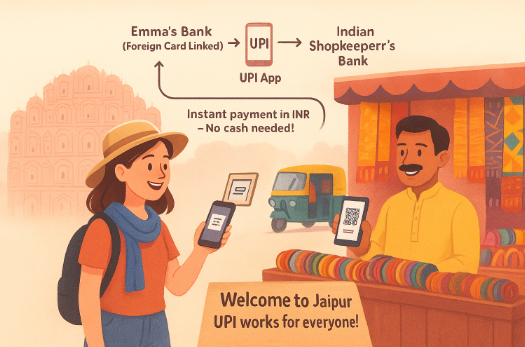
Emma, a tourist from London, is shopping in Jaipur’s bustling bazaars. She spots a scarf, the shopkeeper shows a UPI QR, and she wonders: “But I don’t have an Indian bank account!”

Emma hesitates—she doesn’t have an Indian bank account. But here’s the twist: today, even foreign tourists can use UPI in India. She takes out her phone, opens a global fintech app that’s partnered with UPI, scans the QR, and within seconds, the payment goes through—directly from her international card, converted to INR on the spot.


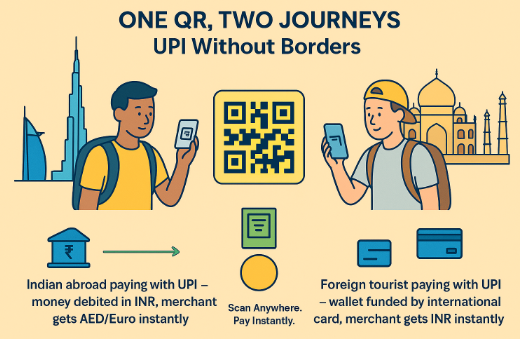
✈️ How It Works for Foreigners

Earlier, UPI was only linked to Indian bank accounts. But since February 2023, NPCI (with RBI’s approval) enabled UPI for international travelers on arrival in India.

Here’s the flow:

  1. Tourists from select countries (e.g., UK, Singapore, UAE, USA) can set up a prepaid wallet/account with an Indian bank or partner fintech at airports or designated counters.
  2. That wallet gets linked to UPI, just like an Indian would do.
  3. Payments happen in Indian Rupees, debited from their wallet (funded by international debit/credit card or forex).
  4. Merchants get paid instantly in INR, while tourists enjoy the same UPI experience as locals.

🌐 Does UPI Connect to Foreign Banks?

  • Directly: No, UPI doesn’t yet pull money straight from foreign bank accounts.
  • Indirectly: Yes, via partner apps, wallets, or card networks. For example:
    • Singapore’s PayNow is linked with UPI for cross-border transfers.
    • NPCI International is signing MoUs with countries like France, UAE, Bhutan, Mauritius, Sri Lanka for UPI acceptance.
    • Tourists can also fund Indian UPI-linked wallets through their international Visa/Mastercard.

So Emma’s London bank isn’t plugged into UPI directly, but her international card → Indian UPI wallet bridge makes it seamless.


📊 The Bigger Picture

  • In 2024–25, NPCI reported thousands of foreign tourists using UPI wallets during their India trips, especially in metros and tourist hubs.
  • India is pushing UPI as an international standard—with live acceptance already in Singapore, UAE, Mauritius, Nepal, Bhutan, and expanding into Europe.
  • The vision: whether you’re an Indian abroad or a tourist in India, one QR should just work.

✨ Why This Matters

  • For tourists: No need to carry wads of cash or constantly swipe cards with forex fees.
  • For merchants: Easy acceptance without extra hardware.
  • For India: A powerful branding tool—showcasing digital leadership to every traveler.

In February 2023, India and Singapore connected UPI with PayNow, allowing instant, low-cost transfers between the two countries.

  • A Singapore tourist in India can link their PayNow account, send money via UPI, and merchants receive it in INR instantly.
  • Similarly, Indians in Singapore can pay merchants through UPI-linked transfers.

This was a world-first in cross-border interoperability—positioning UPI as a global template.


🕌 Real Example 2: UPI in UAE (Dubai & Abu Dhabi)

In August 2023, NPCI International partnered with Mashreq’s NeoPay terminals in the UAE.

  • Indian travelers in Dubai can walk into a café, scan a UPI QR at the POS terminal, and pay directly in AED from their Indian bank account.
  • This eliminated the need for foreign cards and expensive forex charges.

🗼 Real Example 3: UPI in France

In 2023, NPCI International signed a deal with Lyra, a French payments company.

  • The partnership enables UPI acceptance in France, starting with iconic tourist hubs like the Eiffel Tower.
  • So soon, an Indian visiting Paris could pay for tickets or coffee using UPI directly.

📊 The India Advantage

  • Domestic: Foreign tourists in India can now use UPI by setting up local wallets (launched at airports in 2023).
  • International: Indians abroad are already scanning UPI at partner merchants in Singapore, UAE, France, Mauritius, Bhutan, and Nepal.
  • Vision: UPI becomes a universal QR standard—whether you’re an Indian abroad or a tourist in India.

✨ So, Emma’s Jaipur shopping trip is just the beginning. In a few years, she might fly home and buy her morning coffee in London using the same UPI QR code—a payment story that started in India, but belongs to the world.


General UPI Transaction Limits

UPI in India has transaction limits set by NPCI (National Payments Corporation of India), and they vary depending on the bank, purpose, and merchant category. Here’s a clear breakdown (as of 2025):

  • Per Transaction: ₹1 lakh (₹100,000) is the usual cap for most banks.
  • Per Day: ₹1 lakh total across all UPI transactions.

Special Categories with Higher Limits

  1. Capital Markets, IPOs, Insurance, Mutual Funds, NBFC loan repayments:
    👉 Limit increased to ₹2 lakh per transaction.
  2. UPI AutoPay for recurring payments (like OTT, bills, EMI, SIPs):
    👉 Limit is ₹15,000 per mandate (for most categories).
  3. Healthcare & Education (as per 2022 RBI circular):
    👉 UPI limit extended to ₹5 lakh per transaction.

Merchant/Bank Specific Limits

  • Each bank or UPI app (Google Pay, PhonePe, Paytm, BHIM, etc.) can set lower internal limits.
  • Example: Some banks cap at ₹25,000–₹50,000 per day, depending on risk/security.
  • First 24 hours after adding a new payee, banks often impose stricter limits (like ₹5,000).

In short:

  • ₹1 lakh per day for regular users.
  • ₹2–5 lakh for special use cases (IPOs, education, insurance, hospitals).
  • Bank/app-specific rules may further reduce the cap.

Call to Action

Have you tried UPI while traveling abroad or seen a foreigner pay in India with it? Share your story in the comments!

Do you think UPI should be adopted globally? Tell us what country you’d like to see it in next!

UPI is not just a payment system—it’s India’s digital revolution. Stay tuned as we decode more fintech success stories shaping the world.

Subscribe to our Newsletter for more insights on how India is setting benchmarks in digital innovation.

Read our blogs on Corporate Governance here.

Here’s a well-regarded external reference that highlights the growing international acceptance and expansion of UPI, especially its integration with global platforms:

  • PayPal has announced the launch of a cross-border payments platform called PayPal World, linking UPI with major global systems like Tenpay Global (China), Mercado Pago (Latin America), and Venmo—significantly expanding UPI’s international reach. Reuters