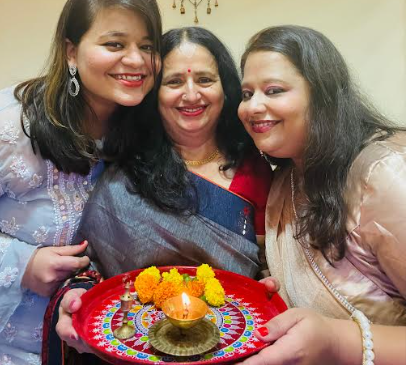
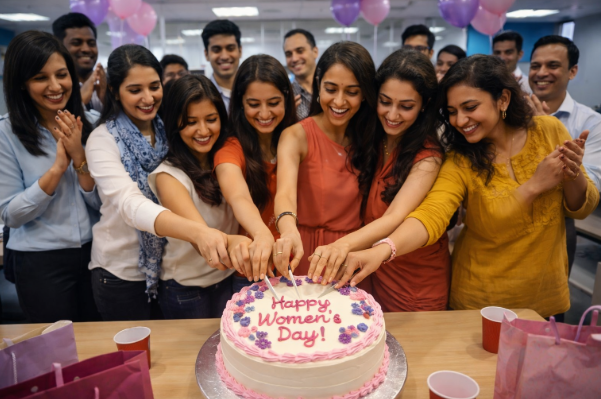
At 4:30 pm on a Friday, the office conference room slowly fills up.
Pink balloons hang from the ceiling.
A cake sits in the center of the table.
Someone announces, “Happy Women’s Day everyone!”
The team claps. Photos are taken. The cake is cut. The HR manager gives a short speech about “empowering women in the workplace.”
Everyone smiles.
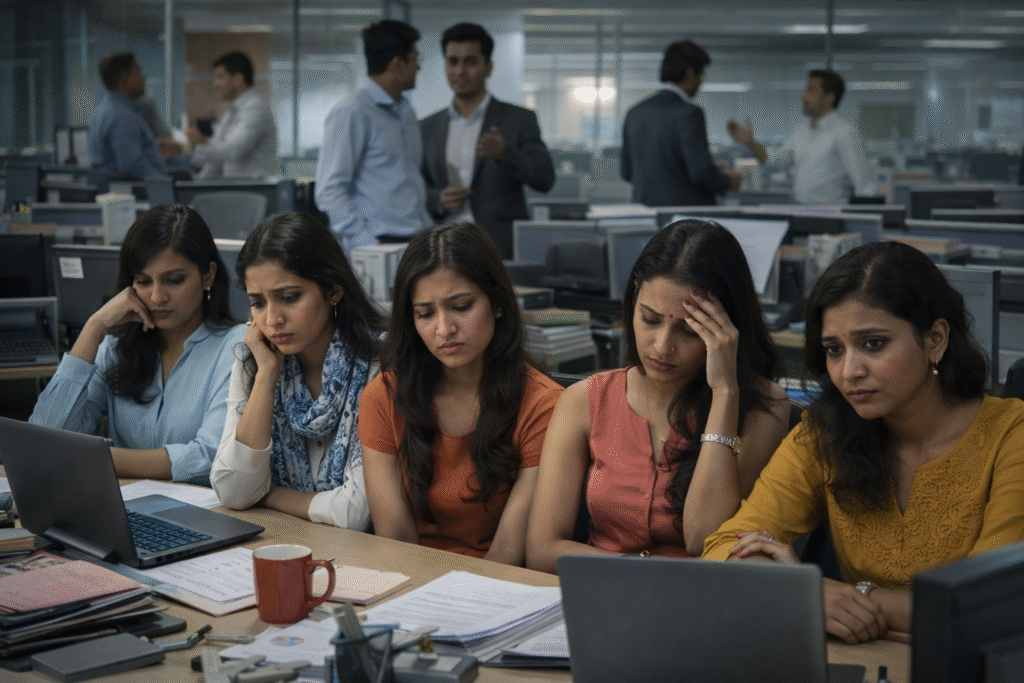
But on Monday morning, the same office quietly returns to normal.
The same women who cut the cake:
• are passed over for promotions and kept in lower roles than men
• are often paid less for the same work, due to pay gap bias and belief men are primary earners
• see their ideas ignored in meetings, until repeated by a man
• are called “too emotional” or “difficult” when they question decisions
• are denied leadership roles due to assumptions about marriage, motherhood, childcare
• face bias around late-night work, travel, relocation expectations
Many struggle to grow due to:
• male-dominated leadership networks where promotions circulate among men
• encounter conscious and unconscious gender bias in hiring and evaluations
• face male ego barriers when women challenge or lead men
• are judged by traditional norms expecting men to lead
• double burden of career and family responsibilities while proving commitment
Many quickly learn the unspoken rule of survival:
The safest way to succeed is to say “yes” to male bosses.
Independent thinking is often seen as difficult.
Disagreement is seen as disrespect.
Leadership is seen as aggression.
And yet, every year we celebrate International Women’s Day.
But this day was never meant to be about cakes, flowers, or corporate photo sessions.
It was born from struggle, courage, and a demand for equality and women are still struggling for equality.
How Women’s Day Began: A Movement, Not a Celebration
International Women’s Day traces its origins to the early 1900s, when women workers across Europe and the United States began protesting against poor working conditions, low wages, and lack of political rights.
In 1917, women in Russia went on strike demanding “Bread and Peace.”
Their protest became a powerful turning point in history and March 8 later became associated with women’s struggles for justice.
Decades later, the United Nations officially recognized International Women’s Day in 1977, giving global legitimacy to the movement.
Since then, March 8 has become a day to recognize women’s achievements while reminding the world that equality is still unfinished business.
Milestones That Changed Women’s Rights
Progress for women has come step by step through decades of activism.
Global milestones
- 1893 – New Zealand becomes the first country to grant women voting rights
- 1945 – The UN Charter recognizes equality between men and women
- 1975 – UN declares International Women’s Year
- 1977 – UN formally recognizes International Women’s Day
- 1993 – UN Declaration on Elimination of Violence Against Women
Milestones in India
India too has seen powerful progress:
- 1917 – Indian women demand voting rights during British rule
- 1950 – The Indian Constitution guarantees equal voting rights
- 1966 – India elects its first woman Prime Minister
- 2005 – Domestic Violence Act strengthens legal protection for women
- Growing participation of women in entrepreneurship, science, governance, and sports
But progress has been uneven.
And many challenges remain.
The Silent Crisis: Domestic Violence
While corporate discussions focus on leadership and diversity, millions of women are still fighting for something far more basic — safety in their own homes.
Globally, 1 in 3 women experience physical or sexual violence during their lifetime, most often from an intimate partner.
Many cases go unreported due to:
- fear
- financial dependence
- social stigma
- pressure to “protect family honour”
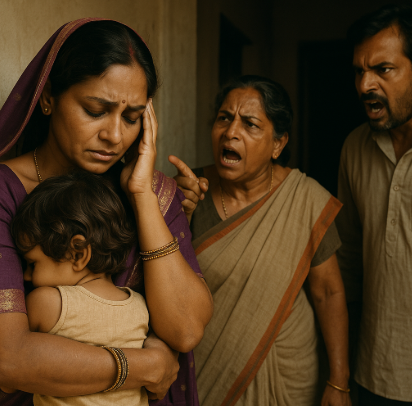
Domestic violence is not limited to physical abuse.
It also includes:
- emotional control
- financial restriction
- intimidation and psychological manipulation
For many women, the most dangerous place is not the street — but their own home.
The Gender Gap: Where the World Stands
Despite decades of progress, gender equality remains far from reality.
According to the Global Gender Gap Report, the world has closed only about 68% of the gender gap.
Countries leading in gender equality include:
- Iceland
- Finland
- Norway
- New Zealand
- United Kingdom
These countries perform well because of:
- equal pay policies
- parental leave for both parents
- higher representation of women in leadership
- strong laws against discrimination
Where India Stands
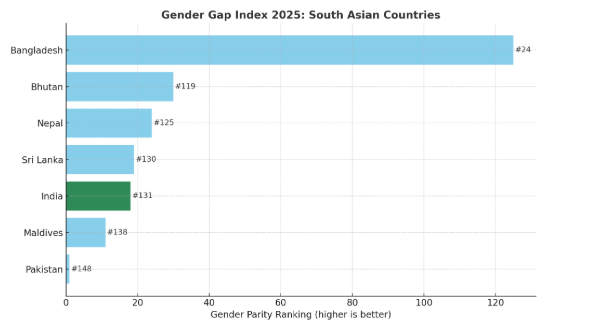
India ranked 131 out of 148 countries in the Global Gender Gap Report 2025.
The biggest challenges remain in:
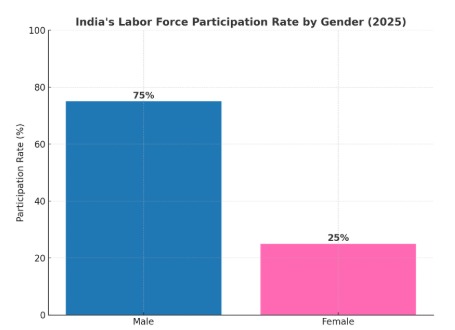
- economic participation
- wage equality
- leadership representation
Even today, many workplaces still struggle with:
- fewer women in senior roles
- gender bias in promotions
- unequal pay for similar work
This shows that economic growth alone does not guarantee gender equality.
Social attitudes must change too.
From Pain to Power: Indian Women Who Broke Barriers
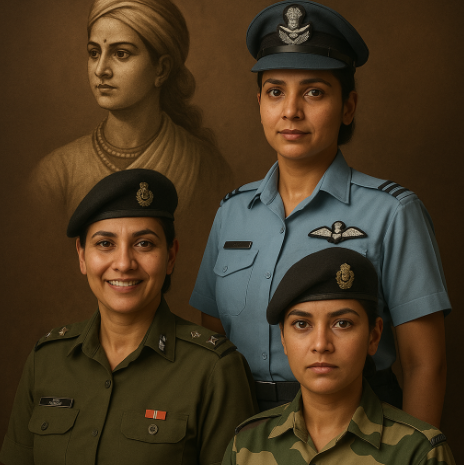
Despite challenges, countless women have risen above adversity and rewritten the rules.
Their stories show what is possible when courage meets opportunity.
Kalpana Chawla – From a Small Town to Space
Born in Karnal, Haryana, Kalpana Chawla grew up in a time when aerospace engineering was considered a male domain.
Yet she pursued her dream relentlessly, eventually becoming an astronaut at NASA.
In 1997 she became the first woman of Indian origin to travel to space.
Her life showed millions of girls that dreams are not limited by geography or gender.
Kiran Mazumdar-Shaw – Building a Global Biotech Company
When Kiran Mazumdar-Shaw started her career, banks refused to lend to her because she was a young woman entrepreneur.
Undeterred, she started a small biotechnology company in a garage.
That company later became Biocon, one of India’s leading biotech firms.
Her journey transformed her from a struggling entrepreneur to one of the most influential business leaders in India.
Mary Kom – Fighting Inside and Outside the Ring
Growing up in rural Manipur, Mary Kom faced poverty, social barriers, and skepticism about women in boxing.
Yet she persevered.
She went on to become a six-time world boxing champion and Olympic medalist.
Her story is proof that strength has nothing to do with gender.
An Often Ignored Truth: Women Must Support Women
While many barriers come from society, another challenge sometimes comes from within our own circles.
Too often, women are pushed into competing for limited opportunities.
This can create:
- jealousy
- unhealthy competition
- lack of mentorship
But real progress happens when women move from competition to collaboration.
When women support each other:
- workplaces become more inclusive
- leadership pipelines become stronger
- younger women gain confidence to rise
The success of one woman should not be seen as a threat.
It should be seen as a door opening for many others.
The Real Call to Action
International Women’s Day should not end with a cake or a social media post.
It should inspire real change.
Governments must
- strengthen laws against domestic violence
- ensure equal pay and workplace protections
- increase women’s political representation
Organizations must
- promote women based on merit
- create inclusive leadership cultures
- eliminate bias in hiring and promotions
Men must
- become allies in equality
- challenge discrimination
- support women’s leadership
And women must
- support other women instead of competing destructively
- mentor younger women
- celebrate each other’s achievements
- speak up against injustice
The Question Every Workplace Must Ask
When the cake is cut and the photos are posted, every organization should pause and ask:
Are we celebrating women — or truly empowering them?
Because the true spirit of International Women’s Day lies not in celebration.
It lies in creating a world where:
- a woman’s voice is heard
- her ideas are respected
- her safety is protected
- her leadership is welcomed
And where women stand not against each other — but together.
🔗 United Nations – International Women’s Day Background
Read more blogs on Women Empowerment here.