


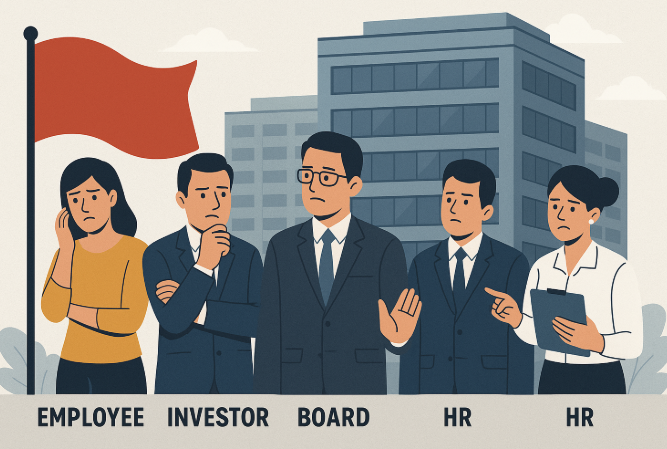
Silent Stakeholders Create Loud Collapses—Don’t Wait Until Trust, Jobs, and Money Are Gone.
Table of Contents
She Watched It All Fall Apart—From the Inside
Priya had joined the company—young, driven, and full of hope.
Every morning, she’d walk into the sleek glass building with pride. The brand was respected, the leadership hailed in magazines, and the future looked promising.
But within months, whispers started.


As a lead in internal testing, she knew the system better than most. And she also knew something else: it wasn’t ready. Flaws surfaced in every trial run—glitches, data errors, serious risks. She raised it again and again.
But her emails went unanswered.
Her reports were buried.
Her concern was seen as “negativity.”
Outside, things were different.
The company was riding a wave of hype. Press coverage called their product “the future.” Stock prices surged. Big names backed the brand. And leadership? They were busy giving interviews, not taking questions.
Then came the quiet layoffs—those who spoke up were “restructured.” Those who didn’t clap loud enough were made invisible. There was no whistleblower channel. No town halls. Only silence—and rising fear.
The truth came out too late. The product failed and the layoffs turned into mass firings.
He Saw the Numbers—But Missed the Signals
Aryan had invested his life savings in shares of the tech company & when it hit all time high, he was fascinated:
📈 Explosive revenue growth
💬 Media buzz
📊 Analyst upgrades
💼 Founders with charisma


What he missed then now haunts him:
- Two independent directors had resigned in the past year—no reasons disclosed.
- The board was made up entirely of insiders and long-time associates—not a single woman or diverse voice.
- Poor financial disclosures, inflated numbers.
- Internal audits were outsourced to a small firm barely known in the industry.
- Excessive Remuneration to Top Management Without Performance Link
- And despite product delays and defect rumors, leadership kept pushing a narrative of dominance and disruption.
He dismissed them all. “It’s just noise,” he told himself. “The market believes in them.”
Until it crashed. Share prices plunged, his life savings lost.
Both Priya & Aryan watched it all fall apart realizing only when it was too late—knowing it could have been prevented.
Introduction: When Governance Fails, Everyone Pays
What went wrong?
The answer often lies in poor corporate governance—and the red flags were there all along.
Why Corporate Governance Matters
Corporate governance is the system of rules, practices, and processes by which a company is directed and controlled. Good governance ensures transparency, fairness, and accountability to shareholders, employees, and the public.
But when governance breaks down, the consequences can be massive:
📉 Shareholder value destruction
⚖️ Legal penalties for directors
📰 Reputation loss
💼 Mass layoffs
Top 10 Red Flags in Corporate Governance
Here are some early warning signs that should not be ignored:
1. 🚪Frequent Resignation of Independent Directors
When Independent Directors step down without detailed reasons, it could indicate internal pressure or ethical concerns.
2. 🧑🤝🧑 Boardroom Dominated by Promoters or Family Members
Lack of independence in the board leads to biased decisions and suppression of dissent.
3. ❌ No Separation of CEO and Chairperson Roles
This consolidation reduces checks and balances and increases the risk of authoritarian leadership.
4. 📉 Poor Financial Disclosures or Frequent Restatements
Opaque accounting or revised earnings often hint at manipulation or cover-ups.
5. 💼 Lack of Board Diversity
Diversity in gender, experience, and backgrounds enhances scrutiny and reduces groupthink.
6. 🤐 No Whistleblower Mechanism or Ignored Complaints
If employees fear retaliation for raising issues, serious misconduct can go unchecked.
7. 🗂️ Related Party Transactions Not Disclosed Properly
This can be a pathway for siphoning funds or unethical favoritism.
8. 📊 Excessive Remuneration to Top Management Without Performance Link
Shows weak oversight and prioritizing executives over stakeholders.
9. 🕳️ Internal Audit Function Missing or Weak
No independent monitoring increases the risk of fraud going unnoticed.
10. 📵 Silence During Crises
If the board doesn’t address crises transparently, it shows disregard for accountability.
🚩 Additional Red Flags in Corporate Governance (Employee & Cultural Focus)
- Yes-man culture that suppresses dissent
- Ignoring employee concerns or feedback
- No safe, trusted whistleblower mechanism
- Culture of fear or retaliation for speaking up
- Unethical behavior tolerated or rewarded
- Silent or opaque layoffs (especially of dissenters)
- Exit interviews ignored or never conducted
- Promotions based on loyalty, not merit
- Leadership disconnected from ground reality
- Scripted or forced positivity in internal communication
- HR used to silence or isolate vocal employees
- Lack of transparency in performance reviews or exits
🚩Additional Red Flags in Corporate Governance (Investor Perspective Only)
- Promoters or insiders selling shares ahead of negative news
- Frequent changes in auditors or legal counsel
- Lack of board disclosures or detailed minutes
- No clear succession planning for top leadership
- Excessive promoter share pledging
- Repeated financial restatements without clarity
- Overly optimistic projections unsupported by fundamentals
- Undisclosed or quietly settled litigations
- Lack of clear strategy in major mergers or acquisitions
- Poor or evasive investor communication
- Minimal or scripted engagement during AGMs or earnings calls
- Strategic dependence on one customer, geography, or contract
- Weak cash flow despite reported profits (earnings quality mismatch)
- Poor quality or credibility of internal or statutory audit firms
- Stock price driven by media hype, not business performance
- No ESG (Environmental, Social, Governance) disclosures despite investor demand
What Should Stakeholders Do?
🔍 Monitor corporate announcements regularly
🧾 Read independent auditor reports
👥 Check board composition and changes
📣 Support whistleblowers
📈 Ask questions during AGMs
🛠️ How to Act on Red Flags in Corporate Governance
✅ A Unified Stakeholder Action Framework
1. Independent Directors
- Ask tough questions; ensure discussions are recorded in minutes
- Escalate unresolved issues to the Audit or Risk Committee
- Demand third-party investigations when serious allegations arise
- Refuse to be a rubber stamp—resign if governance is compromised
- Push for board diversity, fair disclosures, and whistleblower protections
2. Board of Directors
- Review board composition for independence and diversity
- Commission special audits if repeated red flags emerge
- Oversee whistleblower cases and act without bias
- Ensure transparency in financial reporting, pay, and related-party transactions
- Conduct annual board evaluations and act on feedback
3. Senior Management (CXOs, VPs)
- Ensure functional independence of HR, Audit, and Risk teams
- Report major issues or unethical practices to the board
- Avoid punishing employees who raise concerns
- Establish a culture of openness—no retaliation or favoritism
- Address internal product or compliance issues proactively
4. HR Department
- Enable safe, anonymous, and well-communicated whistleblower channels
- Monitor patterns in attrition, layoffs, and performance exits
- Conduct confidential exit interviews and flag recurring red flags
- Prevent use of HR for silencing dissent or unethical layoffs
- Promote ethics training and cultural audits
- Escalate serious complaints when management ignores them
5. Employees
- Document issues with time-stamped evidence
- Use formal internal channels to raise complaints
- Speak to HR or Ethics Committees where safe
- If ignored, escalate through legal/regulatory mechanisms
- Support whistleblowers; avoid silence out of fear
6. Investors & Shareholders
- Read disclosures, auditor reports, and resignation letters critically
- Attend AGMs/EGMs and ask accountability questions
- Engage IR to seek clarification on board changes or red flags
- Vote against resolutions that show governance compromise
- Divest or reduce exposure if governance lapses remain unaddressed
7. Regulators & Authorities
- Investigate whistleblower complaints without bias
- Monitor resignation patterns, audit failures, and financial restatements
- Mandate disclosures of internal investigations and resolutions
- Penalize directors and officers for negligence or misconduct
- Promote board accountability through listing regulations
🧩 Summary:
Red flags aren’t just signals—they are warnings.
Every stakeholder has a duty to act—not with silence or delay, but with integrity, urgency, and transparency.
Real-World Cases to Learn From
- Wirecard: Ignored warnings from auditors; whistleblower was sidelined. Result: $2 billion missing.
- IL&FS (India): Massive debt mismanagement; weak board oversight; conflict of interest.
- Theranos: Powerful board, but little technical knowledge—blind trust in founder’s claims.
Here’s a detailed contrast between two real-world case studies—one where red flags were ignored, resulting in massive failure, and another where red flags were addressed in time, saving the company.
📉 Case Study 1: Wirecard – Red Flags Ignored, Disaster Unfolded
🏢 Company: Wirecard AG (Germany)
💥 Outcome: €1.9 billion missing, insolvency, executives arrested
🚨 What Were the Red Flags?
- Frequent auditor changes and delays in audit reports
- Independent journalists (like the Financial Times) and whistleblowers raised concerns as early as 2015
- High-margin operations reported from opaque overseas subsidiaries
- Aggressive attacks by management against critics rather than engaging in transparent clarification
- Resignations from internal staff uncomfortable with financial practices
😓 What Went Wrong?
Despite these clear red flags, major stakeholders—regulators, auditors (EY), investors, and board members—chose to look the other way. German regulators even investigated journalists instead of the company.
The house of cards collapsed in 2020 when auditors revealed that €1.9 billion in cash didn’t exist. CEO Markus Braun was arrested, and the company filed for insolvency.
🧨 Damage:
- €20 billion in market value destroyed
- Complete loss of investor trust
- Reputation damage to German regulatory systems
- Thousands of employees jobless
- Criminal proceedings for top executives
✅ Case Study 2: Infosys – Red Flags Acknowledged, Crisis Averted
🏢 Company: Infosys (India)
💡 Outcome: Restored investor trust, prevented reputational loss
⚠️ What Were the Red Flags?
- Whistleblower allegations in 2019 against top leadership, accusing them of:
- Pressuring teams to inflate revenue
- Bypassing board and audit committee on large deals
- Anonymous complaints surfaced about ethical lapses
🛡️ What Did the Company Do Right?
- Immediately informed SEBI (the Indian market regulator) about the complaints
- Set up an independent investigation led by external legal counsel and forensic auditors
- Gave regular updates to the public and investors on the probe
- Independent Directors took charge of overseeing the process without CEO interference
- Eventually, the investigation found no wrongdoing, and the transparency helped restore credibility
💪 Result:
- Investor confidence recovered
- Stock price stabilized
- Infosys was seen as a governance-positive company
- A message was sent internally: ethical conduct matters at the highest level
🧭 Key Lesson:
- Wirecard shows what happens when red flags are ignored: hype kills logic, and silence costs billions.
- Infosys proves that timely, transparent governance isn’t just a legal shield—it’s a long-term business asset.
Final Thoughts: Prevention Is Cheaper Than Cure
Corporate governance red flags are often visible before the damage is done. Stakeholders—including investors, regulators, and even employees—must stay alert. The cost of ignoring them? Your savings, your job, your reputation.
💔 Call to Action: Fix the Red Flags—Before Everything Turns to Zero
A broken governance system doesn’t just damage a company—
It destroys lives.
Red flags are not minor glitches.
They are early screams in a silent boardroom.
They are ignored warnings before a storm that wipes everything out.
When no one listens:
- Investors lose everything—years of savings, wiped clean overnight.
- Employees are laid off by the hundreds—careers shattered, families pushed into financial ruin.
- Markets tremble, and entire sectors suffer.
- Credibility collapses, and trust takes decades to rebuild.
- Sometimes, it doesn’t recover at all.
A single fraud can spark a recession.
A single cover-up can erase billions.
One more silence can bring everything to zero.
Don’t wait for the headlines.
Don’t wait for the collapse.
You are not too small to matter.
If you’re on the board, in the office, in the system—
You are responsible.
🔊 Speak up. Step in. Call it out. Correct it.
Before the red flags become regrets.
Before everything—and everyone—breaks.
Read blogs on Corporate Governance here.
🔗 External Resource