
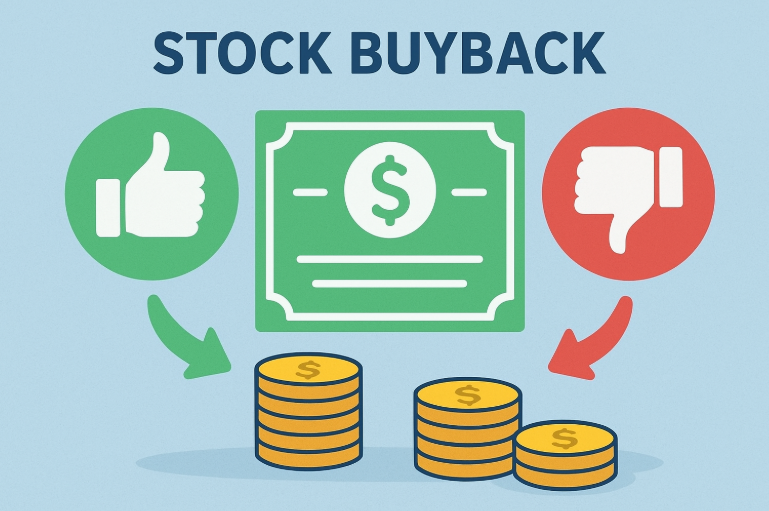
💼 Stock Buybacks: Good or Bad? The Complete Truth Behind the Corporate Move That Everyone Talks About — But Few Truly Understand

Stock buyback

Stock buybacks have become one of the most debated financial strategies across global markets. Every few months, a headline sparks excitement:

“Company announces ₹10,000 crore buyback!”
“Premium offered at 20% above market price!”
“Record-breaking repurchase program!”

Shareholders celebrate. Analysts comment. Stock prices jump.

But behind every buyback lies a deeper story — of confidence, caution, strategy, optics, emotion, and sometimes, corporate insecurity.

Let’s begin the journey.

Table of Contents


1. What Exactly Is a Stock Buyback?

A stock buyback — or share repurchase — happens when a company uses its own cash to buy its shares from the open market or through a tender offer.

Think of it like a cake:
If fewer people share the same cake, each person gets a bigger slice.

Similarly, when shares reduce:

  • Earnings Per Share (EPS) rises
  • Return on Equity (ROE) improves
  • Existing shareholders own a larger percentage of the company

Mechanically simple. Strategically complex. Emotionally powerful.


2. Why Do Companies Do Stock Buybacks? The Real Reasons (With Global + Indian Examples)

Companies don’t do buybacks randomly. Each buyback has a motive — financial, strategic, psychological, sometimes even political.

Let’s break down the top reasons.


Reason #1: Excess Cash + Limited Growth Opportunities

One of the most common reasons companies do buybacks is because they generate more cash than they can productively reinvest.

Example: TCS (India)

TCS does frequent buybacks — ₹16,000 crore in 2017, ₹18,000 crore in 2022, and more later.
Reason?
TCS is a cash machine. It doesn’t need all that cash for aggressive expansion.

The buyback signals:
“We’re stable and mature. Instead of letting cash sit idle, we reward shareholders.”

Example: Apple (Global)

Apple has spent over $500 billion on buybacks — the largest in corporate history.
Apple’s ecosystem is so strong that even after innovation, R&D, and expansion, it still has massive surplus cash.

Buybacks help distribute value back to shareholders.


Reason #2: Management Believes the Stock Is Undervalued

Perhaps the most “emotional” reason behind buybacks.

A buyback at a premium sends a bold message:
“Our stock is worth more than the market thinks.”

Example: Infosys Buyback (India, 2025)

Infosys announced a ₹18,000 crore buyback at ₹1,800 — nearly 19% above market price.
The signal was clear:

“We trust our future. We believe the market is underestimating us.”

Example: Meta (Facebook) — 2022 Crash

After massive losses in the metaverse project, Meta stock fell 70%.
Instead of panicking, Meta initiated buybacks.

Outcome?
Confidence restored → stock recovered massively.

Buybacks can be a psychological booster in the market.


Reason #3: To Boost EPS Without Improving Real Profits

This is where buybacks become controversial.

EPS = Profit / Number of Shares

If profits stay the same but shares reduce → EPS increases.
A neat trick.

Example: IBM (2010–2020)

IBM spent billions on buybacks to maintain EPS growth.
But the underlying business was weakening.

Eventually, the market punished IBM for “financial engineering” instead of “innovation”.


Reason #4: To Reduce Dilution From ESOPs & Maintain Promoter Control

Employee stock options dilute shares.
Buybacks help offset that dilution.

Example: Reliance Industries

Reliance has strategically used buybacks to maintain promoter shareholding while rewarding investors.


Reason #5: To Support the Stock Price in Volatile Times

When stocks fall sharply, a buyback acts like a safety net.

Example: Adani Group (Post-Hindenburg)

Following the crisis, discussions of buybacks emerged as a tool to restore sentiment.

Even the thought of buyback can stabilize investor emotions.


Reason #6: When Debt Is Cheap → Borrow to Buy Back Stock

This is financially risky but attractive to companies.

Example: Boeing (Before 737 MAX Crisis)

Boeing borrowed heavily to buy back $43 billion worth of shares.
Then crisis struck… and they needed liquidity desperately.

A painful lesson:
Debt-funded buybacks can destroy long-term stability.


3. Are Stock Buybacks Good or Bad? A Stakeholder-by-Stakeholder Truth

Buybacks are neither angels nor villains.
Their impact depends on who you are.

Let’s break it down.


A. For Shareholders: Usually Good (Short-Term), Mixed (Long-Term)

Benefits

  • Higher EPS
  • Higher share price due to premium
  • Better ROE & valuation multiples
  • Increased ownership percentage

Risks

  • Tax (treated as income in India now)
  • Low acceptance ratio in tender offers (5–15% for retail)
  • If company overpays, long-term investors suffer

Conclusion for Shareholders:

Short-term gift, long-term depends on why buyback happened.


B. For Management: Mostly Good

Why management loves buybacks:

  • Stock-based compensation becomes more valuable
  • EPS increases without real growth
  • Surface-level financials look better
  • Sends a message of confidence
  • Helps in hostile-takeover defense

But if misused, it signals:
“We don’t have enough growth ideas.”


C. For Employees: Mostly Neutral, Sometimes Negative

Employees often feel little immediate benefit.
Buybacks rarely translate into raises, career growth, or job security.

Upsides

  • ESOP holders benefit
  • Stock optimism can boost morale

Downsides

  • Funds diverted away from hiring, training, R&D
  • Could signal stagnation

D. For Lenders & Creditors: Mostly Negative

Debt holders prefer cash-rich companies.

Buybacks → less liquidity → higher financial risk.

Credit rating agencies closely track large buyback announcements.


E. For Regulators & Policymakers: Mixed

Regulators worry that buybacks encourage short-termism.

India introduced a special buyback tax and later changed rules to classify buyback payout as income, reducing attractiveness.

Governments want companies to reinvest in:

  • Innovation
  • Jobs
  • Sustainability projects
  • Infrastructure
  • Future technologies

—not only in boosting stock prices.


F. For Society & Long-Term Economy: Often Negative

This is the least discussed — but most important.

When mature companies like Apple do buybacks → Good

(They’ve already spent enough on innovation.)

When growing companies do buybacks → Bad

(It signals lack of vision.)

Huge buybacks drain money away from:

  • R&D
  • New jobs
  • Future technologies
  • Capital expansion
  • Social impact

Society pays the price when companies choose financial engineering over innovation.


4. Misconceptions About Buybacks — Debunked

Myth 1: Buybacks always increase stock price

Truth: Only when business fundamentals are strong.

❌ Myth 2: Buybacks are a sign of weakness

Truth: Can be a sign of maturity and confidence too (Apple, TCS).

❌ Myth 3: Large buybacks always benefit retail shareholders

Truth: Retail acceptance is often low; promoters benefit more.

❌ Myth 4: Buybacks mean higher dividends in the future

Truth: Not necessarily. Buybacks and dividends are different signals.


5. Buybacks vs Dividends: Which Is Better?

FeatureBuybackDividend
Tax impactCan be highLower for many investors
PredictabilityOccasionalRegular
SignalingUndervaluationStable cash flow
Long-term effectReduces sharesNo share change
FlexibilityHighLow

Buybacks = flexibility
Dividends = loyalty & stability

Both have their place.


6. Hidden Risks of Buybacks That Investors Ignore

1. Overpaying for shares destroys long-term value

A buyback at a peak price becomes a long-term burden.

2. Buybacks reduce company resilience

Less cash → less buffer during downturns.

3. Financial engineering masks deeper issues

EPS rise looks good, but real profits stay stagnant.

4. Reduces future strategic options

No cash left for acquisitions or innovation.

5. Protects insiders more than small shareholders

Insiders often time their stock options before buybacks.


7. So… Are Buybacks Good or Bad? The Honest Verdict

Buybacks are “good” when:

  • Company generates excess cash
  • Shares are undervalued
  • Debt is low
  • Business is mature
  • Management is disciplined
  • R&D and innovation budgets are strong

Buybacks are “bad” when:

  • They mask weak fundamentals
  • Company borrows for buybacks
  • Leadership prioritizes optics over growth
  • Employees are under-invested
  • Market is overheated
  • Promoters use buybacks to push up stock price temporarily

Buybacks are neither heroes nor villains — they’re tools.
And tools can build — or they can destroy.


8. Call To Action – A Shared Responsibility for All Stakeholders

To Investors:

Don’t celebrate a buyback blindly. Ask why it’s happening. Look deeper than the premium.

To Boards:

Approve buybacks only when they strengthen future resilience and innovation — not vanity metrics.

To Executives:

Use buybacks responsibly. Your legacy depends on how you allocate capital.

To Employees:

Understand what buybacks mean for ESOPs, culture, and company direction. Stay informed.

To Regulators:

Build guardrails that balance market efficiency with long-term societal impact.

To Society:

Value companies that innovate, not just manipulate financial optics.


“Capital is powerful — but only when it fuels progress.
Let’s demand buybacks that build stronger companies, empower employees, reward investors fairly, and create an economy that lasts.”

Read more blogs here.

Reference link.

🧭 When Boards Spoke Up: Real Stories of Directors Who Saved Companies

Effective Governance vs Cosmetic Governance

💔 Effective Governance vs Cosmetic

Some companies hang glossy values on their walls — “Integrity. Transparency. Accountability.”
But when crisis strikes, those words fade into wallpaper.

Real governance isn’t about fancy committees or famous board members.
It’s about the quiet courage to ask hard questions — even when the answers cost power, comfort, or careers.

Effective governance protects truth.
Cosmetic governance protects image.

One builds trust that lasts decades.
The other builds empires that collapse overnight.


💥 Silence Is Not Governance

Corporate boards are supposed to be the conscience of companies — the gatekeepers of integrity.
But too often, they act like spectators, not sentinels.

History has shown that fraud rarely happens overnight — it happens when directors stop asking questions.
And yet, there are times when boards did speak up — challenged powerful CEOs, questioned questionable decisions, and changed the course of corporate history.

These are the rare but powerful stories of effective governance in action.


⚖️ 1. Infosys: The Board That Chose Integrity Over Image

In 2017, whispers of impropriety in Infosys’s $200 million Panaya acquisition grew louder. The CEO, Vishal Sikka, was seen as the visionary bringing Silicon Valley flair — but questions around governance and executive pay wouldn’t die down.

Instead of dismissing whistleblower complaints as noise, Infosys’s board investigated, commissioned external audits, and engaged with founder N.R. Narayana Murthy’s concerns.

When trust became fragile, Sikka resigned — and the board invited Nandan Nilekani back to rebuild confidence.

👉 Result: The company regained investor faith and reinforced its position as a governance icon.
Lesson: Real boards choose transparency over convenience.


🏛️ 2. Tata Sons: The Boardroom Earthquake That Protected Legacy

In 2016, the Tata Group — a 150-year-old symbol of Indian integrity — witnessed a boardroom storm.
The board of Tata Sons voted to remove its own Chairman, Cyrus Mistry, citing misalignment with Tata values and strategy.

It was unprecedented — an Indian board removing its top leader.
While controversial, the move sent a message: even at the highest level, no one is above accountability.

Subsequently, under N. Chandrasekaran, Tata Sons formalized governance charters and strengthened oversight committees.

👉 Result: The Tata Group stabilized and grew stronger post-crisis.
Lesson: Governance isn’t comfort — it’s courage.


🏦 3. Axis Bank: The Board That Acted Before a Crisis

When the Reserve Bank of India raised concerns about rising NPAs and loan disclosures in 2018, the Axis Bank board didn’t wait for headlines.

They chose not to renew the term of then-CEO Shikha Sharma, despite her long tenure and reputation.
Instead, they brought in Amitabh Chaudhry from HDFC Life, known for conservative risk management and transparent leadership.

👉 Result: Axis Bank avoided a potential governance storm and rebuilt market confidence.
Lesson: Good boards prevent crises before they explode.


🚗 4. Uber: When Investors and Board Took on the Founder

In 2017, Uber’s aggressive culture had turned toxic — sexual harassment scandals, data breaches, and legal violations piled up.
The board and major investors faced a hard choice: protect the powerful founder Travis Kalanick, or protect the company’s soul.

They chose the latter.

Kalanick was forced to resign, and Dara Khosrowshahi was brought in to rebuild Uber’s ethics and culture from scratch.

👉 Result: The company went public two years later, with a renewed brand and culture.
Lesson: True governance means ending founder worship when ethics are at stake.


🌍 5. Credit Suisse: Action Came, But Too Late

Credit Suisse’s series of missteps — Archegos, Greensill, data leaks — exposed repeated governance lapses.
The board did intervene, removing CEO Thomas Gottstein and restructuring oversight committees.

But the reforms came too late. By 2023, Credit Suisse was absorbed by UBS after a loss of market trust.

👉 Lesson: Governance delayed is governance denied.


🔍 The Common Thread: When Boards Found Their Voice

Across all these stories, one pattern stands out:
Boards that acted early, independently, and transparently protected value.
Boards that waited or stayed silent — lost everything.

TraitEffective Boards
Courage to QuestionAsked uncomfortable questions, even to founders or CEOs
Timely ActionActed before regulators or crises forced them
TransparencyDisclosed findings openly
Leadership ChangeDidn’t hesitate to remove top management
Long-Term ViewPrioritized integrity over quarterly optics

💬 Conclusion: Governance Is a Verb, Not a Noun

It’s easy to write policies.
It’s hard to speak truth to power.

Effective governance lives in the moments of resistance — when directors say, “No, this isn’t right.”
The companies that survive crises are not the ones with the biggest profits —
but the ones whose boards have the backbone to act before it’s too late.


🔔 Call to Action

If you’re on a board, investor, or policymaker — ask yourself:

“Is my governance real, or just cosmetic?”

Because when boards stay silent, markets eventually speak.


Read more blogs on corporate governance here.

🌐 External Reference

Here are some good public links for the governance examples we discussed:

ExampleLink(s) with details / coverage
Infosys (CEO resigned after board / founder conflict)• “Infosys CEO resigns after long-running feud with founders” — Reuters.Reuters
• “The backstory to Infosys CEO Vishal Sikka’s resignation”
Tata Sons (board removed chairman Cyrus Mistry)• “Tata Sons seeks to oust ex-chairman from boards of Tata group companies” — Reuters.Reuters
• “Revisiting feud between Ratan Tata, Cyrus Mistry: Why it happened” — NDTV.www.ndtv.com
Axis Bank (board / management change)• “India’s Axis Bank re-appoints Amitabh Chaudhry MD, CEO” — Reuters.Reuters
• “Axis Bank MD & CEO Amitabh Chaudhry: AI is the next frontier” — Business Standard.Business Standard
Uber (board / investors forced CEO Travis Kalanick out)• “Uber CEO Travis Kalanick resigns following months of chaos” — The Guardian.The Guardian
• “Why Uber investors revolted against Travis Kalanick” — CBS News.CBS News

IL&FS Collapse – Governance Failure at Scale: When the Watchdogs Slept

IL&FS Collapse - Case Study

A Dream Gone Sour

Once upon a time, IL&FS was India’s pride.
A company that promised to build roads, bridges, ports — the arteries of a new India. Founded in 1987, Infrastructure Leasing & Financial Services Ltd (IL&FS) became synonymous with infrastructure dreams and innovation in finance. It was the institution everyone trusted — a quasi-government entity backed by powerful shareholders like LIC, SBI, HDFC, and Orix.

But in 2018, the unthinkable happened.
The company that once fueled India’s development suddenly ran out of cash.
Creditors were not paid.
Employees were in shock.
The markets panicked.
And the question echoed across boardrooms and Parliament alike —
“How could a company this big, this reputed, just… collapse?”


The Mirage of Success

IL&FS had built an empire of over 300 subsidiaries and associate companies.
Each of them working on projects that seemed noble — highways, ports, renewable energy, and smart cities. But behind this façade was a tangled web of debt, cross-loans, and creative accounting.

On paper, IL&FS looked healthy. Rating agencies showered it with AAA ratings, auditors signed off on clean reports, and the board appeared illustrious.
But the truth was rotting inside.

The company was borrowing short-term money to fund long-term projects — a classic asset-liability mismatch. Infrastructure projects often take 10–15 years to generate cash flows, but IL&FS had to repay its borrowings in 6–12 months.

When new borrowing stopped, the cash dried up.
When the cash dried up, the façade cracked.
And when the façade cracked, India witnessed one of its worst financial governance failures ever.


The Moment the Music Stopped

The first tremors appeared in June 2018, when IL&FS Transportation defaulted on ₹450 crore worth of inter-corporate deposits.
Then came another default. And another.

By September 2018, the group had defaulted on over ₹1,000 crore of short-term loans. Panic spread in financial markets. Mutual funds, banks, and NBFCs that had lent to IL&FS realized their exposure could turn toxic.

Rating agencies — which had called IL&FS a “safe bet” just weeks earlier — suddenly downgraded it from AAA to junk.
Auditors were silent.
Directors were clueless.
And investors were furious.

By October, the Indian government had no choice but to step in.
The entire board was sacked, and a new team led by Uday Kotak took over to clean up the ruins.


A House of Cards Built on Weak Governance

Let’s dissect what really went wrong — because IL&FS wasn’t just a liquidity problem. It was a governance problem at scale.

🧩 1. A Board That Looked Prestigious but Acted Powerless

The IL&FS board included celebrated bureaucrats, ex-CEOs, and eminent names — but most had little experience in infrastructure finance or risk management.
Meetings were formalities; oversight was missing. The risk management committee hadn’t met for nearly three years before the collapse.

The directors trusted management blindly, even when red flags were visible.
Their failure wasn’t ignorance — it was complacency wrapped in reputation.


💰 2. Evergreening and Creative Accounting

Instead of fixing problems, IL&FS often lent more money to struggling subsidiaries to make their books look better.
This circular funding created an illusion of stability — profits on one side, losses buried on another.

In reality, cash was hemorrhaging.
The group borrowed from one arm to pay another — much like moving money from one pocket to another while pretending to be rich.

Forensic audits later revealed round-tripping of funds, fake project advances, and related-party loans that violated every principle of prudence.


⚖️ 3. Auditor and Rating Agency Blindness

The external auditors, instead of being the watchdogs, turned into sleeping partners in silence.
Despite negative cash flows, ballooning debt, and opaque structures, audit reports painted a rosy picture.

Rating agencies too failed spectacularly.
Even a month before default, IL&FS and its key arms were rated AAA — the safest rating possible. Only after the default did they scramble to downgrade — a classic case of too little, too late.


🏛️ 4. Regulator Oversight and Systemic Complacency

IL&FS wasn’t a small firm — it was a systemically important NBFC, which means it was supposed to be under the RBI and SEBI’s radar.
But in practice, no regulator truly had a complete view of the group.
Different arms of IL&FS operated under different regulators, and no one saw the full picture.

By the time concerns reached the top, the group had accumulated over ₹91,000 crore of debt.
It was, quite literally, too big to ignore and too late to fix.


The Emotional Fallout: The Cost of Broken Trust

For thousands of employees, this collapse wasn’t just a financial loss — it was heartbreak.
Many had built their careers, reputations, and futures on the IL&FS brand.
For investors, it shattered faith in India’s financial oversight system.
For regulators, it was a rude awakening.
And for ordinary citizens, it raised haunting questions:

“If a company backed by the government, rated AAA, and audited by top firms can fall — who can we really trust?”


Forensic Red Flags That Were Missed

In hindsight, the IL&FS story reads like a textbook in missed red flags — signs that any forensic accountant or risk analyst should have caught earlier:

  1. Cash Flow vs. Profit Mismatch – Reported profits but negative operating cash flows for multiple years.
  2. Frequent Related-Party Loans – Funds flowing between group entities without clear commercial purpose.
  3. Rapid Debt Expansion – Debt ballooning without proportional increase in asset productivity.
  4. Inactive Committees – Audit and risk management committees not meeting regularly or not minuted properly.
  5. Too Many Subsidiaries – Over 300 entities — an ideal breeding ground for obfuscation.
  6. Management Compensation Rising Amid Stress – Top executives rewarded even during financial strain.
  7. Delayed Audit Reports and Disclosures – Gaps in financial reporting timelines.
  8. Lack of Consolidated Transparency – Investors and regulators focused on individual entities, not the whole group risk.

Investor Cautions: What We Can Learn

For investors and analysts, IL&FS is not just a scandal from the past — it’s a mirror for the future.
Here are lessons every investor should internalize:

🔍 1. Don’t Trust Ratings Blindly

Ratings agencies work with the information they get — often from the company itself. Treat them as opinions, not guarantees.

🧾 2. Follow the Cash

Profits can be manipulated; cash flows rarely lie.
If a company shows profits but consistently negative operating cash flow — that’s a red flag.

Loans or advances between group companies may be hiding real problems. Always look at disclosures in annual reports or forensic filings.

🧠 4. Diversify Exposure

Never have concentrated exposure to one corporate group or sector, however “reputed” it looks. IL&FS was backed by marquee names, yet failed.

🧭 5. Demand Accountability

Boards and independent directors must be held accountable. Corporate governance isn’t a checkbox — it’s a moral duty to protect stakeholders.


The Aftermath: Reforms Born from Ruins

Post-collapse, IL&FS became a turning point for India’s financial governance:

  • Government Interventions: The Ministry of Corporate Affairs replaced the board and initiated forensic investigations by Grant Thornton.
  • Auditor Accountability: The role of Deloitte and BSR was examined for lapses; the National Financial Reporting Authority (NFRA) pushed for stronger auditor accountability.
  • Rating Reforms: SEBI introduced stricter norms for credit rating agencies to disclose methodologies and respond faster to distress signals.
  • NBFC Regulation: RBI strengthened liquidity coverage requirements and stress testing for large NBFCs.

In other words, IL&FS became India’s wake-up call — the costliest lesson in governance complacency.


🧩 Post-Mortem Insight — When One Default Becomes a Domino

In most cases, a single default doesn’t kill a company.
There’s time to refinance, restructure, rebuild trust.
But IL&FS was different — its first default was a spark in a room full of dry paper.

It wasn’t one bad loan — it was a fragile system built on inter-company debt, hidden guarantees, and blind faith.
When one entity defaulted, 340 subsidiaries shook together.

Banks froze exposure.
Rating agencies slashed grades from “AAA” to “junk” in days.
Liquidity dried up overnight.
And when trust evaporated, so did every chance of revival.

IL&FS didn’t collapse because it couldn’t pay.
It collapsed because no one believed it ever could again.

The system didn’t fail in 2018 — it had been quietly cracking for years.
That one default only exposed the truth governance had been hiding.

💬 “Default doesn’t destroy companies. Denial does.”

💡 Investor & Boardroom Lesson

  • A default is a signal, not the end — if acted upon early and transparently.
  • Trust, once lost, can’t be refinanced.
  • Governance is the first line of credit — not the last.

The Broader Message: Trust but Verify

The IL&FS saga is more than a story of financial mismanagement — it’s a story of human failure:
of pride, blindness, and misplaced trust.

It shows that corruption doesn’t always come with theft — sometimes, it’s the slow erosion of accountability that kills an institution.

For every investor, auditor, and policymaker, IL&FS stands as a reminder that good governance is not about compliance checklists, but about courage to question.


🔍 The Emotional Aftermath: IL&FS as a Symbol

IL&FS is no longer a company — it’s a case study.
A name that makes investors shiver and governance students take notes.

It symbolizes how:

  • Reputation can hide rot.
  • Complexity can kill oversight.
  • Silence from auditors and directors can be deadly.

Today, IL&FS is being slowly dismantled — not buried, but studied.
Every asset sale, every recovery, every investigation is a lesson in slow, forensic repair.

And while no one bought IL&FS as a whole, the Indian financial system bought time — time to fix its own governance DNA.


💬 In Summary

StageActionOutcome
Oct 2018Govt takeover, new boardPrevented systemic panic
2019–2022Forensic audit, restructuringIdentified fraud, viable assets
2020–2024Asset sales, debt recovery~60% recovery achieved
2021 onwardLegal & regulatory reformsStronger auditor & NBFC oversight
2024–2025Final resolution nearingIL&FS slowly being wound up

⚠️ A Call to Action: Learning from IL&FS Before It’s Too Late

The IL&FS collapse was not just a corporate failure —
it was a mirror reflecting our collective negligence.
It showed that when everyone assumes “someone else is watching,” no one really is.

🏛️ For Regulators

You are the custodians of systemic trust.
Oversight cannot be reactive — it must be continuous, data-driven, and fearless.
Strengthen early-warning frameworks. Demand transparency beyond compliance.
Because silence today becomes a crisis tomorrow.

“Regulation is not about paperwork — it’s about protecting public faith.”


📊 For Auditors and Rating Agencies

You are the sentinels of truth.
Numbers lie when questions aren’t asked.
Don’t hide behind checklists — dig deeper.
If something feels wrong, say it loudly and early.
Remember: one clean audit can save an economy; one blind eye can sink it.

“Independence is not a word on a letterhead — it’s a moral stance.”


🧑‍💼 For Independent Directors and Boards

You are not ornaments; you are guardians.
Read the fine print, ask the uncomfortable questions, and challenge management.
A boardroom without dissent is a boardroom heading for disaster.
Governance is not about prestige — it’s about courage to confront power.

“Your silence can be more expensive than your salary.”


💰 For Investors and Analysts

Don’t fall for glossy annual reports or celebrity boards.
Look at cash flows, debt ratios, and governance disclosures.
Remember — ratings can mislead, reputations can deceive, but numbers rarely lie.
Do your own due diligence, diversify, and never invest in opacity.

“In finance, curiosity is your best defense.”


🧍‍♀️ For Employees and Citizens

Ask where your money goes — your pension fund, your insurance, your taxes.
Corporate governance is not an elite concept; it decides your future too.
When companies collapse, it’s not just shareholders — it’s society that pays.

“Every citizen has the right to demand accountability — and the duty to stay aware.”


🌱 For Policymakers

Turn lessons into laws.
The IL&FS crisis should never repeat — not because we fear it,
but because we built a system strong enough to prevent it.
Encourage transparent reporting, strengthen NFRA, empower whistleblowers,
and build a culture where ethical business is rewarded, not punished.


Epilogue: The Broken Bridge

In the heart of Mumbai, the IL&FS tower still stands tall — its glass façade reflecting the skyline it helped shape.
But for those who know its story, that building is no longer a symbol of progress.
It’s a monument to arrogance, a reminder that governance without conscience is a ticking time bomb.

When the watchmen sleep, even the strongest walls crumble.
And IL&FS — once the builder of India’s roads — became the roadblock that taught us how fragile trust can be.


💡 “Governance is not just about preventing fraud; it’s about preserving faith.”

Let’s remember IL&FS — not as a failure, but as a warning that even the largest empires fall when accountability disappears.

💡 Final Word

The fall of IL&FS was a tragedy of trust —
a warning carved in stone that governance isn’t optional, it’s existential.

We can mourn the loss,
or we can learn, rebuild, and rise stronger — together.

Governance is everyone’s business — because when trust collapses, everyone pays.

Read our blogs on corporate governance here.

Here is an academic paper reference for more reading:

Corporate governance failure at IL&FS: The role of internal and external mechanisms

Red Flags in Financial Statements-Every Investor Must Know!

Red Flags in Financial Statements

Table of Contents


💣 The Truth Behind the Numbers: Are You Reading the Signs?

Why the red flags in financial statements get overlooked often?

It was 2008. The stock market was booming, and Satyam Computer Services was the pride of India’s corporate world.
The company had just bagged the Golden Peacock Award for Excellence in Corporate Governance — a badge of honor few could dream of.
Analysts called it a “blue-chip gem,” and investors rushed to buy more shares, confident in its spotless reputation.

But within months, the mask fell.
The same company that won awards for transparency was exposed in one of India’s biggest accounting frauds — ₹7,000 crore of fake profits, inflated cash balances, and falsified invoices.

Around the world, stories like Wirecard, Enron, and IL&FS followed the same pattern — glittering success hiding deep cracks.
Every fraud left behind the same painful question:

Were the red flags always there — and did we just fail to see them?

This blog dives into those warning signs — the subtle yet powerful red flags in financial statements that can reveal when a company’s story doesn’t match its numbers.
Because in investing, it’s not optimism that saves your money — it’s awareness.


🧭 10-Point Cash Flow Red-Flag Checklist for Investors

Red Flags in Financial Statements - Cash Flow Statement

For investors, cash flow statements are the lifeline that reveal the true health of a business, beyond the glossy headlines. Ignoring subtle red flags can turn seemingly safe investments into painful losses. Here we summarize 10 red flags in cash flow that every investor must know, helping you spot trouble before it’s too late.

#Check ThisWhy It Matters / Red Flag SignalReal-World Example
1Is Cash Flow from Operations (CFO) consistently positive?Profitable businesses should generate cash. Multiple years of negative CFO = unsustainable.Kingfisher Airlines – persistent negative CFO led to debt trap.
2Compare CFO vs Net ProfitCFO should roughly track profit. If profit > CFO for 2–3 years → likely aggressive revenue recognition.Satyam, Enron.
3Check CFO/Net Profit Ratio (>1 ideally)A healthy company converts most of its earnings into cash. <1 indicates weak cash collection or fake sales.Satyam – ratio <0.5 before scandal.
4Look at Free Cash Flow (FCF = CFO – Capex)Negative FCF over long periods → dependency on external funding.Kingfisher, Start-ups like WeWork pre-IPO.
5Watch “Other Current Assets/Liabilities” in CFO adjustmentsLarge swings here can be used to manipulate CFO.Enron used complex structures to inflate CFO.
6Scrutinize Investing Cash Flows (CFI)Sale of assets or “investments in subsidiaries” might hide poor operations or round-tripping.Wirecard – fake “escrow” accounts & investments.
7Analyze Financing Cash Flow (CFF)Rising borrowings or frequent equity dilution despite profit = cash crunch.Yes Bank – relied on fresh borrowings.
8Verify Cash Balances with Debt LevelsHigh cash + high debt = questionable. Why borrow if cash exists?Wirecard claimed high cash but was actually missing €1.9 bn.
9Look for One-time or Unusual InflowsSudden inflows from asset sales, grants, or subsidiaries may inflate CFO temporarily.Satyam & Enron both showed “one-off” boosts.
10Read Auditor’s and Notes to Accounts for cash-flow anomaliesAuditors often flag inconsistencies in “bank balances,” “related-party cash flows,” or “non-reconciled statements.”Wirecard, Yes Bank (RBI observations).

⚙️ How to Apply This Practically

  1. Pull last 5 years’ cash flow data (from Annual Report or Screener.in).
  2. Create simple ratios:
    • CFO / Net Profit
    • FCF = CFO – Capex
    • Debt / CFO
  3. Watch for trends, not one-year anomalies.
  4. Cross-verify cash with borrowings — if both rise together, investigate.
  5. Always read the Notes section — that’s where hidden details lie.

Quick Rule of Thumb

“If profits rise but cash doesn’t, believe the cash.”

Because cash is reality, profit is opinion.


🚨 Red Flags in Profit & Loss Statement (with Real-World Examples)

P&L

While revenue growth and profits may look impressive on the surface, subtle anomalies—like unusual expense patterns, inconsistent margins, or one-off gains—can signal deeper financial troubles. Early detection of these warning signs helps investors avoid costly mistakes and make informed decisions, ensuring that a promising-looking business doesn’t turn into a hidden risk.


1️⃣ Rapid Revenue Growth without Cash Support

Red Flag: Revenue growing fast but not matched by cash inflow or customer receipts.
Why It’s Risky: Indicates fake/inflated sales, round-tripping, or channel stuffing.
Case: Satyam Computer (India, 2009)

  • Reported strong double-digit revenue growth every year.
  • But receivables kept rising, and cash didn’t increase proportionately.
  • Later revealed that invoices were fabricated to show fake revenue.
    → Check: Revenue growth vs. CFO growth; Debtors turnover ratio.

2️⃣ Consistently Rising Profits with Flat or Declining Sales

Red Flag: Margins rising unnaturally while sales stagnate.
Why It’s Risky: Artificial margin inflation via reduced depreciation, deferred expenses, or lower provisions.
Case: Enron (USA, 2001)

  • Reported massive profit growth by using mark-to-market accounting — recognizing future gains as present income.
  • Actual sales and cash lagged behind.
    → Check: Profit growth vs. sales growth; sudden margin expansion.

Mark-to-market accounting is legal, but it becomes dangerous when abused. Enron, for example, booked projected profits as actual income long before cash arrived, using unrealistic assumptions. For investors, this is a clear red flag—profits on paper don’t always mean real money in the bank.


3️⃣ High “Other Income” Contribution

Red Flag: A big chunk of profit coming from “Other Income” rather than core operations.
Why It’s Risky: Non-operating income (interest, asset sale, forex gain) may be one-time or non-recurring.
Case: Yes Bank (India, 2017–19)

  • Showed stable profit numbers despite rising NPAs.
  • Part of the earnings came from “bond trading gains” and write-back of provisions.
    → Check: % of Other Income in total profit; sustainability of that income.

4️⃣ Frequent Changes in Accounting Policies or Estimates

Red Flag: Change in depreciation method, inventory valuation, or revenue recognition timing.
Why It’s Risky: Such changes can boost or delay expenses to inflate profit.
Case: Jet Airways (India)

  • Changed depreciation policy to extend asset life → reduced annual depreciation expense.
  • Helped temporarily improve profits before eventual collapse.
    → Check: Notes to Accounts — “Change in accounting policies.”

5️⃣ Low or Declining Expense Ratios without Operational Explanation

Red Flag: Sharp drop in cost of goods sold or operating expenses without clear reason.
Why It’s Risky: Indicates expense under-reporting, capitalization, or deferred recognition.
Case: DHFL (India)

  • Expenses understated by showing interest costs as “capitalized” assets, boosting short-term profits.
    → Check: Expense-to-sales ratios; sudden improvement in margins.

6️⃣ High Reported Profit but Low EPS Growth

Red Flag: EPS growth lagging behind profit growth.
Why It’s Risky: Means frequent equity dilution or aggressive accounting adjustments.
Case: Suzlon Energy (India)

  • Reported profits while issuing more shares and booking notional gains.
  • EPS stagnated despite high reported PAT.
    → Check: Compare PAT growth vs EPS growth; dilution impact.

7️⃣ Sudden Jump in “Other Expenses” or Unexplained Items

Red Flag: Vague line items like “miscellaneous expenses,” “exceptional items,” or “adjustments.”
Why It’s Risky: Hides write-offs, penalties, or related-party payments.
Case: IL&FS (India, 2018)

  • Large “miscellaneous expenses” masked provisioning for bad loans and project losses.
    → Check: Trend of “Other Expenses” and read notes carefully.

8️⃣ Low Tax Outgo despite High Reported Profits

Red Flag: High book profits but very low actual tax payment or deferred tax adjustments.
Why It’s Risky: Indicates manipulation, deferred taxes, or use of tax shelters.
Case: Enron again — paid negligible taxes on billions of “profits.”
→ Check: Effective Tax Rate = Tax / PBT → should not be drastically low for long.


9️⃣ Frequent “Exceptional Gains” Saving Results

Red Flag: Company shows profit mainly because of “one-time” gains every year.
Why It’s Risky: Genuine business performance is weak; management masking issues.
Case: Reliance Capital / ADAG firms (2015–18)

  • Several “exceptional gains” from asset sales and revaluation helped maintain profit.
    → Check: Recurrence of “one-time” gains; remove them for normalized profit.

🔟 Promoter Compensation Rising Despite Weak Performance

Red Flag: Salaries, commissions, or bonuses to promoters increasing even when profits or revenues fall.
Why It’s Risky: Signals governance issues and poor alignment with shareholders.
Case: Kingfisher Airlines / Vijay Mallya

  • Management took high compensation despite continuous losses.
    → Check: Director remuneration trend vs company performance.

⚙️ Quick Investor Ratios to Detect P&L Red Flags

MetricFormula / CheckHealthy Range
CFO / Net ProfitCash conversion of profit> 1 preferred
Operating Margin ConsistencyEBIT / SalesShould be stable; not volatile without reason
Other Income %Other Income / Total Income< 10–15% ideal
Effective Tax RateTax / PBTShould be near statutory rate (25–30% in India)
Debt Service CoverageEBIT / (Interest + Principal)> 1.5 preferred

📘 Key Lesson

“When the story in the P&L looks too good to be true — check the cash flow and the notes.”


🚨 Balance Sheet Red Flags (with Real-World Case Studies)

Balance Sheet

The Balance Sheet (BS) reveals the company’s financial strength and reality behind the numbers. Even when P&L and CFO look good, the balance sheet often exposes hidden manipulation.

1️⃣ Inflated or Fake Assets

Red Flag: Sudden rise in assets (cash, investments, receivables) without supporting business activity.
Why It’s Risky: Common trick to show inflated financial strength or hide missing money.
Case: Wirecard (Germany, 2020)

  • Claimed €1.9 billion in “cash balances” held in escrow accounts that didn’t exist.
  • Auditors (EY) couldn’t verify bank confirmations.
    → Check: Cash balances vs CFO; auditor notes on verification of balances.

2️⃣ Rising Receivables vs Sales

Red Flag: Receivables growing faster than revenue.
Why It’s Risky: Indicates fake sales, delayed collections, or weak customer base.
Case: Satyam Computer (India, 2009)

  • Trade receivables rose sharply compared to revenue growth.
  • Revealed later that many invoices were fictitious.
    → Check: Debtors Turnover = Sales / Receivables → should remain stable.

3️⃣ High or Growing Inventory without Sales Growth

Red Flag: Inventory piling up even as sales stagnate.
Why It’s Risky: Could indicate overproduction, obsolete stock, or fake capitalization.
Case: Ricoh India (2016)

  • Reported huge jump in inventory and receivables to inflate revenue.
  • Later disclosed major accounting irregularities.
    → Check: Inventory Turnover; Inventory growth vs Sales growth.

4️⃣ Capitalizing Operating Expenses

Red Flag: Unusually high “Capital Work-in-Progress (CWIP)” or “Intangible Assets.”
Why It’s Risky: Expenses booked as assets → inflates profits and total assets.
Case: Infrastructure Leasing & Financial Services (IL&FS, India, 2018)

  • Capitalized project costs that should’ve been expensed, masking true losses.
    → Check: CWIP and intangible growth vs actual new projects.

Red Flag: Loans/advances to subsidiaries, associates, or promoters without clear recovery terms.
Why It’s Risky: Cash diversion or round-tripping.
Case: DHFL (India, 2019)

  • Large inter-company loans routed to promoter-linked entities, later found to be siphoning.
    → Check: Related Party Disclosures in Notes; compare loans vs group revenue.

6️⃣ Sharp Increase in Goodwill or Intangibles

Red Flag: Rising goodwill from frequent acquisitions.
Why It’s Risky: Used to mask overpayment or inflate total asset base.
Case: Jet Airways / Fortis Healthcare

  • Acquisitions led to inflated goodwill, later written off.
    → Check: Goodwill as % of Total Assets; watch for future impairment losses.

7️⃣ Hidden Debt through Off-Balance-Sheet Liabilities

Red Flag: Leases, guarantees, or SPVs not reflected as liabilities.
Why It’s Risky: Hides true leverage and risk.
Case: Enron (USA, 2001)

  • Used hundreds of off-balance-sheet partnerships (SPEs) to hide debt.
    → Check: Notes on Contingent Liabilities and Commitments.

8️⃣ Negative Working Capital in Non-FMCG Businesses

Red Flag: Current liabilities > current assets in industries not typically prepaid by customers.
Why It’s Risky: Indicates cash flow stress, delayed supplier payments.
Case: Yes Bank (2018–20)

  • Negative working capital arose as deposits fled and loans turned bad.
    → Check: Current Ratio = Current Assets / Current Liabilities → should be >1.

9️⃣ Frequent Equity Dilution Despite Profits

Red Flag: New share issues or warrants even when retained earnings are strong.
Why It’s Risky: Indicates poor cash generation; promoter enrichment at minority expense.
Case: Suzlon Energy (India)

  • Repeated equity issuances to fund losses and pay debt.
    → Check: Change in share capital vs retained earnings trend.

🔟 Auditor or Credit Rating Resignations

Red Flag: Sudden resignation or qualification in auditor’s report.
Why It’s Risky: Often happens just before major fraud revelations.
Case:

  • CG Power (India, 2019) – auditor flagged fund diversion.
  • Manpasand Beverages (India, 2018) – auditor resigned before fraud exposed.
    → Check: Auditor notes, qualifications, emphasis of matter, and resignation reasons.

📊 Summary Table: Balance Sheet Red Flags

Red FlagLikely ManipulationExample
Fake/Inflated CashRound-tripping or missing moneyWirecard
Receivables > Sales GrowthFake revenueSatyam
High CWIP/IntangiblesExpense capitalizationIL&FS
High Related-Party LoansFund diversionDHFL
Hidden Debt (Off-BS)Leverage concealmentEnron
Sudden Goodwill JumpOvervaluation of M&AJet Airways
Negative Working CapitalLiquidity stressYes Bank
Auditor ChangesFraud cover-upManpasand, CG Power

🧭 Practical Investor Checks

  1. Compare asset growth vs revenue growth. Assets growing faster = efficiency drop or asset inflation.
  2. Read Notes to Accounts every time. Most manipulations hide in footnotes.
  3. Check debt trends vs CFO. If debt rises but CFO doesn’t, beware.
  4. Track auditor comments & resignations.
  5. Cross-verify cash with interest income. Big cash → should yield interest; if not, fake.

ESG Red Flags in Financial Statements & Reporting

From an ESG lens, red flags go beyond just profits—they reveal how responsibly a company operates. Warning signs include:

  • Environmental: Lack of disclosure on carbon emissions, excessive resource consumption, or sudden rise in “green” claims without credible data (greenwashing).
  • Social: Frequent labor disputes, poor worker safety records, or unusually high employee turnover that contradicts “people-first” claims.
  • Governance: Related-party transactions, auditor resignations, opaque ownership structures, or delays in ESG/sustainability reporting.

Why it matters: Weak ESG practices often correlate with financial manipulation, compliance risks, or reputational damage. Inconsistent or overly polished ESG reports—without independent verification—are major red flags that a company may be using ESG as a PR tool rather than a genuine framework.


Final Takeaway

“Balance Sheets tell you what’s real — P&L tells you what they wish were real.”
Always reconcile P&L + CFO + Balance Sheet together for true financial health.


⚠️ Call to Action for Investors: Don’t Just Read Profits — Read Between the Lines

💡 Most corporate disasters don’t happen overnight — they unfold slowly in the financial statements.
The signs are always there — in cash flow mismatches, bloated receivables, or auditor notes that nobody bothers to read.

👉 As an investor, your best protection isn’t luck — it’s literacy.
Learn to read beyond the headlines and glossy earnings presentations.
Every rupee you invest is a vote of trust. Don’t give that trust blindly.

Before you invest, ask yourself:

  1. Do profits convert into real cash?
  2. Are assets genuine, or just accounting entries?
  3. Is debt rising faster than business growth?
  4. Are auditors, credit raters, and management aligned — or exiting quietly?

🚨 If the numbers don’t tell a consistent story — walk away.
Greed makes you chase high returns; wisdom makes you protect your capital.


“Markets reward curiosity, not complacency.”
Read. Question. Compare. Verify.
Because the next Satyam, Wirecard, or IL&FS will again look like a success story — until it isn’t.

Read blogs on corporate governance here.

Weaver – Critical Red Flags in Financial Statement Reviews
This resource outlines key indicators such as unusual fluctuations in account balances and inconsistent trends across reporting periods, emphasizing the significance of early identification to mitigate risks. weaver.com

Financial Modeling: What It Is, How to Build It, and a Case Study

Financial Modeling

What is Financial Modeling?

Imagine being able to predict the future of your business, make smarter investment decisions, and turn raw numbers into a clear roadmap for growth. That’s exactly what financial modeling does—it transforms complex financial data into actionable insights, helping entrepreneurs, investors, and professionals make decisions with confidence. Whether you’re planning a startup, evaluating a new project, or managing an existing business, mastering financial modeling can be your ultimate game-changer.

Financial modeling is a critical tool in corporate finance, investment analysis, and strategic decision-making. It allows analysts, investors, and business leaders to forecast a company’s financial performance, evaluate investment opportunities, and make informed decisions.

Financial modeling is the process of creating a mathematical representation of a company’s financial performance. Typically built in Excel or other spreadsheet tools, a financial model uses historical data and assumptions about the future to predict revenue, expenses, cash flows, and profitability.

Key purposes of financial modeling include:

  • Valuation: Estimating a company’s worth for M&A, IPOs, or investment decisions.
  • Decision-making: Assessing the impact of strategic initiatives such as new projects or cost-cutting measures.
  • Fundraising & budgeting: Helping companies plan capital requirements and allocations.
  • Scenario analysis: Evaluating “what if” scenarios, like changes in sales growth, interest rates, or market conditions.

How to Build a Financial Model

Financial Modeling

Building a financial model requires both financial knowledge and technical skills in Excel or similar tools. Here’s a step-by-step approach:

1. Gather Historical Data

Collect at least 3–5 years of financial statements, including:

  • Income Statement
  • Balance Sheet
  • Cash Flow Statement

2. Identify Key Drivers

Determine the main variables that influence the company’s financial performance, such as:

  • Revenue growth rate
  • Gross margin
  • Operating expenses
  • Capital expenditures
  • Debt levels

3. Build Assumptions

Assumptions are the foundation of your model. For example:

  • Sales will grow 10% annually
  • Gross margin will remain 45%
  • Debt repayment schedule and interest rates

4. Forecast Financial Statements

Using historical data and assumptions, project:

  • Income Statement: Revenues, expenses, EBITDA, net income
  • Balance Sheet: Assets, liabilities, equity
  • Cash Flow Statement: Cash inflows and outflows, free cash flow

5. Conduct Scenario Analysis

Evaluate different situations such as:

  • Optimistic case (higher sales, lower costs)
  • Base case (expected performance)
  • Pessimistic case (lower sales, higher costs)

6. Perform Valuation

Use methods like:

  • Discounted Cash Flow (DCF) analysis
  • Comparable company analysis
  • Precedent transactions

7. Make Decisions

  • Evaluates Feasibility – Tests if new projects or expansions (like going online) are financially viable.
  • Forecasts Performance – Projects revenues, costs, and cash flows to anticipate future results.
  • Assesses Value – Helps determine enterprise value (EV) and shareholder returns.
  • Compares Scenarios – Runs “what-if” analyses to see outcomes under different assumptions.
  • Supports Investors & Lenders – Builds confidence by showing structured, data-driven decisions.

TrendMart’s Journey: How Financial Modeling Guided a Smart Online Expansion

Financial Modeling

Meet Rohit, a passionate entrepreneur running TrendMart, a small retail store in his hometown. For years, Rohit had a loyal local customer base, but he wanted to expand online to tap into a larger market. The big question:

“Is going online financially feasible, or will it drain my resources?”

To answer this, Rohit turned to financial modeling.


Step 1: Looking Back – Understanding the Past

Rohit started by analyzing TrendMart’s historical performance:

YearRevenue (₹M)Net Profit (₹M)
2022505
2023606
2024707

Revenue grew steadily, and net profit hovered around 10% of revenue. This gave Rohit a solid base for future projections.


Step 2: Identifying Key Drivers

Next, Rohit worked with a financial analyst to identify key drivers for his online expansion:

  • Revenue growth: How quickly online sales could increase
  • Gross margin: Ensuring products remain profitable after platform fees
  • Operating expenses: Marketing, logistics, and technology costs
  • Expansion cost: Initial setup investment for online operations

How Key Drivers Are Determined

Drivers are the variables that directly affect financial performance. Analysts identify them by studying the business model, industry, and past data.

For TrendMart (a retail business going online), the key drivers were:

  • Revenue growth rate
    • Determined from historical trends (2022–2024 revenue grew ~15–20%).
    • Benchmarked against industry growth rates (e.g., online retail sector in India might be growing 15–25% per year).
    • Adjusted for company’s capacity (Rohit can’t grow faster than logistics/marketing allows).
  • Gross margin (profit after direct costs)
    • Historical gross margin (in local retail ~40%).
    • Industry benchmarks for online retail margins.
    • Impact of platform commissions (e.g., Amazon, Flipkart might take 8–15%).
  • Operating expenses (marketing, logistics, salaries, rent, IT)
    • Historical expense ratio ~20% of revenue.
    • Online expansion typically increases marketing costs, so assumption tested at 20–25%.
  • Capital expenditures (CapEx)
    • One-time expansion cost (₹10M) estimated from tech platform setup, warehouse, delivery tie-ups, and digital marketing campaigns.
    • Cross-checked with vendor quotations or benchmarks.
  • Discount rate (12%)
    • Based on cost of capital (Rohit could borrow at ~10–12%, investors would also expect ~12–15%).

Step 3: Making Realistic Assumptions

Together, they agreed on the following assumptions:

  • Revenue growth: 15% per year
  • Gross margin: 40%
  • Operating expenses: 20% of revenue
  • One-time online expansion cost: ₹10M in Year 1
  • Discount rate for valuation: 12%

These assumptions became the backbone of TrendMart’s financial model.

The strength of a financial model lies in how realistic and justifiable the assumptions are. A smart analyst:

  • Uses data + industry research + judgment
  • Tests multiple scenarios (best, worst, base)
  • Documents the rationale, so investors and managers know why those numbers were used

Step 4: Forecasting the Future

Using the model, Rohit projected revenues, profits, and cash flow for the next 3 years.

YearRevenue (₹M)Gross Profit (₹M)Operating Expenses (₹M)Expansion Cost (₹M)Net Profit (₹M)
2025803216106
20269236.818.4018.4
202710642.421.2021.2

Step-by-step calculations for 2025:

  • Revenue = 70 × 1.15 = 80.5 ≈ 80
  • Gross Profit = 80 × 0.40 = 32
  • Operating Expenses = 80 × 0.20 = 16
  • Net Profit = 32 − 16 − 10 (expansion cost) = 6

This forecast gave Rohit a clear picture of profitability under the expansion plan.


Step 5: Valuation Using Discounted Cash Flow (DCF)

Rohit wanted to know the value his business could achieve with an online presence. Using a simplified DCF approach:

Step 5a: Free Cash Flow (FCF)

YearNet Profit / FCF (₹M)
20256
202618.4
202721.2

Free Cash Flow is the cash available to investors (debt + equity holders) after the company pays for:

  • Day-to-day operations, and
  • Necessary capital expenditures (CapEx).

👉 Formula (simplified):

FCF=EBIT×(1−Tax Rate)+Depreciation−CapEx−ΔWorking Capital

In practice, analysts often adjust based on data availability. For smaller case studies (like TrendMart), we sometimes approximate FCF ≈ Net Profit if depreciation, taxes, and working capital changes are small or stable.

In real-world corporate models, FCF requires:

  • Working capital projections (inventory, receivables, payables)
  • Detailed tax calculation (EBIT × (1 – tax rate))
  • Depreciation & amortization adjustments
  • Ongoing CapEx estimates (warehouses, logistics, IT upgrades)

Step 5b: Present Value of Cash Flows

PV=FCF​/(1+r)^t

Where r = 12% discount rate, t = year number

  • 2025: 6 / 1.12 ≈ 5.36
  • 2026: 18.4 / (1.12)^2 ≈ 14.66
  • 2027: 21.2 / (1.12)^3 ≈ 15.1

Total Present Value (EV) = 5.36 + 14.66 + 15.1 ≈ ₹35.1M

👉 This is the Enterprise Value of TrendMart based on our simplified 3-year model.

Note: A full DCF would include a terminal value, but even this simplified model shows the financial upside of going online.


Step 6: Scenario Analysis – Preparing for Uncertainty

Rohit tested different growth scenarios:

  • Optimistic: 20% revenue growth → Net Profit Year 2027 ≈ 26.8 → EV higher
  • Pessimistic: 10% growth → Net Profit Year 2027 ≈ 16.1 → EV lower

This risk assessment helped him plan contingencies, like phasing marketing spend or gradual rollout, if online adoption was slower.


Step 7: Making the Decision – Go Online or Not?

The financial model guided Rohit in multiple ways:

  1. Profitability check: Even after the ₹10M expansion cost, profits remain positive.
  2. Cash flow planning: He knew exactly how much funding was needed upfront.
  3. Risk assessment: Scenario analysis prepared him for slow or fast growth.
  4. Valuation insight: The online expansion could significantly increase TrendMart’s worth, attracting potential investors.
  5. Timing strategy: He could plan when to spend on marketing and platform development to optimize returns.

✅ With these insights, Rohit made a data-driven decision: he would expand online, confident that TrendMart could grow sustainably and profitably.


Considering Terminal Value

Let’s extend the TrendMart case with a Terminal Value (TV) to get a more realistic Enterprise Value (EV).


Step 1: Recap of Free Cash Flows (FCFs)

From TrendMart’s online expansion model:

YearForecast FCF (₹M)
20256.0
202618.4
202721.2

We will now discount these to present value (PV).

Discount rate (WACC) = 12%.

PV=FCF/(1+r)^t

  • 2025 PV = 6 / (1.12)^1 ≈ 5.36M
  • 2026 PV = 18.4 / (1.12)^2 ≈ 14.66M
  • 2027 PV = 21.2 / (1.12)^3 ≈ 15.10M

👉 Sum of 3-year PVs = 35.12M


Step 2: Add Terminal Value (TV)

Since businesses don’t stop after 3 years, we estimate a terminal value from 2027 onward.

We’ll use the Gordon Growth Method: TV=FCF2027×(1+g)/(r−g)

Where:

  • FCF2027=21.2M
  • Long-term growth rate (ggg) = 4% (reasonable for retail in India)
  • Discount rate (rrr) = 12%

TV=21.2×1.04/(0.12−0.04)

TV=22.048/0.08=275.6


Step 3: Discount the Terminal Value

PV(TV)=275.6(1.12)^3

PV(TV) ≈ 275.6/1.4049 ​≈ 196.2M


Step 4: Enterprise Value (EV)

EV=PV(FCFs)+PV(TV)

EV=35.12M+196.2M=231.3M

👉 Enterprise Value of TrendMart ≈ ₹231M


Step 5: Equity Value

If TrendMart has:

  • Debt = ₹30M
  • Cash = ₹5M

Then, Equity Value=EV−Debt+Cash

Equity Value=231.3−30+5=206.3M

So the shareholders’ value of TrendMart is about ₹206M.


Why This Matters for Rohit’s Decision

  • Before expansion, TrendMart might have been valued much lower (say ₹80–100M).
  • After adding the online channel, EV rises to ₹231MValue Creation confirmed.
  • Rohit now has proof that going online is not just profitable, but also increases shareholder wealth significantly.

In short: Adding the terminal value makes the model realistic, showing that TrendMart’s long-term value creation is far greater than the near-term profits.


Key Takeaways

  • Financial modeling turns uncertainty into clarity.
  • Even small businesses can use it to plan expansions, manage cash flow, and attract investors.
  • Scenario analysis ensures you are prepared for risks, not just optimistic forecasts.
  • A model is not just numbers—it’s a decision-making tool that guides strategy and growth.

Call to Action

“Don’t leave your business decisions to guesswork—start building your financial model today and take control of your financial future. Download our free template, explore step-by-step examples, and turn numbers into actionable insights!”

Read more blogs here.

Here’s a good reference link for financial modeling (concepts, examples, templates):

11 Financial Modeling Examples & Templates for 2025

Portfolio Diversification: How to Select the Right Sectors & Industries?

Portfolio Diversification

What is Sector, Industry & Portfolio?

Here’s a crisp 1-line definition for each:

  • Sector: A broad segment of the economy grouping companies with similar business activities (e.g., Healthcare, IT, Banking).
  • Industry: A more specific division within a sector focusing on a particular type of business (e.g., within Healthcare: Pharmaceuticals, Hospitals, Diagnostics).
  • Portfolio: A collection of financial investments—such as stocks, bonds, or mutual funds—held by an individual or institution.

Ravi, a young investor, started his journey by putting almost all his savings into technology stocks. In the first year, his portfolio soared as IT companies reported record profits. But when global demand slowed and the IT sector corrected sharply, Ravi saw nearly half his portfolio’s value wiped out.

Around the same time, his friend Meera had invested differently. Instead of focusing only on one sector, she spread her money across IT, banking, FMCG, and healthcare. When IT fell, her FMCG and pharma stocks held strong, while banking and infrastructure benefited from India’s growing economy. She also diversified her portfolio to include investments in gold, fixed deposits & real-estate. Her portfolio didn’t just protect her from big losses—it kept growing steadily.

Portfolio Diversification

The difference between Ravi and Meera highlights a powerful lesson: sector and industry diversification, portfolio diversification is what turns investing into wealth-building. It ensures that no single downturn can sink your portfolio, while giving you access to multiple growth opportunities across India’s economy.


Why Sector and Industry Selection Matters in Investing

Investing isn’t just about picking individual stocks—it’s about understanding the environment in which those companies operate. Different sectors and industries perform differently depending on economic cycles, government policies, technological trends, and global events. Choosing the right sector or industry can amplify returns and reduce risks, while investing blindly can expose you to unnecessary volatility.

For example, consumer staples tend to perform steadily even during recessions, whereas sectors like IT or automobiles may skyrocket during economic booms but suffer during slowdowns. By analyzing sectors and industries first, investors can align their portfolios with market trends, diversify effectively, and position themselves for sustainable long-term growth.

Here’s a comprehensive table of Indian sectors, industries, and sample leading companies for each.

SectorIndustrySample Leading Companies
Energy & UtilitiesOil & Gas (Exploration, Refining, Distribution)Reliance Industries, ONGC, Indian Oil Corporation
Power Generation & TransmissionNTPC, Tata Power, Power Grid Corporation
Renewable EnergyAdani Green, Suzlon, ReNew Power
Financial ServicesBankingHDFC Bank, ICICI Bank, State Bank of India
NBFCsBajaj Finance, Mahindra Finance, Muthoot Finance
InsuranceHDFC Life, ICICI Lombard, SBI Life
Asset Management / Mutual FundsHDFC AMC, ICICI Prudential AMC, SBI Mutual Fund
FinTech / Digital PaymentsPaytm, Razorpay, PhonePe (subsidiary of Walmart)
Information TechnologyIT Services & ConsultingTCS, Infosys, Wipro
Software Products / SaaSZoho, Freshworks, Mindtree
Hardware & IT InfrastructureHCL Technologies, L&T Technology Services
Consumer Goods & FMCGFood & BeveragesNestle India, Britannia, Amul (co-op)
Personal Care & HygieneHindustan Unilever, Dabur, Godrej Consumer Products
Household ProductsAsian Paints, Pidilite Industries
Luxury & Lifestyle ProductsTitan Company, Raymond
Healthcare & PharmaceuticalsPharmaceuticalsSun Pharma, Dr. Reddy’s, Cipla
Healthcare ServicesApollo Hospitals, Fortis Healthcare, Max Healthcare
Medical Devices & DiagnosticsSiemens Healthineers, Transasia Bio-Medicals
Wellness & NutraceuticalsHerbalife India, Patanjali
Automobiles & TransportationAutomobile ManufacturingMaruti Suzuki, Tata Motors, Mahindra & Mahindra
Electric Vehicles (EVs)Tata Motors EV, Mahindra EV, Ola Electric
Auto Components & AncillariesMotherson Sumi, Bosch India, Bharat Forge
Logistics & Transportation ServicesContainer Corporation of India (CONCOR), Blue Dart
Infrastructure & ConstructionReal EstateDLF, Godrej Properties, Oberoi Realty
Construction & EngineeringLarsen & Toubro, Shapoorji Pallonji
Cement & Building MaterialsUltraTech Cement, ACC, Ambuja Cement
Ports, Railways, Roads & HighwaysAdani Ports, IRCTC, KNR Constructions
Metals, Mining & ChemicalsSteel & AluminiumTata Steel, JSW Steel, Hindalco Industries
Cement & Non-Metallic MineralsUltraTech Cement, Ambuja Cement, JK Cement
Industrial Chemicals & PetrochemicalsReliance Industries, Aarti Industries
Mining & MineralsNMDC, Vedanta, Hindustan Zinc
Telecommunications & MediaTelecom ServicesBharti Airtel, Jio (Reliance), Vodafone Idea
Telecom EquipmentSterlite Technologies, Tejas Networks
Media & EntertainmentZee Entertainment, PVR, Sun TV Network
Agriculture & Agro-based IndustriesFarming & PlantationsITC (Agri-business), Kaveri Seeds
Agrochemicals & FertilizersUPL, Coromandel International, Dhanuka Agritech
Food Processing & PackagingNestle India, Godrej Agrovet
Agri-Tech & Supply ChainNinjacart, AgroStar
Retail & Consumer ServicesRetail Chains / E-commerceReliance Retail, Future Retail, Amazon India
Hospitality & TourismIndian Hotels (Taj), Lemon Tree, ITC Hotels
Education & Training ServicesNIIT, Aptech, BYJU’S
Emerging / New Age SectorsElectric Vehicles & Battery ManufacturingTata Motors EV, Ola Electric, Exide Industries
Renewable Energy & Clean TechAdani Green, ReNew Power, Suzlon
AI & Data AnalyticsFractal Analytics, Mu Sigma, TCS AI Solutions
Space & Defence TechnologyHAL, Bharat Dynamics, Godrej Aerospace
FinTech & Digital PaymentsPaytm, Razorpay, PhonePe

How to Select Sectors & Industries?

Selecting the right sector and industry for investment in India involves a mix of macro analysis, market trends, government policies, and individual company fundamentals. Let’s break it down step by step:


1. Start with Macro Factors

Macro analysis helps you identify which sectors are likely to grow based on the overall economy.

Key Macro Indicators:

  • GDP Growth: Sectors linked to infrastructure, consumer demand, or exports may benefit when GDP is strong.
  • Interest Rates: Low rates benefit capital-intensive sectors like real estate, automobiles, and infrastructure.
  • Inflation: High inflation may favor sectors like FMCG, commodities, and consumer staples.
  • Government Policy: Look at government push for sectors like renewable energy, EVs, digital economy, and Make in India initiatives.

Example: India’s focus on renewable energy (solar, wind) and EVs has made these sectors attractive for investors.


2. Identify High-Growth Industries

  • Consumer Staples: FMCG, food processing – steady growth, defensive during downturns.
  • Technology & IT Services: Exports-driven, benefits from global demand for IT.
  • Pharmaceuticals & Healthcare: Demographics and healthcare spending are growing.
  • Financial Services: Banks, NBFCs – benefit from rising credit demand and financial inclusion.
  • Infrastructure & Real Estate: Linked to government spending and urbanization.
  • Energy & Commodities: Oil & gas, metals – cyclical, tied to global prices.
  • Renewables & EV: Emerging growth driven by policy support.

3. Use Economic & Market Signals

  • PE/Valuation Trends: Avoid sectors that are overvalued.
  • Sector Rotation: Some sectors perform better in different economic cycles (e.g., cyclical vs. defensive sectors).
  • Global Demand & Exports: IT, pharma, steel, and chemicals can benefit from international demand.
  • Interest & Inflation Sensitivity: Financials benefit from higher rates; utilities and real estate suffer.

4. Check Policy & Regulatory Tailwinds

India often supports certain industries through incentives:

  • Renewable energy: subsidies & tax benefits.
  • EVs: FAME scheme & state incentives.
  • Startups: government funding and tax benefits.
  • Defence & Make in India: local manufacturing is incentivized.

5. Consider Risk & Investment Horizon

  • Defensive sectors: FMCG, healthcare – safer for long-term investors.
  • Cyclical sectors: Metals, automobiles, banking – higher returns but more volatile.
  • Emerging sectors: EVs, AI, renewables – high growth, high risk.

6. Evaluate Industry-Specific Metrics

Before investing, analyze:

  • Growth rates: revenue, profits.
  • Profit margins & ROE (Return on Equity).
  • Debt levels & leverage.
  • Competitive landscape: number of players, pricing power.
  • Regulatory risks & market size.

7. Tools & Resources

  • NSE/BSE sector indices to track performance.
  • SEBI filings for industry trends.
  • Reports by CRISIL, ICRA, Nomura, and Morgan Stanley India.
  • News on government policy and budget announcements.

Example Approach:

  1. Macro: India GDP growing → infrastructure & consumer discretionary look promising.
  2. Policy: Government pushing EVs & renewable energy → check these sectors.
  3. Industry Health: Low debt, strong revenue growth → shortlist companies in these industries.
  4. Investment Horizon: Long-term → focus on growth sectors (EVs, renewable, IT).

Sector Category

Here’s a practical table for investors that classifies sectors in India as fast-growing vs. defensive, along with sample leading companies. This helps you choose based on risk appetite and investment horizon.

CategorySectorKey IndustriesSample Leading Companies
Fast-Growing / High PotentialInformation TechnologyIT Services, Software, AI & AnalyticsTCS, Infosys, Wipro, Zoho, Fractal Analytics
Renewable Energy & Clean TechSolar, Wind, BiomassAdani Green, ReNew Power, Suzlon
Electric Vehicles & BatteriesEV Manufacturing, Battery ProductionTata Motors EV, Ola Electric, Exide Industries
Pharmaceuticals & Healthcare InnovationBiologics, Medical Devices, DiagnosticsSun Pharma, Dr. Reddy’s, Apollo Hospitals
Consumer Discretionary / LifestyleLuxury Goods, Apparel, RetailTitan, Raymond, Reliance Retail
FinTech / Digital PaymentsDigital Wallets, Lending PlatformsPaytm, Razorpay, PhonePe
Cyclical / Growth Sensitive to EconomyAutomobiles & Auto ComponentsPassenger Vehicles, Commercial Vehicles, Auto PartsMaruti Suzuki, Tata Motors, Motherson Sumi
Metals, Mining & Industrial ChemicalsSteel, Aluminium, Cement, PetrochemicalsTata Steel, JSW Steel, Hindalco, UltraTech Cement
Infrastructure & ConstructionReal Estate, Roads, Ports, ConstructionL&T, DLF, Adani Ports, Shapoorji Pallonji
Energy & Utilities (Conventional)Oil & Gas, Thermal PowerReliance Industries, ONGC, NTPC
Defensive / StableConsumer Staples & FMCGFood, Beverages, Household ProductsHUL, Britannia, Dabur, Godrej Consumer Products
Financial Services (Banking & Insurance)Banks, NBFCs, Life & General InsuranceHDFC Bank, ICICI Bank, Bajaj Finance, HDFC Life
Healthcare & Pharma (Essential Products)Generic Drugs, Hospital ServicesCipla, Apollo Hospitals, Fortis Healthcare
Telecom & MediaTelecom Services, Streaming, EntertainmentBharti Airtel, Jio, Zee Entertainment

Investor Insight:

  • Fast-Growing Sectors: Higher potential returns but higher risk; good for long-term growth investors.
  • Cyclical Sectors: Sensitive to economic cycles; better to time entry based on economic indicators.
  • Defensive Sectors: Stable returns even in downturns; suitable for risk-averse or dividend-focused investors.

Portfolio Diversification

Building a winning portfolio isn’t about chasing one hot stock—it’s about balance. Sector and industry diversification helps investors spread risk, capture growth across multiple themes, and stay resilient against market ups and downs. By mixing defensives like FMCG and pharma with growth drivers like IT, financials, and emerging sectors, you create a portfolio that can thrive in both booms and downturns.

Here’s a structured industry/sector-based diversification strategy for investing in India. I’ll break it down step by step for clarity and practical use:


1. Core Diversification Principle

  • Avoid putting all your money into one sector—different sectors react differently to economic cycles.
  • Spread investments across sectors with low correlation to each other.
  • Include a mix of growth, defensive, cyclical, and emerging sectors.

2. Suggested Sector Allocation (Example for India)

Sector TypePurposeSuggested % of PortfolioSample Leading Industries / Companies
DefensiveStability in downturns20–25%FMCG: HUL, ITC, Nestle India; Healthcare: Sun Pharma, Dr. Reddy’s
Growth / CyclicalCapitalize on economic booms25–30%Automobiles: Maruti, Tata Motors; IT: TCS, Infosys; Consumer Durables: Bajaj Electricals
FinancialsCore of Indian market; dividend & growth15–20%Banks: HDFC Bank, ICICI Bank; NBFCs: Bajaj Finance
Infrastructure & EnergyLong-term growth, Govt initiatives10–15%Reliance Industries, L&T, NTPC, Adani Ports
Emerging / High PotentialHigh risk, high reward10–15%Renewable Energy: Adani Green; EV/Tech: Tata Elxsi, Greaves Cotton; Semiconductors: Tata Electronics, SMIT
International / Global Exposure (via ETFs)Hedge India-specific risks5–10%Global ETFs, S&P 500 ETFs, Nasdaq ETFs

3. Diversification Tips

  1. Blend cyclical & defensive sectors: Balances risk in recessions and growth phases.
  2. Include financials carefully: Banks & NBFCs are sensitive to interest rates & NPAs.
  3. Monitor government policies: Sectors like renewable energy, semiconductor, and defense can get sudden boosts from policy announcements.
  4. Consider market capitalization: Mix large-caps (stability) and mid/small-caps (growth potential).
  5. Rebalance periodically: Shift allocations based on economic cycles and sector performance.

Why Sector Diversification is Important in a Portfolio

  1. Reduces Risk of Concentration
    If you put most of your money in one sector—say IT—your entire portfolio suffers if that sector underperforms. Diversification spreads the risk across multiple industries.
  2. Balances Economic Cycles
    Different sectors perform differently in economic ups and downs.
    • Defensive sectors (FMCG, Pharma) stay stable in slowdowns.
    • Cyclical sectors (Automobiles, Capital Goods) shine during growth phases.
      Balancing them smooths returns.
  3. Captures Growth Opportunities
    Some sectors, like renewable energy or semiconductors in India, are high-growth but risky. Adding them in moderation lets you benefit from future trends without overexposure.
  4. Protects Against Policy & Global Shocks
    Government regulations, commodity price swings, or global crises often hit specific sectors harder. A diversified portfolio cushions these shocks.
  5. Improves Long-Term Stability
    Over the long run, sector diversification ensures that your portfolio isn’t tied to the fate of a single industry, making compounding smoother and more reliable.

In short: Sector diversification in India helps investors reduce risks, balance returns, and stay aligned with long-term economic growth, rather than being dependent on one industry’s fortunes.


Portfolio Diversification: Equity vs Other Investments

The ideal portfolio allocation between equity and other investments depends mainly on your age, risk tolerance, financial goals, and market conditions. Here’s a practical framework you can use:


1. Thumb Rule (Age-Based)

  • Equity Allocation (%) ≈ 100 – Your Age
    Example: At age 30 → ~70% equity, 30% others.
    This balances growth (equity) with stability (debt/other assets).

2. Suggested Allocation Framework for India

Investor TypeEquityDebt / Fixed IncomeGoldReal Estate / REITsOthers (Cash, Alt Assets, Global ETFs)
Conservative (low risk, capital protection)30–40%40–50%10–15%10–15%5%
Balanced (moderate risk, steady growth)50–60%25–30%10%10–15%5%
Aggressive (high risk, long-term wealth)70–80%10–15%5–10%10%5%

3. Asset Class Rationale

  • Equity (Stocks/Mutual Funds/ETFs): Long-term growth, beats inflation, higher volatility.
  • Debt / Fixed Income (Bonds, FD, Debt Funds): Stability, steady returns, lowers portfolio risk.
  • Gold: Hedge against inflation & geopolitical risks; decorrelates from equities.
  • Real Estate / REITs: Tangible asset, rental yield, diversification.
  • Global Exposure: Reduces India-specific risk, captures global growth (US, Nasdaq ETFs).

4. Rebalancing Tip

Review portfolio every 6–12 months. If equity grows too much (say from 60% to 75%), shift some profits back into debt/gold to restore balance.

👉 In short: Younger, aggressive investors can go heavy on equity (70–80%), while older or conservative investors should keep more in debt and gold (40–60%).


👉 Explore more insights, tools, and strategies in our blogs to make informed investment decisions.

Reference: NSE Industry Classification (India)
Provides the structure of macro-economic sectors, sectors, industries, and basic industries.
Link: Industry Classification — NSE India NSE India

Why India’s Growth Story Outshines the U.S., China, and Europe for Investors

India's Growth Story - Investment in Stock markets

India’s Growth Story vs Rest of the World

India Growth - Michael's Story

Michael, a portfolio manager in London, had a decision to make.
He sat in his office overlooking the Thames, spreadsheets glowing on his screen. Billions of dollars to allocate — but where?


🇺🇸 First Stop: The U.S.

Michael’s first instinct was home turf: the United States. It had always been the safe bet — the land of Silicon Valley, Wall Street, and endless innovation.

But when he looked closer, doubts crept in. Growth was slowing to just 2%, interest rates were high, and valuations stretched. Buying more U.S. equities felt like buying into yesterday’s growth at tomorrow’s prices.


🇨🇳 Then Came China

Michael shifted his gaze eastward. China, the old favorite of emerging-market investors. Once it promised double-digit growth and endless opportunity.

But the headlines worried him — a property sector in crisis, regulatory crackdowns, slowing demographics. Yes, stocks were cheap at 10–12x earnings, but cheap didn’t always mean safe. What if the story never turned around?


🇪🇺 Europe: Stability Without Spark

Europe was next on his screen. Political stability, solid infrastructure, and deep markets. But GDP growth crawling at 1%, an ageing population, and fragmented energy policies. It looked more like a bond market than an equity opportunity.


🌍 Other Emerging Markets

Michael skimmed through Brazil, South Africa, Turkey. Attractive on paper, but currencies swung like a pendulum, and political instability made him nervous. They felt more like gambles than investments.


🇮🇳 Finally, India

Then Michael clicked open the India report. His eyes widened.

  • GDP Growth: ~6.3%, one of the fastest in the world.
  • Demographics: Median age 28, a young, growing consumer base.
  • Forex Reserves: $650B+, providing a cushion against shocks.
  • Digital Revolution: QR codes, fintech, and e-commerce booming.
  • Policy Push: Infrastructure, manufacturing incentives, and a pro-reform government, stable government.
  • FDI Inflows: India ranks among the top 5 global FDI destinations, reflecting strong investor confidence.
  • Startup Ecosystem: With 100+ unicorns, India is the world’s 3rd largest startup hub.
  • Energy Transition: Ambitious renewable energy target of 500 GW by 2030 is driving green and ESG-focused investments.
  • Urbanization: Rapid growth of smart cities and rising housing demand are boosting real estate and infrastructure sectors.
  • Banking & Credit Growth: Record-low NPAs and expanding credit penetration are powering the financial sector.
  • Global Supply Chain Shift: The “China+1” strategy is positioning India as a major manufacturing alternative.
  • Consumption Boom: Rising disposable incomes and demand from tier-2/3 cities are fueling FMCG, auto, and retail growth.
  • Stock Market Depth: NSE ranks among the largest by trading volume globally, ensuring liquidity and access for investors.

Walking the streets of Mumbai on his last visit, Michael had felt the buzz firsthand — highways expanding, tech startups buzzing, and middle-class families upgrading their lifestyles. It wasn’t just numbers on a report. It was energy.

India Growth - Middle Class Lifestyle & Shopping

Additional Points: Sustainability & Climate Leadership

  • Paris Agreement Commitment: India has pledged to achieve net-zero emissions by 2070 and is actively working toward its Nationally Determined Contributions (NDCs). Unlike the US, which briefly exited the Paris Agreement under the Trump administration, India has consistently honored its commitments. This long-term policy stability boosts global investor trust.
  • Renewable Energy Leader: With a target of 500 GW of renewable capacity by 2030, India is one of the world’s largest green energy markets—attracting investments in solar, wind, and hydrogen.
  • Lower Per-Capita Emissions: Compared to the US, Europe, and China, India’s per-capita emissions are far lower, giving it more room to grow sustainably while still being compliant with global climate goals.
  • Green Finance Push: The Indian government and RBI are encouraging green bonds, ESG funds, and climate financing, creating new avenues for sustainable investing.
  • Corporate ESG Adoption: Leading Indian firms (like Infosys, Tata Group, Reliance) are actively integrating ESG frameworks, making them attractive to global institutional investors.
  • Resilient Growth with Sustainability: Unlike Europe (where growth is slowing under climate compliance costs) or China (where pollution control remains a struggle), India is positioning itself as a growth + sustainability hub, aligning profit with purpose.

📈 India Surpassing the Old Titans – Japan & the UK

India has quietly overtaken Japan and the UK in GDP (PPP), becoming the 3rd largest economy in the world, with a PPP GDP of around $17.65 trillion. Even in nominal terms, India (~$4.19T) is close to surpassing the UK (~$3.84T).

  • Services, IT, digital economy, and manufacturing drive this growth.
  • Domestic consumption and investment ensure robust demand.

For investors, this means scale and opportunity: India is no longer a “small emerging market”; it is a global heavyweight in real economic activity.


🔒 Inflation Under Control

High growth often leads to price spikes. Yet India has managed:

  • Headline CPI around 2–3%, with rural and urban inflation stable.
  • RBI’s inflation-targeting framework (4% ±2%) ensures disciplined monetary policy.
  • Food and energy supply interventions, infrastructure improvements, and fiscal discipline help contain price pressures.

The result? Strong growth without runaway inflation, rare in emerging markets.


🌱 Sustainability & Climate Progress

Save the Planet

India is actively pursuing sustainability, aligning with the Paris Agreement, and presenting a new avenue for investment:

  • Net-zero target by 2070 – India’s long-term commitment to reducing emissions.
  • Renewable energy expansion: Added 25.1 GW in H1 2025, a 69% increase over the previous record.
  • Climate finance: India attracted US$5.1 billion in 2024, becoming the 2nd largest hub globally.
  • Emission reductions: CO₂ emissions in the power sector fell 1% year-on-year, the second such drop in 50 years.

Investor opportunities: Renewable energy, green infrastructure, climate tech innovations, and government-backed green finance schemes.

Challenges: Coal dependency, financing gaps (~US$10T needed for net-zero), and the need to accelerate emission intensity reduction.


🇮🇳 India’s Economic Indicators Snapshot (2025)

1. GDP & Growth Indicators

  • Nominal GDP: Approximately $4.19 trillion, placing India among the top economies globally.
  • GDP (PPP): Estimated at $17.65 trillion, ranking India 3rd globally, ahead of Japan and the UK.
  • Real GDP Growth Rate: Projected at 6.5% for FY2025, driven by robust domestic demand and structural reforms. The Times of India
  • Per Capita GDP: Approximately $2,878 (nominal), reflecting the nation’s growing economic output per individual.
  • Sectoral Contributions:
    • Services: Dominant sector, contributing significantly to GDP.
    • Industry: Includes manufacturing and construction, showing steady growth.
    • Agriculture: Remains a vital sector, though its share in GDP is gradually declining.

2. Inflation & Prices

  • Consumer Price Index (CPI) Inflation: Recorded at 4.95% for 2024, indicating moderate inflation levels. Macrotrends
  • Wholesale Price Index (WPI) Inflation: Reflects trends in wholesale prices, impacting producer costs.
  • Food Inflation: Specific data varies; however, food prices have shown volatility, affecting rural consumption patterns.

3. Monetary Policy & Banking

  • Repo Rate: Currently at 5.50%, following a 50 basis point cut in June 2025 to stimulate economic activity. The Times of India
  • Reverse Repo Rate: Aligned with the repo rate to manage liquidity in the banking system.
  • Liquidity Conditions: The banking system experienced a liquidity deficit in FY26, prompting RBI interventions to stabilize short-term interest rates. The Economic Times

4. Fiscal Policy & Government Finances

  • Fiscal Deficit: Achieved a target of 4.8% of GDP for FY2024–25, indicating controlled government borrowing. Drishti IAS
  • Revenue Collections: Showed resilience, supported by improved tax compliance and reforms.
  • Expenditure: Focused on infrastructure development and social welfare programs.

5. External Sector / Balance of Payments

  • Current Account Balance: Recorded a surplus of $13.5 billion (1.3% of GDP) in Q4 FY2024–25, driven by strong services exports and remittances. Reuters
  • Forex Reserves: Held at levels sufficient to cover several months of imports, providing a buffer against external shocks.
  • Exchange Rate: The Indian Rupee (INR) faced depreciation pressures, reaching an all-time low of ₹88.62 against the US Dollar in September 2025. Reuters

6. Employment & Demographics

  • Unemployment Rate: Recorded at 4.20% in 2024, reflecting a stable labor market. Macrotrends
  • Labor Force Participation: Approximately 42.1%, indicating a significant portion of the working-age population is engaged in economic activities.
  • Demographics: India’s median age is rising, signaling a shift towards an aging population.

7. Industrial & Business Indicators

  • Index of Industrial Production (IIP): Showed a growth rate of 5.2% in November 2024, indicating expansion in industrial activities. Press Information Bureau
  • Purchasing Managers’ Index (PMI): Manufacturing PMI remained above the neutral 50-point mark, suggesting expansion in the manufacturing sector.
  • Capacity Utilization: Indicates efficient use of industrial capacity, with levels improving over time.

8. Consumer & Retail Indicators

  • Retail Sales: Showed positive growth, bolstered by festive seasons and increased consumer spending.
  • Auto Sales: Experienced a rebound, reflecting improved consumer confidence.
  • Digital Payments: Continued to rise, with UPI transactions reaching new milestones, indicating a shift towards digital financial inclusion.

9. Real Estate & Infrastructure

  • Housing Starts: Showed an upward trend, supported by government initiatives and urbanization.
  • Infrastructure Investment: Increased focus on projects like highways, ports, and smart cities, aiming to boost economic growth.
  • Electricity Consumption: Growth in electricity demand aligns with industrial expansion and urban development.

10. Trade & Commodity Prices

  • Oil Prices: India’s oil import bill remains a concern, with fluctuations in global oil prices impacting the trade balance.
  • Gold & Metal Prices: Influence consumer behavior, especially in rural areas where gold is a preferred investment.
  • Agricultural Commodities: Prices have shown volatility, affecting both producers and consumers.

11. Stock Market & Sentiment Indicators

  • Nifty/Sensex Movements: Experienced volatility, influenced by global economic conditions and domestic factors.
  • Market Valuations: Remain elevated compared to historical averages, warranting cautious optimism.
  • Foreign Investment Flows: Showed signs of slowing down, impacted by global risk aversion and domestic policy uncertainties.

📊 Summary: Key Economic Indicators to Watch

IndicatorIndia’s Status (2025)Investor Implication
GDP (Nominal)~$4.19TLarge market scale
GDP (PPP)~$17.65T3rd largest globally
Real GDP Growth6–6.5%Strong expansion potential
CPI Inflation~4–5%Controlled price environment
Fiscal Deficit4.8% of GDPSustainable government borrowing
Current AccountSlight surplus ($13.5B)Stable external balance
Forex Reserves$700BStrong buffer against shocks
Unemployment4.2–5.1%Stable labor market
IIP & PMI3.5–5% growth, PMI >50Industrial expansion
Renewable Energy25.1 GW added H1 2025Green investment opportunities
CO₂ Emissions-1% YoY in power sectorPositive climate progress

✅ Why Investors Are Watching India

  • Size: 3rd largest economy by PPP.
  • Growth: Sustained 6%+ GDP growth, outpacing many advanced economies.
  • Stability: Inflation under control, credible monetary policy, structural reforms, and strong domestic consumption.
  • Sustainability: Committed to renewable energy, emissions reduction, and green finance — a new growth frontier.

Investor Takeaway: India presents a dynamic investment landscape, characterized by strong economic growth, demographic advantages, and ongoing reforms. However, investors should remain vigilant of external pressures, currency fluctuations, and policy shifts that may impact returns.


⚖️ The Catch: Valuations

Of course, India wasn’t cheap. With the Nifty trading at 20–22x earnings, far above the 12–14x of other emerging markets, it gave Michael pause.

But then he remembered something his mentor once told him: “The best stories rarely come at bargain prices.”


⚠️ Risks on the Radar

Michael knew every market carried risks. For India, the list was longer than most:

  1. Oil Dependence: With over 80% of crude imported, global oil spikes could dent India’s current account and currency.
  2. Global Slowdown: A recession in the U.S. or Europe could hurt IT exports, outsourcing, and capital flows.
  3. Policy Execution: Infrastructure and reform projects need consistent delivery to keep momentum alive.
  4. Geopolitical Tensions: Border issues with China, Pakistan, and wider Asia could trigger volatility.
  5. Trade & Tariff Risks: A return of U.S. protectionist policies (e.g., Trump-style tariffs) could pressure Indian exports.
  6. Immigration & H-1B Visas: Stricter U.S. work visa policies could hurt Indian IT companies that rely on overseas talent deployment.
  7. Sanctions & Global Alliances: India’s balancing act between the West, Russia, and Middle East could become tricky — sanctions on oil or defense trade could spill over into markets.
  8. High Valuations: Global investors already price in optimism. Any earnings miss could spark sharp corrections.

Michael weighed these risks carefully. But he also reminded himself: no growth story comes without challenges.


✅ Michael’s Decision

After weeks of analysis, Michael made his call. He wouldn’t just “dip a toe” into India — he’d make it a core part of his portfolio.

Why? Because in a world of uncertainty, India offered the rare mix of growth and resilience.

India Growth - Young Working Population

The U.S. had innovation. China had scale. Europe had maturity.
But India had tomorrow — a young population, digital adoption, and an economy powering ahead even in a fragile global environment.

As he finalized the allocation, Michael leaned back, satisfied. For him, the bet was clear: If the next decade belongs to any emerging market, it belongs to India.


👉 Take Action Now

India’s story is no longer just about potential — it’s about scale, growth, and resilience. For investors, this is a once-in-a-generation opportunity to position portfolios for the next decade of expansion.

  • Analyze the indicators: GDP growth, inflation, fiscal discipline, and foreign investment trends.
  • Identify sectors: Services, digital economy, infrastructure, and manufacturing are driving India’s growth engine.
  • Act with insight: Make India a core allocation in your investment strategy, balancing opportunities with macroeconomic and geopolitical risks.

💡 Don’t wait on the sidelines — the numbers show that India is moving fast, and smart investors move faster.

Read about investment & portfolio diversification here.

📝 Equity Research – Investor’s Checklist: The Story of Raj Before Buying a Stock

Investor Checklist

Raj was an enthusiastic retail investor. One evening, while scrolling through the latest market buzz, he spotted a stock being hyped everywhere. Twitter threads, WhatsApp groups, even his colleagues at work — everyone said it was the “next multibagger.”

Tempted, Raj hovered over the Buy button on his trading app. But then he remembered something his mentor once told him:

“Never invest with excitement. Invest with a checklist.”

That night, Raj pulled out his notebook and started ticking off questions.


📝 Investor Checklist:

✅ Step 1: Business Understanding

Raj asked himself: Do I really understand this company’s business model?

  • What does the company sell?
  • Who are its customers?
  • Does it have a competitive advantage (brand, technology, cost leadership)?

Red Flag: If you can’t explain the business in simple terms, don’t invest.


✅ Step 2: Management Quality

Raj flipped through the annual report. He checked the promoters’ track record, corporate governance, and whether auditors had raised concerns.

  • Is management honest and shareholder-friendly?
  • Any history of fraud or regulatory issues?
  • Are promoters pledging their shares heavily?

Red Flag: Frequent auditor resignations, related-party transactions, or excessive pledging.


✅ Step 3: Financial Health (Ratios)

Raj knew numbers tell stories too. He checked key ratios:

  • Liquidity: Current Ratio > 1, Quick Ratio stable.
  • Leverage: Debt-to-Equity not ballooning.
  • Profitability: Consistent ROE and margins.
  • Cash Flow: Net profit ≈ Operating cash flow.

Red Flag: High profits but weak cash flow → accounting trickery.


✅ Step 4: Growth Sustainability

Raj compared revenue and profit growth over 5–10 years. He avoided companies that showed sudden spikes only in the last year.

  • Are revenues and earnings growing steadily?
  • Or is it a one-hit wonder due to a temporary boom?

Red Flag: Growth dependent on one-time events or subsidies.


✅ Step 5: Valuation Check

Finally, Raj compared valuation ratios with peers.

  • P/E too high? → Hype.
  • P/B very low? → Market distrust.
  • EV/EBITDA far above industry? → Overvaluation risk.

Red Flag: Buying “popular” stocks at bubble valuations.

Learn more about equity valuation here.


📌 Raj’s Realization

After running through his checklist, Raj realized the hyped stock failed on multiple counts — high debt, weak cash flow, and overpriced. Instead of chasing noise, he shortlisted two other companies that passed most of his tests.

The next morning, while the crowd rushed into the hot stock, Raj calmly bought his chosen picks. Months later, when the hyped stock crashed 40%, Raj’s disciplined approach saved him.


📝 Investor’s Checklist Before Buying Any Stock

  1. Understand the business (simple, durable, competitive).
  2. Evaluate management (honest, transparent, low pledging).
  3. Check financial health (ratios + cash flow).
  4. Look for sustainable growth (not one-time boosts).
  5. Do valuation sanity check (compare with peers).
  6. Cross-verify income vs cash flow (profits must equal cash over time).

📊 How to Check Financial Health

Before buying any stock, smart investors always ask: Is this company financially healthy?

Financial health ratios act like a blood test for a company. They reveal if a business can survive short-term shocks, manage debt, generate profits, and convert those profits into real cash.

Let’s break down the key financial health ratios, the red flags, and where you can find them easily.


🔹 1. Liquidity Ratios – Can the company pay its bills?

Current Ratio

Formula:

Current Assets÷Current Liabilities

  • Healthy: > 1.5 (enough assets to cover liabilities).)
  • Red Flag: < 1 → company may struggle to meet short-term dues.

Quick Ratio (Acid-Test)

Formula:

(Current Assets – Inventory​) / Current Liabilities

  • Healthy: > 1.
  • Red Flag: Sharp fall → relying on selling inventory to pay debts, risky in downturns.

👉 Source: Balance sheet (current assets, liabilities, inventory).


🔹 2. Leverage Ratios – Is debt a ticking time bomb?

Debt-to-Equity (D/E)

Formula:

Total Debt÷Shareholders’ Equity

  • Healthy: < 1 for most industries (banks/utilities can be higher).
  • Red Flag: Rising D/E → too much borrowing.

Interest Coverage Ratio

Formula: EBIT÷Interest Expense

  • Healthy: > 3.
  • Red Flag: < 2 → company may default on loans if profits dip.

👉 Source: Income statement (EBIT, interest expense).


🔹 3. Profitability Ratios – Is the company really making money?

Gross Margin

Gross Profit÷Revenue

  • Red Flag: Declining margin → rising costs or pricing pressure.

Net Profit Margin

Net Income÷Revenue

  • Red Flag: Falling despite revenue growth → costs eating profits.

Return on Equity (ROE)

Net Income÷Shareholders’ Equity

  • Healthy: 15–20% for good companies.
  • Red Flag: Very high ROE driven by debt (not efficiency).

👉 Source: Income statement + balance sheet.

When ROE is Good

  • Consistent, sustainable ROE above industry average = strong profitability.
  • 10–20% range is considered healthy for most industries.
  • High ROE backed by growing revenues and cash flows = competitive advantage.

🚨 ROE Red Flags

  1. Very High ROE (>40–50%)
    • Could be due to low equity (not genuine profitability).
    • Often happens if the company has taken on excessive debt (tiny equity base).
    • Example: A debt-heavy company may show inflated ROE but is actually risky.
  2. Declining ROE Trend
    • Falling ROE over 3–5 years may signal deteriorating business fundamentals, shrinking margins, or inefficient capital use.
  3. ROE Much Higher Than Cash Flow Growth
    • If net income is rising but operating cash flow is weak, profits may not be real.
  4. Inconsistent ROE vs. Peers
    • If industry average is ~15% and one company shows 60%, check why. It might be due to accounting adjustments, asset sales, or unsustainable leverage.
  5. Negative ROE
    • Occurs when net income is negative → company is loss-making.

⚖️ Bottom Line:
A healthy ROE signals good capital efficiency, but an unusually high or falling ROE should make you dig deeper — especially into debt levels and cash flows.

🔎 What is DuPont Analysis?

Instead of looking at ROE as a single number, DuPont splits it into 3 parts: ROE=NetProfitMargin×AssetTurnover×EquityMultiplierROE = Net Profit Margin \times Asset Turnover \times Equity MultiplierROE=NetProfitMargin×AssetTurnover×EquityMultiplier

Where:

  • Net Profit Margin = Net Income ÷ Sales (profitability)
  • Asset Turnover = Sales ÷ Assets (efficiency)
  • Equity Multiplier = Assets ÷ Equity (financial leverage)

Why It Helps Investors

By decomposing ROE, you can see what’s driving returns:

  • Is ROE high because the company is genuinely profitable?
  • Or is it high only because of heavy debt?
  • Or is it shrinking because sales are weak despite high margins?

🚨 Red Flags DuPont Can Reveal

  1. High ROE due to High Leverage (Equity Multiplier)
    • If margins and efficiency are weak, but leverage is high, ROE may look “good” — but the business is riskier.
    • Example: A company taking on lots of debt will have low equity → inflated ROE.
  2. Falling Asset Turnover
    • Means the company is using assets inefficiently (poor sales relative to asset size).
    • Could suggest bloated balance sheet, poor management, or slowing demand.
  3. Weak Profit Margins but Stable ROE
    • Sometimes, a company boosts ROE by taking on debt or selling assets, hiding the fact that core profitability is weak.
  4. Year-to-Year Volatility
    • A stable business shows consistent DuPont components. Big swings may signal accounting tricks, cyclical risk, or one-off gains/losses.

🧩 Investor Use-Case

  • If Net Profit Margin drives ROE → business has pricing power, brand strength.
  • If Asset Turnover drives ROE → business is efficient in using resources.
  • If only Leverage drives ROE → 🚨 red flag → avoid or investigate further.

⚖️ Bottom Line:
DuPont Analysis is like an X-ray of ROE. It helps investors avoid the trap of thinking “high ROE = good business” when in reality, the company may just be piling on debt or underperforming in core operations.


🔹 4. Efficiency Ratios – Is the company using resources well?

Inventory Turnover

COGS÷Average Inventory

  • Red Flag: Decline → unsold or obsolete stock.

Receivables Turnover

Net Credit Sales÷Average Accounts Receivable

  • Red Flag: Decline → customers not paying.

Asset Turnover

Revenue÷Total Assets

  • Red Flag: Falling → underutilized assets.

👉 Source: Income statement + balance sheet (sales, COGS, receivables, assets).


🔹 5. Cash Flow Ratios – Profits vs Reality

Operating Cash Flow to Net Income

CFO÷Net Income

  • Healthy: Around 1 over long term.
  • Red Flag: < 1 → profits not backed by cash.

Free Cash Flow (FCF)

CFO – Capital Expenditure

  • Red Flag: Consistently negative while net income is positive → poor earnings quality.

👉 Source: Cash flow statement (CFO, capex).


🧭 Where Can an Investor Find These Ratios?

You don’t need to calculate all ratios manually unless you want to dig deeper.

Investor Checklist - Equity Valuation

  1. Company Annual Reports → Primary, most authentic source.
    • Balance Sheet, Income Statement, Cash Flow Statement.
    • Notes to accounts explain unusual changes.
  2. Stock Market Websites & Data Platforms
    • India: Screener.in, Moneycontrol, NSE/BSE websites.
    • Global: Yahoo Finance, Morningstar, Investing.com.
    • These sites provide pre-calculated ratios + historical trends.
  3. Brokerage Reports
    • ICICI Direct, HDFC Securities, Motilal Oswal, etc. publish research reports with ratio analysis.
  4. Financial Databases (Pro level)
    • Bloomberg, Capital IQ, Refinitiv, TradingView.

👉 Tip for beginners: Start with free tools like Screener.in (India) or Yahoo Finance (Global) — they display all major ratios with history.


✅ Key Takeaway

  • Liquidity ratios → survival in the short term.
  • Leverage ratios → risk from debt.
  • Profitability ratios → efficiency of making profits.
  • Efficiency ratios → asset utilization.
  • Cash flow ratios → whether profits are real.

Golden Rule: Always look for trends (3–5 years), not just one year. And compare ratios with industry peers to spot hidden red flags.


📌 Investor Action Step

✅ Next time you look at a stock, don’t just glance at the price chart.

  • Download the company’s financials (annual reports, Screener.in, Moneycontrol, Yahoo Finance).
  • Pull up the checklist.
  • Tick off each item honestly.

👉 If the company passes most boxes → consider buying.
👉 If it fails too many → walk away.

Remember: Great investments are found in discipline, not hype.

Investing isn’t about following the noise — it’s about asking the right questions. Raj’s story is every investor’s lesson:

👉 “Buy discipline, not hype.”

Read blogs on corporate governance here.

Equity Valuation Secrets: 3 Powerful Methods Every Investor Must Know

Equity Valuation


📖 The Story Behind Valuing a Company

Equity Valuation

In 2008, when global markets were crumbling, a small-town investor named Rajesh watched his entire savings vanish in a matter of weeks. He had invested in a “hot stock tip” from friends without ever asking a simple question: “What is this company’s real worth?”

Years later, Rajesh reflected on that painful mistake. It wasn’t that the company was bad — it was that he had no framework to judge whether the stock price made sense. If he had known how analysts use tools like the Dividend Discount Model (DDM), Discounted Cash Flow (DCF), or Relative Valuation (Multiples), he could have avoided being swept away by market hype.

That’s the essence of equity valuation. Behind every stock price is a story — of dividends, cash flows, growth, and market perception. And as investors, our job is to separate the noise from reality.

In this blog, we’ll explore the three most powerful methods of valuing a stock, see how they work with an example, and learn how analysts triangulate between them to arrive at a fair value.

Because at the end of the day, valuation is not just numbers on a sheet — it’s the difference between making informed decisions or repeating Rajesh’s mistake.

Equity Valuation

📊 Understanding Equity Valuation: DDM vs DCF vs Relative Models

Valuing a company’s stock is at the heart of investing. But with multiple valuation models available, which one should you rely on? The answer often depends on the type of company and the purpose of your analysis. Let’s break down the three most widely used approaches: the Dividend Discount Model (DDM), the Discounted Cash Flow Model (DCF), and Relative Valuation Models.


🔹 1. Dividend Discount Model (DDM)

The Dividend Discount Model is one of the oldest valuation methods. It assumes that a stock’s value is simply the present value of all future dividends it will pay.

  • Formula (Gordon Growth Model): P0=D1r−gP_0 = \frac{D_1}{r – g}P0​=r−gD1​​ where D1D_1D1​ is the expected dividend, rrr is the cost of equity, and ggg is the dividend growth rate.
  • When to Use:
    • Mature companies with consistent dividend payouts (banks, utilities, FMCG).
  • Strength: Simple, dividend-focused.
  • Weakness: Doesn’t work for companies that don’t pay dividends or have erratic payout policies.

🔹 2. Discounted Cash Flow Model (DCF)

The DCF model looks beyond dividends. It values a company based on the free cash flows it can generate in the future, discounted back at the appropriate cost of capital.

  • Steps:
    1. Forecast revenues, margins, capex, and working capital.
    2. Estimate free cash flows (FCF).
    3. Discount FCF at the cost of capital.
    4. Add terminal value to capture long-term growth.
  • When to Use:
    • Growth firms, startups, or companies reinvesting heavily rather than paying dividends.
  • Strength: Comprehensive, captures firm fundamentals.
  • Weakness: Highly sensitive to assumptions on growth, discount rate, and terminal value.

🔹 3. Relative Valuation (Multiples Approach)

Sometimes, the best way to value a company is to compare it with its peers. This is where relative valuation comes in.

  • Common Multiples:
    • Price-to-Earnings (P/E)
    • Enterprise Value / EBITDA
    • Price-to-Book (P/B)
    • Price-to-Sales (P/S)
  • When to Use:
    • Benchmarking against competitors.
    • Quick checks against market sentiment.
  • Strength: Market-driven, easy to apply.
  • Weakness: Peer group choice can distort results; ignores unique fundamentals.

🔹 Putting It All Together

No single model is perfect. Analysts typically use a combination of methods:

  • DDM for stable dividend-paying firms,
  • DCF as the core valuation for most businesses,
  • Relative Valuation as a cross-check against market pricing.

By triangulating between these models, investors gain a more balanced and reliable view of a company’s true worth.


💡 Final Thought

Equity valuation is as much an art as it is a science. Models provide the framework, but judgment, market context, and sector knowledge make the difference. The key is not to rely on just one method—but to use them together for better decision-making.

Let’s walk through each model (DDM, DCF, Relative Valuation) with a simple example so you can see the actual calculation step by step.


📊 Example: Valuing XYZ Ltd.

Suppose we are trying to value XYZ Ltd., a listed company. Here are some assumptions:

  • Current dividend per share: ₹5
  • Expected dividend growth rate (g): 6% per year
  • Cost of equity (r): 10%
  • Projected Free Cash Flow to Firm (FCFF): grows at 8% for the next 5 years, then stabilizes at 4%
  • Peer group average P/E multiple: 18x
  • XYZ Ltd.’s expected EPS next year: ₹100

1️⃣ Dividend Discount Model (DDM)

We use the Gordon Growth Model (assuming dividends grow forever at constant rate g): P0=D1r−gP_0 = \frac{D_1}{r – g}P0​=r−gD1​​

  • Next year’s dividend = D1=5×(1+0.06)=₹5.30D_1 = 5 \times (1+0.06) = ₹5.30D1​=5×(1+0.06)=₹5.30
  • r=10%=0.10r = 10\% = 0.10r=10%=0.10
  • g=6%=0.06g = 6\% = 0.06g=6%=0.06

P0=5.300.10−0.06=5.300.04=₹132.5P_0 = \frac{5.30}{0.10 – 0.06} = \frac{5.30}{0.04} = ₹132.5P0​=0.10−0.065.30​=0.045.30​=₹132.5

👉 According to DDM, the stock is worth ₹132.5 per share.


2️⃣ Discounted Cash Flow (DCF) Model

Let’s assume projected Free Cash Flow to Firm (FCFF):

  • Year 1: ₹200 Cr
  • Year 2: ₹216 Cr (grows 8%)
  • Year 3: ₹233 Cr
  • Year 4: ₹252 Cr
  • Year 5: ₹272 Cr

After Year 5, growth slows to 4% (terminal growth rate).
Discount rate (WACC) = 10%.

Step 1: Discount projected cash flows

PV=FCFt(1+r)tPV = \frac{FCF_t}{(1+r)^t}PV=(1+r)tFCFt​​

  • Year 1: 200/1.1=182200 / 1.1 = 182200/1.1=182
  • Year 2: 216/(1.1)2=179216 / (1.1)^2 = 179216/(1.1)2=179
  • Year 3: 233/(1.1)3=175233 / (1.1)^3 = 175233/(1.1)3=175
  • Year 4: 252/(1.1)4=172252 / (1.1)^4 = 172252/(1.1)4=172
  • Year 5: 272/(1.1)5=169272 / (1.1)^5 = 169272/(1.1)5=169

Sum (Years 1–5) = ₹877 Cr

Step 2: Terminal Value (TV) at Year 5

TV=FCF6r−g=272×1.040.10−0.04=282.90.06=₹4715CrTV = \frac{FCF_6}{r – g} = \frac{272 \times 1.04}{0.10 – 0.04} = \frac{282.9}{0.06} = ₹4715 CrTV=r−gFCF6​​=0.10−0.04272×1.04​=0.06282.9​=₹4715Cr

Discounted back: PVTV=4715(1.1)5=₹2928CrPV_{TV} = \frac{4715}{(1.1)^5} = ₹2928 CrPVTV​=(1.1)54715​=₹2928Cr

Step 3: Total Firm Value

EV=877+2928=₹3805CrEV = 877 + 2928 = ₹3805 CrEV=877+2928=₹3805Cr

👉 According to DCF, the firm’s value = ₹3805 Cr. Divide by number of shares outstanding (say 25 Cr shares): Value per share=380525=₹152Value \ per \ share = \frac{3805}{25} = ₹152Value per share=253805​=₹152


3️⃣ Relative Valuation (Multiples)

Given:

  • Peer group average P/E = 18x
  • XYZ Ltd.’s expected EPS = ₹100

Value per share=EPS×P/E=100×18=₹1800Value \ per \ share = EPS \times P/E = 100 \times 18 = ₹1800Value per share=EPS×P/E=100×18=₹1800

👉 According to relative valuation, the stock is worth ₹1800 per share.


✅ Comparison of Results

MethodValue per share
DDM₹132.5
DCF₹152
Relative (P/E)₹1800

🔎 Interpretation

  • DDM gives a low value, since dividends are relatively small compared to earnings.
  • DCF provides a more balanced view, reflecting future cash flows.
  • Relative valuation shows a much higher number — suggesting the market pays a premium for peers (maybe due to growth expectations, brand, or sector hype).

👉 In real-world practice, an analyst would triangulate between these models to arrive at a fair valuation range.


🔎 Triangulating Equity Valuation Methods

When analysts value a stock, they rarely rely on a single model. Each method captures a different perspective:

  • DDM → Focuses only on dividends (income for shareholders).
  • DCF → Captures the company’s true cash-generating ability.
  • Relative Valuation → Reflects how the market is pricing peers.

By combining all three, analysts balance fundamentals, income, and market sentiment.

🧭 Step 1: Assess Reliability of Each Model

  • DDM (₹132.5)
    • XYZ pays low dividends compared to earnings.
    • DDM undervalues companies that retain profits for growth.
    • Analyst conclusion → Low weight (not very reliable here).
  • DCF (₹152)
    • Based on fundamentals: free cash flow, growth, terminal value.
    • Best reflection of intrinsic value if assumptions are reasonable.
    • Analyst conclusion → High weight (most reliable).
  • Relative Valuation (₹1800)
    • Shows the market is paying very high multiples for peers.
    • Could be due to sector hype or investor optimism.
    • Analyst conclusion → Cross-check only (market-driven, but can be inflated).

🧭 Step 2: Assign Weights

Analysts often assign weights to each method based on relevance:

  • DDM → 10% (since dividends aren’t the main driver)
  • DCF → 60% (captures fundamentals best)
  • Relative → 30% (reflects market perception)

🧭 Step 3: Weighted Average

Fair Value=(132.5×0.10)+(152×0.60)+(1800×0.30)Fair\ Value = (132.5 \times 0.10) + (152 \times 0.60) + (1800 \times 0.30)Fair Value=(132.5×0.10)+(152×0.60)+(1800×0.30) =13.25+91.2+540=₹644.5= 13.25 + 91.2 + 540 = ₹644.5=13.25+91.2+540=₹644.5

👉 Fair Value Estimate ≈ ₹650 per share


🎯 Analyst’s Final View

  • Intrinsic value (DCF) suggests the business fundamentals justify ~₹150 per share.
  • Market sentiment (Relative) pushes the number much higher (~₹1800).
  • By triangulating, the analyst finds a middle ground (~₹650).

This tells us:

  • Market may be overpricing peers (bubble risk).
  • The stock might be undervalued if growth justifies higher multiples.
  • Final recommendation → “Fair Value Range: ₹600–₹700 per share” (but watch sector sentiment).

🔎 Investment Thesis

  • Strong Fundamentals (DCF Value ~₹152):
    XYZ Ltd. generates consistent free cash flows and has healthy growth prospects. However, intrinsic cash flow value alone suggests a modest per-share valuation.
  • Low Dividend Yield (DDM Value ~₹132.5):
    Dividend payouts are relatively small compared to earnings, making DDM less relevant for this stock.
  • High Market Multiples (Relative Value ~₹1800):
    Peer group trades at elevated valuations (avg. P/E ~18x), significantly above fundamental value. This reflects sector optimism and investor sentiment, not necessarily underlying cash flows.

🎯 Analyst Conclusion

Triangulating the three methods, we estimate a fair value of ~₹650 per share.

  • At current levels (~₹620), the stock trades close to fair value.
  • Upside is limited unless earnings growth accelerates to justify higher multiples.
  • Downside risk exists if sector multiples de-rate closer to intrinsic fundamentals.

✅ Recommendation

  • Rating: HOLD
  • Fair Value Range: ₹600 – ₹700
  • Catalysts: Faster revenue growth, margin expansion, or higher dividend payout.
  • Risks: Market de-rating, lower cash flow generation, or over-dependence on sector hype.

🔎 Why Not a SELL Rating?

Although intrinsic value (DCF ~₹152) is far below the market multiples, analysts usually consider three factors before giving a SELL:

1. Current Price vs Fair Value Range

  • Our triangulated fair value = ~₹650.
  • If current price is ~₹620, the stock is within the fair value band (₹600–₹700).
  • Analysts usually issue SELL only if price is well above fair value, say >20–30% overvaluation.

👉 Since the stock is trading fairly valued, SELL may be too harsh.


2. Market Sentiment and Relative Valuation

  • Peers are trading at very high multiples (P/E ~18x).
  • If XYZ trades significantly below peers, issuing SELL could ignore the market’s willingness to pay a premium for the sector.
  • A HOLD signals: “It’s not cheap, but not overvalued relative to the market either.”

👉 SELL might not align with how the sector is priced.


3. Analyst Communication

  • A HOLD rating often communicates: “No strong reason to buy, but also no urgency to sell.”
  • SELL ratings are relatively rare because they imply clear overvaluation and strong downside risk.
  • Since our fair value (~₹650) is close to market price (~₹620), HOLD is the neutral and professional stance.

🆚 What Would Justify a SELL?

XYZ Ltd. would deserve a SELL if:

  • The stock was trading significantly above fair value (e.g., at ₹900 or ₹1,200 when fair value is ₹650).
  • There was clear downside risk not priced in (weakening cash flows, regulatory threats, competitive losses).
  • Sector multiples were normalizing, and relative valuation no longer supported high premiums.

✅ Revised View (if stricter fundamental lens is used)

If the analyst gives more weight to DCF (since intrinsic value is much lower at ₹152), the case for a SELL strengthens. But in practice, because investors benchmark against peers and the stock trades in line with the triangulated fair value, most equity research desks would keep it at HOLD.


Key Takeaway:
Triangulation isn’t about averaging numbers blindly. It’s about understanding what each model captures, assigning importance, and arriving at a valuation range that balances fundamentals with market reality.


🌟 Closing Thoughts

Rajesh’s story could have ended differently. If back then he had paused, run the numbers, and asked “What is this stock truly worth?” he might have protected his savings and invested with confidence.

That’s the power of equity valuation. Whether through the Dividend Discount Model (DDM), the Discounted Cash Flow Model (DCF), or Relative Valuation, these tools give you a lens to see beyond market noise and hype.

The next time you face a stock tip or a tempting rally, remember: prices move fast, but value is steady. Just like Rajesh, you’ll have a choice — to follow the crowd blindly, or to use valuation models to make decisions grounded in clarity and conviction.

Your investments deserve more than guesswork. They deserve the discipline of valuation.

Read more blogs on Finance & Corporate Governance here. External reference Investopedia.

🧘How Spiritual & Emotional Health & Intelligence Improves Corporate Culture, Productivity & Governance: 5 Stories

Emotional Health at Workplace

Table of Contents


💙 Emotional Health (Definition)

Emotional health means being able to understand and manage your feelings, express them in healthy ways, and stay strong under pressure while keeping good relationships.

It’s not about never feeling negative emotions—but about handling them constructively without letting them harm your mental state, work, or relationships.


🔑 Key Aspects of Emotional Health:

  1. Self-awareness – Recognizing your emotions as they arise.
  2. Emotional regulation – Managing stress, anger, or anxiety without being overwhelmed.
  3. Healthy expression – Communicating feelings in constructive ways.
  4. Resilience – Bouncing back from setbacks with perspective.
  5. Positive connection – Building supportive, respectful relationships.

🏢 At Work:

An emotionally healthy employee doesn’t suppress emotions, but channels them wisely.
👉 They can receive criticism without collapsing, handle deadlines without burnout, and resolve conflicts without damaging trust.


🧠 Emotional Intelligence (EQ)

  • Definition: The ability to recognize, understand, and manage one’s own emotions—and to recognize, understand, and influence the emotions of others.
  • Focus: Skills in self-awareness, self-regulation, empathy, and social interaction.
  • Nature: More about doing (an applied capability).
  • Workplace Impact: High EQ managers can de-escalate conflicts, motivate teams, and build stronger collaboration.

Example: A leader senses frustration in a meeting, acknowledges it openly, and guides the discussion back to constructive problem-solving.


⚖️ The Difference in Simple Words

  • Emotional Health = “I feel balanced and resilient inside.”
  • Emotional Intelligence = “I can use that awareness to manage myself and connect better with others.”

🤝 How Emotional Health Transforms Relationships at Work

A Tale of Two Teams

At a busy corporate office, two teams worked on similar projects.

Team A was led by a results-only manager. His style was simple: “Hit the target or face consequences.” The employees felt micromanaged, fearful, and suspicious of one another. Instead of collaborating, they competed fiercely, hiding information just to stay ahead. Stress was high, conflicts frequent, and innovation low.

Frustrated Employees

Team B, facing identical deadlines, benefited from a manager with high emotional intelligence and a holistic approach to leadership. Meetings began with two minutes of silence, followed by genuine check-ins on team well-being. He practiced active listening and provided constructive feedback rather than criticism. Employees were trained in emotional health, learning to respond thoughtfully instead of reacting, to respect diversity, and to collaborate effectively. This created a healthier, more productive work environment.

Emotional Health

Instead of competing destructively, the employees in Team B began sharing knowledge, supporting one another, and even celebrating small wins together. The team not only met deadlines—they exceeded them.

The difference? Emotional health awareness.


🌟 How Emotional Health Improves Manager–Employee Relations

  1. Managers Who Listen, Not Command
    • Emotionally healthy managers build trust by listening without judgment.
    • Employees feel valued, not just as workers, but as people.

👉 Result: Lower attrition, higher engagement, and loyal teams.


  1. Feedback That Motivates, Not Breaks
    • Instead of harsh criticism, managers trained in emotional intelligence provide feedback that encourages growth.
    • Employees stay motivated to improve without fear.

👉 Result: Continuous learning culture instead of defensive culture.


  1. Empathy in Leadership
    • Managers who understand employee stress and personal struggles handle situations with compassion.
    • This empathy strengthens the bond and boosts morale.

👉 Result: Stronger manager–employee trust, fewer conflicts.


🌟 How Emotional Health Reduces Unhealthy Competition Among Employees

  1. From Rivalry to Collaboration
    • Emotionally healthy employees see colleagues as partners, not threats.
    • They share knowledge instead of hoarding it.

👉 Result: Teams become stronger than the sum of individuals.


  1. From Envy to Respect
    • Training helps employees manage feelings of jealousy by turning them into inspiration.
    • Success of one is celebrated as motivation for all.

👉 Result: A culture of collective growth replaces toxic envy.


  1. From Isolation to Belonging
    • Unhealthy competition often isolates people. Emotional health builds connection through empathy and inclusivity.
    • Teams start working with each other rather than against each other.

👉 Result: Higher creativity, better problem-solving, and healthier work environments.


🌍 The Culture Shift

When managers and employees practice emotional health, the workplace transforms:

  • Managers become mentors, not dictators.
  • Employees become collaborators, not competitors.
  • The office becomes a community, not a battlefield.

And with this shift, productivity rises—not from fear or rivalry, but from trust, cooperation, and shared purpose.


Final Thought:
A company isn’t just built on products or profits. It’s built on relationships. And emotional health is the secret ingredient that turns those relationships from fragile to flourishing.


🌱 How Emotional Health Improves Work Conflicts & Reduces Stress

A Workplace Story

Riya and Arjun worked in the same department. One day, a project delay turned into a heated argument.
Riya felt Arjun wasn’t pulling his weight. Arjun felt Riya was micromanaging. Voices rose, emails grew harsher, and the team atmosphere soured.

This is where many conflicts spiral—because unmanaged emotions spread like wildfire. Stress rises, blame builds, and collaboration breaks down.

Angry Employees

But their manager, trained in emotional intelligence, stepped in—not by scolding, but by inviting both to share how they felt. For the first time, Riya admitted she was anxious about deadlines and feared letting the team down. Arjun admitted he felt untrusted and under constant scrutiny.

Emotional Health

By bringing these emotions to light, the invisible tension lost its grip. With empathy in the room, blame turned into understanding. They agreed on clearer task division and even shared a laugh about how quickly things had escalated.

What could have been a toxic feud turned into teamwork—thanks to emotional health.

This shows why emotional health isn’t a “soft skill”—it’s a business essential that reduces stress, prevents conflicts, and strengthens collaboration.


🌟 How Emotional Health Improves Work Conflicts

  1. Self-Awareness Before Reaction
    • Emotionally healthy employees recognize their triggers.
    • Instead of snapping, they pause and choose a calmer response.
      👉 Result: Fewer arguments spiral out of control.
  2. Empathy for the Other Side
    • Emotional health builds empathy—understanding the feelings behind someone’s words.
    • Disagreements shift from personal attacks to problem-solving.
      👉 Result: Conflicts become constructive debates.
  3. Better Communication Skills
    • With emotional intelligence, people learn to express concerns without blame.
    • Active listening replaces defensive interruptions.
      👉 Result: Conflicts resolve faster, with less resentment.

🌟 How Emotional Health Reduces Stress

  1. Managing Pressure With Calm
    • Practices like mindfulness and breathing help employees regulate emotions during crunch times.
      👉 Result: Stress feels manageable, not overwhelming.
  2. Turning Challenges Into Growth
    • Emotionally healthy people reframe setbacks as learning, not failures.
      👉 Result: Less anxiety, more resilience.
  3. Stronger Relationships = Less Stress
    • When employees trust their peers, they don’t waste energy on politics.
    • Healthy relationships act as a buffer against workplace pressure.
      👉 Result: A supportive culture that reduces burnout.

🌍 The Culture Shift

When emotional health is prioritized:

  • Conflicts become conversations, not battles.
  • Stress becomes a challenge to grow from, not a weight to drown under.
  • Teams move from friction to flow.

Final Thought:
Conflict and stress will never disappear from workplaces—but with emotional health, they stop being threats and start becoming opportunities for stronger culture and better performance.

Learn more about emotional health here.


🌿 Spiritual Health

  • Definition: A state of well-being where a person feels connected to their values, purpose, and meaning in life.
  • Focus: Inner balance, peace, and alignment between actions and values.
  • Nature: More about being (a condition of the self).
  • Workplace Impact: Employees with spiritual health act with integrity, feel purposeful, and bring calmness to stressful situations.

Example: An employee who feels her work contributes to something meaningful experiences less burnout and more ethical clarity.


🧭 Spiritual Intelligence (SQ)

  • Definition: The capacity to apply spiritual principles—like compassion, integrity, humility, and purpose—in decision-making and problem-solving.
  • Focus: Skills and abilities that help people navigate challenges with wisdom and values.
  • Nature: More about doing (an applied capability).
  • Workplace Impact: Leaders with high SQ can handle moral dilemmas, resolve conflicts ethically, and inspire teams with purpose-driven leadership.

Example: A manager facing pressure to “adjust” financial numbers uses spiritual intelligence to stand firm on ethical choices, protecting both values and governance.


⚖️ The Difference in Simple Words

  • Spiritual Health = “I feel aligned and at peace inside.”
  • Spiritual Intelligence = “I can apply that alignment to make wise, ethical choices in the outside world.”

👉 Together, they’re powerful: Spiritual health gives the inner strength, while spiritual intelligence channels it into action.


The Story of Two Leaders

At a multinational company, two senior leaders faced the same challenge: declining employee morale.

Corporate Oppression & Mismanagement

Leader A tried to fix it with stricter rules and performance incentives. Numbers improved briefly, but soon stress, conflicts, and attrition returned. Employees felt like cogs in a machine.

Leader B, instead of more rules, invited her team to a short weekly reflection circle. People shared what gave them meaning in their work and how their efforts connected to a larger purpose. Over time, employees began to feel not just like workers, but like contributors to something bigger.

Spiritual Health

The difference? Spiritual health in leadership.


🌟 What Is Spiritual Health at Work?

Spiritual health isn’t about religion—it’s about:

  • Finding purpose and meaning in work
  • Living with integrity and values
  • Feeling a sense of connection—to people, the organization, and society
  • Practicing reflection, gratitude, and balance

When workplaces cultivate spiritual health, they don’t just produce profit; they produce trust, loyalty, and resilience.


🌟 How Spiritual Health Transforms Corporate Culture

1. From Work to Purpose

  • Spiritually healthy employees see work as more than a paycheck.
  • They connect their role to a greater mission—be it innovation, service, or impact.

👉 Result: Higher engagement, lower attrition, and inspired teams.


2. From Ego to Integrity

  • Spiritual grounding helps leaders act with humility, fairness, and conscience.
  • Instead of cutting corners, they prioritize ethics and transparency.

👉 Result: Stronger governance and long-term trust.


3. From Fragmentation to Connection

  • Spiritual practices like reflection and gratitude build empathy.
  • Employees feel connected to each other as humans, not just co-workers.

👉 Result: Collaboration thrives, silos shrink, culture heals.


4. From Stress to Balance

  • Spiritual health nurtures inner calm.
  • Employees handle uncertainty without panic, finding strength in meaning and reflection.

👉 Result: Resilient teams that bounce back from challenges.


5. From Compliance to Conscience

  • Rules tell people what not to do.
  • Spiritual health instills an inner compass, so people choose the right action even when no one is watching.

👉 Result: Governance by values, not just by manuals.


🌍 The Ripple Effect

When spiritual health is integrated into corporate life, productivity is no longer fueled by pressure alone—it’s fueled by purpose and integrity. The ripple effects include:

  • Ethical decision-making
  • Inclusive and compassionate culture
  • Sustainable long-term success
  • Stronger reputation and employee loyalty

Final Thought:
A spiritually healthy organization doesn’t just ask “How much did we achieve?” but also “Why does this achievement matter?”

That shift—from output to meaning—is what truly transforms corporate culture.


🌱 How Spiritual Health Strengthens Ethics, Integrity & Corporate Governance

The Story of Two Managers

Imagine two managers under pressure to “adjust” financial numbers.

  • Manager A signs off, fearing backlash from seniors.
  • Manager B pauses, reflects on her values, and says no—even though it’s uncomfortable.

Same situation, same risks, but different choices.
The difference? Spiritual health.

Spiritual health isn’t about religion. It’s about:

  • Living by core values like honesty and fairness
  • Acting with integrity, even when no one is watching
  • Seeing work as purpose and service, not just a paycheck
  • Balancing decisions with a long-term conscience

When spiritual health is nurtured, ethics and governance stop being compliance checklists—they become lived culture.


🌟 How Spiritual Health Improves Ethics & Integrity

  1. Clarity of Values → Clearer Decisions
    Grounded employees don’t get lost in gray zones; they know what’s right.
  2. Inner Compass > Outer Pressure
    Bonuses, targets, or fear lose power when conscience is strong.
  3. Humility Over Ego
    Acknowledging mistakes and prioritizing truth builds trust.
  4. Service Mindset
    Employees feel their work serves society, not just profits.
  5. Courage to Speak Up
    Spiritual grounding gives strength to challenge wrong practices.

👉 Together, these create an environment where integrity thrives.


⚠️ Cautionary Sidebar: The Enron Lesson

Enron Logo

Enron was once a darling of Wall Street. On the surface, it had brilliant strategies, bold leadership, and soaring profits.
But behind the numbers lay arrogance, greed, and deceit. Leaders prioritized image over integrity, ego over humility, and pressure over purpose.

  • Financial manipulation went unquestioned.
  • Employees feared speaking up.
  • Governance structures existed, but values didn’t guide them.

👉 The result? A collapse that wiped out billions, ruined careers, and became a global cautionary tale.

Enron’s collapse wasn’t just about bad accounting—it was about the absence of emotional and spiritual grounding.

  • Lack of Emotional Health → Leaders and employees operated under constant stress, fear, and ego-driven competition. Instead of managing pressure with balance, emotions were suppressed or misdirected into arrogance and aggression.
  • Lack of Emotional Intelligence → No one paused to listen, empathize, or build trust. Toxic competition replaced collaboration, and conflicts escalated unchecked.
  • Lack of Spiritual Health → Purpose was defined by profit at all costs, not integrity or service. There was no inner alignment with values—only external pressure to perform.
  • Lack of Spiritual Intelligence → Leaders failed to apply ethics or long-term wisdom in decision-making. Short-term gains were prioritized, even at the expense of truth and sustainability.

📉 The result? A governance system that looked strong on paper but collapsed in practice—because there was no inner compass guiding the organization.

Enron reminds us: Without emotional and spiritual health, corporate governance becomes hollow. Without emotional and spiritual intelligence, leadership becomes reckless.

✨ In contrast, organizations that invest in both health (inner balance) and intelligence (applied wisdom) create cultures of trust, ethics, and sustainable success.

Lesson: Without spiritual health, intelligence and policies aren’t enough. Companies crumble when conscience is missing.


🌟 Why Spiritual Health Matters for Corporate Governance

Corporate governance is about transparency, accountability, and fairness. But policies alone can’t guarantee that.

  • Without spiritual health: governance becomes box-ticking, easily bypassed under pressure.
  • With spiritual health: governance becomes values-driven—employees choose ethics naturally, not reluctantly.

👉 This is the shift from compliance-driven governance to conscience-driven governance.


🌍 Final Thought

Enron’s collapse and similar scandals show that intelligence without integrity is fragile.
Spiritual health strengthens both ethics and governance by grounding organizations in values, conscience, and purpose.

✅ A spiritually healthy workplace doesn’t just ask “Are we compliant?”—it asks “Are we doing what’s right?”

That shift protects reputation, builds trust, and ensures truly sustainable success. Learn more about spiritual health here.


✅ 5 Steps to Nurture Spiritual Health for Stronger Ethics & Governance

1. Define & Live Core Values

Leaders must model honesty, fairness, and responsibility daily.
👉 Governance Impact: Culture aligns with principles, not just policies.

2. Encourage Reflection & Dialogue

Create space for employees to discuss purpose and dilemmas.
👉 Governance Impact: Transparency grows; issues surface early.

3. Recognize Integrity, Not Just Results

Reward courage and honesty—not only targets achieved.
👉 Governance Impact: Incentives align with sustainability.

4. Promote a Service Mindset

Connect business outcomes with societal good.
👉 Governance Impact: Shifts focus from short-term profit to long-term accountability.

5. Create Safe Channels to Speak Up

Encourage ethical reporting without fear.
👉 Governance Impact: Prevents cover-ups and builds regulatory trust.


Call To Action

✅ For Corporate Leaders / HR Professionals

  • “Start investing in emotional & spiritual health training today—because stronger people create stronger companies.”
  • “Redesign your workplace not just for performance, but for purpose. Begin with emotional and spiritual well-being.”

✅ For Employees / Teams

  • “Take a mindful pause in your next meeting—small steps create big cultural shifts.”
  • “Bring empathy and meaning into your daily work—because culture starts with you.”

✅ For General Blog Readers

  • “The future belongs to organizations that balance profit with purpose. Is your workplace ready?”
  • “Culture is not what’s written on walls—it’s how people feel at work. Start building a healthier one today.”

Supporting Research

Academic studies confirm the benefits of workplace spirituality. For instance, a recent systematic review highlights that workplace spirituality—defined as a sense of purpose, emotional balance, and leadership guided by values—boosts employee well-being, enhances ethical behavior, and even elevates governance quality in organizations.SpringerLink

Read our blogs on corporate Governance here.