What happens when one of the world’s biggest companies decides that making soap and ice cream isn’t enough — and instead chooses to heal the planet?
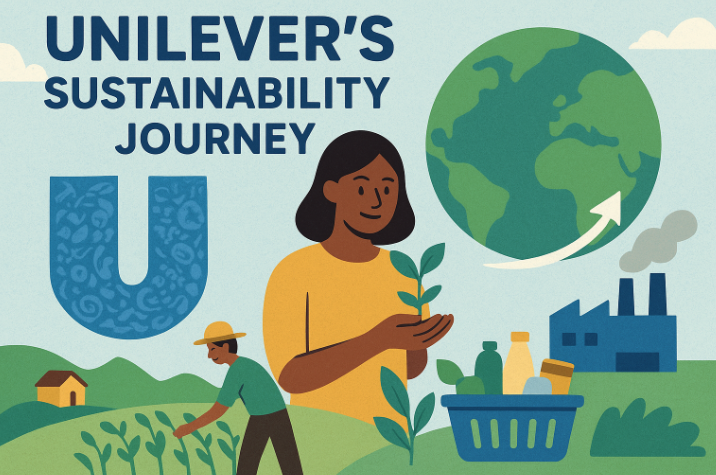
This is the story of Unilever’s Sustainability Journey, the Unilever Sustainable Living Plan (USLP) — one of the boldest experiments in corporate responsibility the world has ever seen.
A story filled with hope, failures, innovation, resistance, breakthroughs, and above all… courage.
And whether you’re a business leader, employee, investor, or consumer — this story is for you.
Table of Contents
🟦 The World Before the Plan — And the Turning Point
Let’s rewind to the year 2010.
Climate change was speeding up.
Plastic pollution was everywhere.
Inequality was widening.
Supply chains were stretched and fragile.
And millions of small farmers — the ones who fuel global brands — were struggling silently.
Most corporations, meanwhile, were doing what they had always done:
- Make products.
- Sell them.
- Maximize profits.
Sustainability was a footnote, not a strategy.
But inside Unilever’s boardroom, something different was stirring.
Led by then-CEO Paul Polman, the company was wrestling with a question most companies avoided:
“What good is growth if the world we grow in is collapsing?”
And so, in one of the boldest corporate moves of the decade, Unilever declared:
“We will double our business — while halving our environmental footprint.”
The world froze.
Analysts rolled their eyes.
Competitors called it unrealistic.
Some internal teams feared costs, complexity, and disruption.
But the decision was made.
Unilever wasn’t dipping a toe into sustainability.
It was diving headfirst.
Thus began the decade-long experiment called:
🌍 The Unilever Sustainable Living Plan (USLP)
A plan that would challenge global norms, change millions of lives, and set new expectations for businesses worldwide.
🟦 The Vision — Big, Messy, Beautiful
USLP wasn’t a PR campaign.
It wasn’t CSR.
It wasn’t “green marketing.”
It was a total rewiring of how a giant company operates.
The Plan Had Three Massive Goals
1️⃣ Health & Well-Being
Help 1 billion people improve hygiene, sanitation, and nutrition.
This meant using brands — yes, brands — like Lifebuoy, Dove, Knorr, and more to educate, empower, and uplift communities.
2️⃣ Environment
Halve the environmental footprint per use of Unilever products — including:
- water
- waste
- greenhouse gases
- plastic
- resource use
Bold. Messy. Hard to measure.
But necessary.
3️⃣ Livelihoods
Improve the lives of farmers, workers, distributors, and communities across its value chain.
This included:
- fair wages
- sustainable farming
- support for small entrepreneurs
- women empowerment
- human rights commitments
USLP was massive, complicated, ambitious — and that’s exactly what made it revolutionary.
🟦 The Journey — Reinventing a Giant on the Move
Transforming a company with:
- 400+ brands
- 150,000+ employees
- suppliers across 190 countries
- 3.4 billion customers using its products daily
…is not easy.
But the USLP pushed change into every corner.
🔹 1. Products Were Reimagined
Unilever began redesigning everything:
- soaps that used less water
- detergents that worked in cold water
- food products with better nutrition
- deodorants with lower-carbon formulas
- recyclable packaging
- plant-based ingredients
Brands became change-makers, not just money-makers.
🔹 2. Supply Chains Became Fairer & Cleaner
Unilever started mapping its supply chain, identifying:
- deforestation risks
- human rights issues
- smallholder farmer challenges
This was uncomfortable — but necessary.
Programs to support farmers in tea, palm oil, vegetables, dairy, and spices changed lives across Africa, Latin America, and Asia.
In India, Project Shakti empowered thousands of rural women to become micro-entrepreneurs, improving income stability and dignity.
🔹 3. Factories Went Green
Factories across the world slashed:
- CO₂ emissions
- water consumption
- energy use
- waste to landfill
In many regions — including India — Unilever achieved zero waste to landfill years before competitors.
Resource efficiency saved the company over €1 billion, proving sustainability isn’t just “nice”…
It’s smart business.
🔹 4. Packaging Became Smarter
Plastic. The word that haunts every consumer brand.
Unilever began shifting to:
- recyclable materials
- reusable packaging
- compostable alternatives
- reduced-plastic bottle designs
Was it enough?
No.
But it was one of the most aggressive attempts by any global FMCG company at the time.
🟦 The Impact — Numbers That Tell a Human Story
By 2020, USLP had created real, measurable change.
📌 Health & Wellbeing
Reached 1.3 billion people with hygiene, sanitation, and nutrition programs.
Millions of children learned proper handwashing.
Families gained awareness about safe drinking water.
Women received better health education.
📌 Environment
- 85% reduction in manufacturing CO₂ (in many regions)
- 50%+ reduction in water use
- 63% reduction in waste per tonne of production
- Dozens of factories running on renewable energy
- Zero waste to landfill across huge parts of the network
📌 Livelihoods
Millions of smallholder farmers trained.
Retailers supported.
Supply-chain workers brought into formal systems.
Rural entrepreneurs empowered.
📌 Business Growth
Here’s the twist:
Brands with a strong sustainability mission grew 69% faster
and delivered the majority of Unilever’s growth.
Sustainability wasn’t a cost.
It was a catalyst.
🟦 The Struggles — Because Real Change Isn’t Pretty
USLP wasn’t perfect.
And Unilever openly admitted that.
Some targets weren’t met:
- Plastic waste reduction wasn’t fast enough
- Consumer-use emissions were complex
- Social impact measurement was difficult
- Some sustainability ingredients faced cost and sourcing challenges
- Global teams sometimes resisted change due to short-term pressure
But here’s the part we often forget:
Failure is not the opposite of progress.
It is part of progress.
Where most companies showed glossy, meaningless ESG slides,
Unilever showed vulnerability and transparency.
And that is leadership.
🟦 The Legacy — The Spark That Ignited a Movement
The USLP ended in 2020.
But its ideas became global movements.
Today:
- Investors demand sustainability disclosures
- Consumers buy based on values
- Employees want purpose-driven companies
- Governments push for climate responsibility
- ESG is no longer optional — it’s essential
Unilever’s plan didn’t fix everything.
But it shifted the mindset of an entire generation of businesses.
It proved:
You can grow AND reduce harm.
You can sell AND uplift.
You can lead AND heal.
The future of business is purpose-driven — and USLP helped write that future.
🟦 The Lessons — 5 Powerful Takeaways for Everyone
Here are the 5 lessons this story offers to the world:
1️⃣ Purpose Is a Growth Strategy — Not a Slogan
Consumers today want brands that stand for something.
Purpose isn’t marketing.
Purpose is how you behave.
And Unilever showed the world that purpose-driven brands grow faster.
2️⃣ Sustainability Saves Money, Not Just the Planet
Energy efficiency… saves money.
Less plastic… saves money.
Less waste… saves money.
Better water management… saves money.
Being responsible is profitable.
3️⃣ Livelihoods Are the Backbone of Supply Chains
Treating farmers, workers, and communities with dignity is not charity —
it’s smart economics.
Empowered communities create resilient supply chains.
4️⃣ Big Problems Need Bold Decisions
Halving the environmental footprint was a wild, unrealistic goal.
And yet the pursuit unlocked innovation nobody imagined.
Big goals create big breakthroughs.
5️⃣ Real Leadership Requires Courage — Not Perfection
The world doesn’t need perfect companies.
It needs brave ones.
Unilever wasn’t flawless.
But it was fearless.
And that made all the difference.
🟦 Why This Matters — To You, Me, and All of Us
Whether you are:
- a CEO
- a young professional
- a policymaker
- a parent
- a farmer
- a teacher
- a student
- a consumer
This story matters because:
We are all part of the same ecosystem —
the economy cannot thrive if the environment and society collapse.
We don’t have to wait for governments.
We don’t have to wait for perfect solutions.
Every choice — from the products we buy to the policies we support — shapes the future.
USLP is not just a corporate case study.
It is a reminder:
Business-as-usual is no longer an option.
Business-as-responsible is the new normal.
🌍 Unified Call to Action — For Everyone Who Shares This Planet
This moment is bigger than any one company.
Bigger than any government.
Bigger than any movement.
Whether you’re a business leader shaping strategies…
an employee questioning the status quo…
a consumer choosing what to buy…
an investor deciding where money flows…
or a citizen who simply wants a better world —
your choices carry power.
Unilever’s story proves one truth:
When people, companies, and communities move with intention, transformation becomes unstoppable.
So here’s our shared commitment:
💼 Businesses:
Embed sustainability into strategy — not CSR pages.
🧑💼 Leaders:
Make decisions that will matter a decade from now.
👥 Employees:
Be the voice that asks, “Is there a better, greener way?”
💰 Investors:
Fund the future — not outdated, extractive models.
🛒 Consumers:
Choose consciously. Every purchase shapes a supply chain.
🌱 Communities:
Demand transparency, fairness, and accountability.
🌍 Citizens:
Use your voice. Use your vote. Use your influence.
No role is too small. No choice is insignificant.
Collectively, we can build a world that thrives.
**Let’s start today.
Let’s choose purpose.
Let’s build a future we are proud to leave behind — together.**
Read more blogs here.
Reference: Case Study: Unilever’s “Sustainable Living Plan” — Oxford Executive Institute — third-party case-study summary of USLP’s aims (health, environment, livelihoods) and interpretations. Oxford