A practical, story-driven guide with real-world examples
Table of Contents
In today’s fast-changing world, companies are under unprecedented pressure—from regulators, investors, customers, employees, and even the planet—to act responsibly and transparently. But the challenge is real:
How do you decide which ESG issues truly matter? Which ones deserve board attention? And how do you manage stakeholders with conflicting priorities?
This is where materiality assessment and stakeholder engagement become the strategic backbone of ESG leadership.
Let’s explore them through stories, real-world examples, and lessons from companies that got it right—and those that paid the price for ignoring them.
1. What Is Materiality? The Art of Choosing What Really Matters
Materiality is about identifying the ESG issues that can significantly impact a company’s financial performance and/or create substantial impact on stakeholders.
Think of it as corporate triage: What could truly make or break your business?
Most companies face dozens of ESG issues—climate, labor, waste, cybersecurity, human rights, diversity, water, supply chain ethics. But only some are material, meaning:
They influence long-term value creation
They affect critical stakeholder groups
They pose strategic, reputational, or regulatory risk
A robust materiality assessment cuts through the noise.
2. Why Materiality Matters: Lessons From the Real World
Volkswagen Emissions Scandal — Ignoring a Material Issue
VW treated emissions compliance as a technical issue, not a material governance risk. Outcome?
€30 billion in fines
Years of reputational damage
Loss of investor trust
Materiality blind spot: Ethics of engineering & transparent reporting.
Tesla’s Labor Relations Blind Spot
Tesla focused heavily on innovation and safety but underestimated labor issues—union tensions, worker fatigue, injuries.
Materiality blind spot: Workforce welfare.
Lesson: Social issues can become as financially material as environmental ones.
Wells Fargo — Culture Is Material
The bank ignored its toxic sales culture until it became a multi-billion-dollar crisis.
Materiality blind spot: Employee incentives, ethics, and governance.
Lesson: Internal culture is not “soft”—it can bankrupt trust.
Ørsted — Materiality as a Strategic Weapon
Once a fossil-heavy energy company, Ørsted used materiality to pivot toward offshore wind.
Do regulators, customers, communities, employees, or investors deeply care?
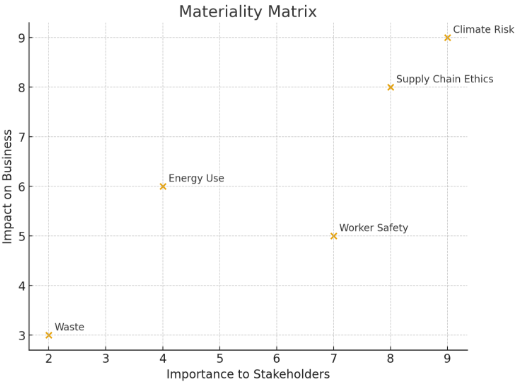
Example: In the auto sector, battery safety, supply chain ethics, and worker reskilling sit in the top-right quadrant—high business impact, high stakeholder interest.
That’s where board focus is needed.
4. Double Materiality: When Impact Matters as Much as Financials
Europe’s CSRD introduced the concept of double materiality:
Financial Materiality: Could this ESG issue affect the company’s value?
Impact Materiality: Could the company’s actions harm society or the environment?
Example: For a beverage company in India, water scarcity is both:
Financial risk (plant shutdowns)
Social risk (community protests, environmental impact)
But in Norway, with abundant water, the materiality changes.
5. Stakeholder Engagement: Turning Friction into Strategy
Identifying what matters is only half the battle. The real challenge: Stakeholders rarely agree.
Different stakeholders = Different concerns = Conflicting priorities.
A mature company maps them using a Power–Interest Grid:
High power, high interest: Regulators, governments, major investors
High power, low interest: Large institutional shareholders
Low power, high interest: Communities, NGOs, employees
High influence groups: Media, civil society, activists
Each group sees risk differently.
6. Real-World Stakeholder Conflict Examples
1. Apple & Supplier Labor Practices (China)
Stakeholders involved:
Workers (interest in conditions)
NGOs (interest in human rights)
U.S. government (power due to geopolitical tension)
Investors (concerned about brand risk)
Materiality outcome: Labour rights + supply chain ethics become high-priority issues.
2. Nestlé & Palm Oil Sourcing
Conflicting views:
NGOs: Deforestation and biodiversity
Farmers: Income security
Consumers: Ethical products
Governments: Land use policies
Materiality outcome: Deforestation became a top-tier risk, leading to stricter supplier requirements.
3. Auto Manufacturers & EV Battery Supply Chains
Example from India: Choosing Chinese suppliers triggers:
National security concerns
Investor ESG scrutiny
Customer safety worries
Worker job concerns
NGO pressure on mineral ethics
Stakeholder engagement becomes a strategic tool, not a communication exercise.
7. Why Companies Fail at Materiality & Stakeholder Engagement
Most failures come from:
❌ Treating ESG as compliance
❌ Assuming stakeholders have the same priorities
❌ Underestimating ethics and human rights
❌ Focusing on technology but ignoring people
❌ Not updating materiality regularly
The world changes. Stakeholders change. Materiality must evolve too.
8. A 5-Step Blueprint: How Companies Can Get It Right
1. Identify potential ESG issues
Use sector benchmarks, peer analysis, standards (SASB, GRI, CSRD).
2. Engage stakeholders early
Before announcing strategies—not after.
3. Map issues on a materiality matrix
Highlight the top-right quadrant (board focus areas).
4. Integrate into strategy & KPIs
Tie material issues to budgets, executive KPIs, risk systems.
5. Communicate transparently
Regular disclosures, dashboards, and honest updates build trust.
9. The Big Insight: ESG Is Not About Reporting—It’s About Risk, Trust & Growth
Materiality assessment is not an ESG “task.” It is strategic risk management.
Stakeholder engagement is not “PR.” It is conflict resolution, trust-building, and future-proofing.
Companies that understand this become leaders. Companies that ignore it learn the hard way.
10. Final Thought: The Future Belongs to the Materiality-Mature
In a world of climate shocks, social tensions, geopolitical uncertainty, and rapid technology shifts—materiality is the compass. Stakeholder engagement is the map.
Together, they help businesses answer the only question that matters:
“What do we need to focus on today to be trusted, resilient, and relevant tomorrow?”
The companies that master this will not just survive the ESG era—they will define it.
🔔 Call to Action: Let’s Build the Future Together
Whether you are an investor, employee, customer, supplier, community partner, or regulator, your voice shapes what truly matters. Join us in co-creating a transparent, resilient, and responsible future—participate in our materiality conversations, share your expectations, and help guide our sustainability priorities. Together, we can turn shared insights into meaningful impact.
“We thought risk meant market volatility… until climate change taught us the meaning of existential risk.”
Table of Contents
For decades, Indian conglomerates have been the backbone of the economy — spanning chemicals, consumer goods, real estate, agriculture, energy, and industrial manufacturing. Their reach is vast, their influence immense, and their operations deeply interwoven into the nation’s growth story. But climate change has emerged as a force more disruptive than any market shock, technological disruption, or regulatory change.
In the last five years, floods, cyclones, heatwaves, and droughts have battered multi-business groups, exposing hidden vulnerabilities in operations, supply chains, and governance. In boardrooms from Mumbai to Chennai, leaders have been forced to ask:
“Are we prepared for a future where the climate doesn’t wait for our strategy?”
This is the story of how a typical Indian multi-business conglomerate can confront climate risk head-on — turning crisis into opportunity, and risk into resilience.
🌪️ The Wake-Up Call: When Climate Strikes
Multi-business conglomerates, by nature, are diversified. This has historically been a shield against sector-specific shocks. But climate change cuts across business silos. For these groups, recent disruptions have been wake-up calls:
Examples of Climate Shocks
Cyclones and Floods: Coastal chemical plants and consumer goods factories facing shutdowns for days or weeks.
Droughts: Agriculture and food processing operations experiencing crop failures and supply chain disruption.
Heatwaves: Manufacturing plants and construction sites suffering productivity losses, higher cooling costs, and worker health issues.
Sea-Level Rise & Water Stress: Real estate and industrial operations exposed to flooding risk and water scarcity.
Stakeholder Pressure Escalates
Investors managing large funds are demanding climate action plans.
Regulators are tightening disclosure requirements (SEBI BRSR, TCFD alignment).
Customers are increasingly seeking climate-resilient supply chain certifications.
Insurance providers are raising premiums or denying coverage for high-risk locations.
The financial impact is tangible: operational losses, increased insurance costs, additional working capital to buffer supply chain volatility, and delayed project launches. But the strategic impact is even more critical: a conglomerate’s reputation, investor confidence, and license to operate are all on the line.
🧭 Understanding the Challenge: Hidden Vulnerabilities in Diversification
The very diversity that is a conglomerate’s strength also makes it complex to manage risk. Different business segments face different physical and operational vulnerabilities:
Competitive Advantage: Market differentiation in climate-smart real estate.
Enterprise-Wide Benefits
Climate adaptation delivers operational efficiency, risk reduction, stakeholder trust, and new revenue streams.
Forward-looking conglomerates use adaptation as a driver for innovation, not merely compliance.
🏛️ Governing Climate at the Board Level
A climate strategy is only as strong as the governance that supports it. Fragmented efforts fail without board-level accountability.
Board Climate & Resilience Committee (BCRC)
Oversees enterprise-wide climate strategy.
Reviews C-VaR and scenario analyses quarterly.
Approves adaptation investments.
Director Competency
Minimum two directors with climate or sustainability expertise.
Annual board training on climate science, regulation, and risk integration.
CEO/CFO sign-offs on climate disclosures.
Integration with Risk Management
Climate risk integrated into enterprise risk management (ERM).
Plant heads and business heads have climate KPIs linked to performance bonuses.
Stakeholder Communication
Publish TCFD-aligned climate disclosures.
Share facility-level climate resilience dashboards with insurers and investors.
Report supply chain climate performance to B2B customers.
This governance structure ensures accountability, transparency, and strategic alignment.
📊 Monitoring and Metrics: An Always-On System
Leading conglomerates implement digital dashboards tracking:
Carbon intensity per facility
Energy and water usage
Climate-related downtime
Supply chain resilience
Financial losses avoided through adaptation
Escalation triggers ensure early warnings:
5% deviation in climate-related performance metrics
Non-compliance with new regulations
Extreme weather event triggers
This system ensures that climate adaptation is dynamic, measurable, and continuously improving.
🌟 The Transformation: Resilience as a Business Strategy
By applying these frameworks, multi-business conglomerates can achieve:
Reduced operational losses and insurance costs
Stabilized supply chains across all business segments
New revenue opportunities from climate-resilient products and services
Enhanced brand and investor confidence
Stronger employee engagement and retention
The transformation is not just operational. It is strategic, financial, and cultural. Climate resilience becomes a core competency, not a side project.
💡 Lessons Learned for Multi-Business Conglomerates
Risk Must Be Visible: Asset-level and supply chain mapping uncovers hidden vulnerabilities.
Adaptation Can Create Value: Every investment in resilience has financial and strategic payback.
Governance is Critical: Board-level oversight ensures climate initiatives are credible and executed effectively.
Integration Beats Fragmentation: Climate strategies must be enterprise-wide, not siloed.
Proactivity Over Reactivity: Early adaptation creates competitive advantage; waiting is expensive.
In a warming world, the companies that adapt fastest, govern best, and innovate boldly will not just survive — they will thrive.
For more than a century, cement industry has been the silent architect of humanity. It built our schools, our hospitals, our roads, our skylines. It created the foundations on which millions of dreams rose higher than ever before. But in 2025, the world finally confronted an uncomfortable truth:
Cement — the very material that builds our future — is also silently heating our planet.
Globally, the cement industry is responsible for 7–8% of total CO₂ emissions, with more than half coming not from fuel, but from the chemical breakdown of limestone itself. It consumes enormous energy, draws water intensively, and sits at the center of climate regulations worldwide.
The sector now faces unprecedented risks:
Carbon pricing making production costlier
EU’s CBAM taxing carbon-heavy exports
Domestic carbon markets reshaping profitability
Investor divestment from carbon-intensive industries
Customers demanding low-carbon construction materials
Competitors innovating aggressively
And at the heart of this transformation stands RockSolid Cement Ltd., our fictional but representative company.
In 2025, RockSolid was like many major Indian cement producers—built on volume, clinker capacity, coal-based energy, and operational efficiency. But now, the company found itself staring at a future where carbon emissions mattered more than market share and climate strategy mattered more than production expansion.
This is the story of how RockSolid Cement embraced a bold, painful, transformational journey—one that turned crushing risks into a competitive advantage and carved a pathway that can guide the entire cement sector.
🌍 CHAPTER 1 — THE ESG CHALLENGE: A COMPANY AT A CROSSROADS
RockSolid Cement was preparing to raise ₹1,500 crore for expansion. Financial investors loved the numbers—steady revenue, solid demand outlook, healthy margins.
But ESG due diligence told a different story:
Carbon intensity 20% higher than best-in-class peers
Operations in water-stressed districts
Lack of third-party verified energy & emissions data
Outdated pollution control systems
Heavy dependence on coal
Zero readiness for India’s upcoming carbon markets
What looked like a profitable investment suddenly looked like a climate liability.
But the board didn’t run from the findings. Instead, they asked a new question:
“What if we don’t fix these issues just to unlock capital? What if we fix them to unlock our future?”
Thus began a journey that reshaped the company forever.
🚧 CHAPTER 2 — INDUSTRY RISKS RISING: WHY CHANGE WAS NO LONGER OPTIONAL
Before diving into the solutions, RockSolid took stock of the threats reshaping the entire cement sector.
1️⃣ Policy & Regulatory Risks
EU CBAM adding €25–40 per tonne on high-carbon cement
Energy Conservation Act 2022 mandating carbon trading by 2025
Green Taxonomy making cost of capital 75–125 bps higher for carbon-heavy firms
State carbon pricing in Gujarat & Tamil Nadu
Suddenly, compliance became a cost heart attack.
2️⃣ Market & Competitive Risks
UltraTech targeting 25% AFR
ACC reducing emissions via blended cements
Global leaders like LafargeHolcim piloting carbon capture
The race was on. Those who moved early would define market leadership for the next 20 years.
3️⃣ Financial Risks
Banks began categorising cement as a high transition risk sector.
The company built a digital monitoring system integrating:
🔢 Key Metrics
CO₂/tonne
Clinker ratio
AFR share
Water withdrawal
Dust emissions
Safety & LTIFR
Community grievances
⚠️ Escalation Triggers
5% deviation in carbon intensity
Non-compliance with pollution norms
Any fatal safety incident
Community protest or legal notice
🔗 Portfolio Integration
Risk alerts to investors
Quarterly ESG + financial review
Annual third-party audits
RockSolid didn’t just promise transition—it measured it.
🌟 CHAPTER 7 — HUMAN ELEMENT: COMMUNITIES, WORKERS & SOCIETY
RockSolid realized:
“Net-zero without people is zero value.”
It adopted:
Closed-loop water systems
2-billion-liter groundwater recharge per year
Dust suppression & green belt development
Mining pit restoration into community lakes
Skill programs for workers for green jobs
Trust was rebuilt, one community at a time.
🏆 CHAPTER 8 — THE RESULT: A BLUEPRINT FOR INDIA’S CEMENT FUTURE
RockSolid Cement emerged as:
More investable
More efficient
More resilient
More respected
More future-ready
It turned:
Risk → strategy
Regulation → opportunity
Technology → advantage
Emissions → efficiency
Community pressure → partnership
And along the way, it showed the entire cement sector what leadership looks like.
🧱 FINAL WORD — BUILDING THE FUTURE WITHOUT DAMAGING IT
The cement industry will define whether the next century is hotter… or more hopeful.
Companies like RockSolid prove that:
Cement can still build the world — without breaking the planet.
The transformation won’t be easy. It won’t be cheap. But it will be worth it — for the climate, for business, and for humanity.
Reference – Global Cement and Concrete Association (GCCA) / global cement emissions statistics — the industry is responsible for ~ 7–8% of global CO₂ emissions. World Economic Forum
In the last decade, global finance has been undergoing a quiet revolution. Money is no longer just about returns—it’s about responsibility. Investors, lenders, and corporations now increasingly align capital with sustainability commitments.
And one of the most powerful tools driving this transformation is the Sustainability-Linked Loan (SLL).
Unlike green loans that restrict the use of proceeds, SLLs reward a company for meeting environmental or social performance goals—no matter how the money is used. They create a direct link between a company’s sustainability journey and its financial cost of capital.
But what makes SLLs truly credible? The KPIs. The heart of the instrument.
Let’s explore how SLLs work, how KPIs are structured, and what makes a KPI framework robust, measurable, and meaningful.
🌍 What Are Sustainability-Linked Loans (SLLs)?
SLLs are a type of loan where the interest rate changes (goes down or sometimes up) depending on whether the borrower achieves certain Sustainability Performance Targets (SPTs) that are tied to KPIs (Key Performance Indicators).
✔️ If the company meets its targets → Interest rate decreases
❌ If the company misses → Interest rate increases
This mechanism motivates companies to embed sustainability into their operations—not just in speeches but in real, quantifiable action.
💡 Why KPIs Matter in SLLs
Not all sustainability claims are meaningful. To avoid greenwashing, lenders require borrowers to commit to KPIs that are:
Material to their business
Ambitious compared to past performance
Measurable & independently verifiable
Aligned with long-term sustainability strategy
Benchmarkable with industry standards
🧭 KPI Structure in Sustainability-Linked Loans
Here’s a standard KPI architecture used by global banks, sustainability advisors, and rating agencies:
1. Materiality Assessment
This answers: Are these KPIs relevant to the borrower’s industry?
Examples:
For manufacturing: GHG emissions, energy efficiency
For real estate: green building certification, energy intensity
For banking/finance: sustainable financing portfolio, diversity ratios
For FMCG: water intensity, plastic reduction
Material KPIs build credibility and ensure real-world impact.
2. Baseline Establishment
A KPI must start with:
Historical performance data (3–5 years ideally)
Current baseline year (e.g., FY2024 emissions = 1.2 million tCO₂e)
The MRV system is what gives investors confidence in the numbers.
5. Incentive Mechanism (Pricing Adjustment)
Typically:
5–15 basis point reduction for meeting SPT
5–10 bps penalty for missing
Some loans modify commitment fees, profit margins, or rebates
This financial linkage ensures accountability.
6. Reporting & Governance Structure
The borrower must:
Publish annual sustainability reports
Provide audited KPI performance reports
Notify lenders immediately if discrepancies arise
Establish internal committees for SLL oversight
Good governance protects the loan from manipulation and greenwashing.
Real World Examples
Here are real-world, globally recognized examples of Sustainability-Linked Loans (SLLs) along with their actual KPIs, Assessment, Outcomes. These cases show how top companies are using SLLs to link financial performance with sustainability outcomes.
1. Walmart – When a Retail Giant Chose Responsibility Over Routine
Walmart didn’t need an SLL. It could have continued business as usual. But instead, the world’s biggest retailer chose to tie $5 billion of its financing to its promise to protect the planet.
KPIs
Renewable energy share
Waste diverted from landfills
Supplier emissions cuts
Assessment
Independent sustainability audits
Supplier GHG verification
Annual ESG reports
Outcome
The results speak for themselves: Walmart now runs on 47% renewable energy, diverts 80% of its waste, and its suppliers have prevented 750 million tonnes of CO₂e. The company literally earned its lower interest rate — by earning the planet’s trust.
2. Philips – A Billion-Euro Loan Fueled by Purpose, Not Pressure
Philips didn’t treat sustainability as a checkbox — it treated it as a promise to the future of healthcare and humanity.
KPIs
Carbon-neutral operations
Circular economy revenue share
Assessment
SBTi-aligned carbon audits
Circularity data assurance
Annual ESG certification
Outcome
Philips became carbon neutral earlier than expected and pushed its circular revenues to 18% — turning a loan agreement into a global message: “Healing the world begins with healing the planet.”
3. Mercedes-Benz – Racing Into the Future With Electric Courage
For Mercedes-Benz, sustainability wasn’t a PR effort. It was a form of redemption — a vow to move from fossil-fueled legacy to electric leadership.
KPIs
EU fleet CO₂ emissions
Share of BEV sales
Assessment
EU WLTP framework
Verified vehicle sales data
Outcome
The company exceeded its EV target with 15%+ BEV sales, even though it stumbled on early CO₂ goals. It paid a step-up penalty — and wore it as a badge of honesty. Because real transformation is not about perfection… but progress.
4. DBS Bank – When a Bank Decided Women Should Lead the Future
DBS tied its loan to something deeply human: gender equality, not just environmental metrics.
KPI
Women in senior leadership roles
Assessment
HR governance audits
Third-party verified DEI metrics
Outcome
DBS reached 40% women leaders, ahead of schedule. This wasn’t just a KPI — it was a cultural revolution financed through accountability.
5. Novartis – Financing Hope for Millions Who Deserve Access
Novartis used an SLL to expand access to medicines, showing the world that finance can be a force for health equity.
KPIs
Patients reached in low-income countries
Scope 1 & 2 emissions
Assessment
Impact assessments
GHG audits under global standards
Outcome
Millions benefited as Novartis expanded to 34+ underserved countries and slashed emissions by 30%. A loan helped deliver medicine — and dignity.
6. Tesco – A Supermarket Chain That Declared War on Waste
Tesco didn’t wait for regulations. It tied billions of pounds to a fight against waste, carbon, and excess.
KPIs
Emissions
Food waste
Renewable electricity
Assessment
ISO 14064 GHG audits
Waste verification
Renewable energy audits
Outcome
Tesco reached 100% renewable electricity in the UK, cut emissions by 55%, and reduced food waste by 45%. Its SLL became a beacon of practical climate action.
7. Adani Electricity Mumbai – Powering India’s Clean Energy Transition
In Mumbai, a city that never sleeps, Adani Electricity pledged to change the way the city is powered.
KPI
Renewable energy share
Assessment
Certified energy audits
Renewable certificates
Outcome
Renewables grew from 3% to over 30%. The city’s night skyline now shines a little greener — and its loan margin a little lower.
8. UltraTech Cement – Reinventing a Hard-to-Abate Industry
Cement is one of the hardest sectors to decarbonize — and UltraTech still stepped up.
KPIs
Thermal energy intensity
Emissions intensity
WHR capacity
Assessment
GHG Protocol audits
Plant-level energy assessments
Outcome
UltraTech reduced emissions intensity by 8%, expanded WHR capacity, and began proving that even heavy industries can lighten their footprint.
9. Arvind Ltd – Weaving Sustainability Into Every Thread
For Arvind, sustainability wasn’t a boardroom KPI — it was a craftsmanship ethic.
KPIs
Water intensity
Renewable power share
Wastewater recycling %
Assessment
Independent water audits
RE certificate checks
Environmental assurance reports
Outcome
Water intensity dropped by 17%, renewable energy rose to 34%, and major facilities hit 100% wastewater recycling. Their fabrics now carry a softer footprint on the planet.
10. Trafigura – Transforming a Commodity Giant Through Accountability
Trafigura operates in one of the toughest industries to regulate — global commodities trading. Its SLL was a bet that transparency can clean even the dirtiest supply chains.
KPIs
Emissions
Renewable energy use
Supply chain ESG audits
Assessment
Independent carbon audits
Utility data verification
Accredited supplier ESG audits
Outcome
Emissions fell 19%, renewable usage hit 45%, and over 1,250 suppliers were ESG-audited. A global trader proved that accountability scales.
⭐ What You Learn from These Real Cases
Across all these examples, the KPI structure follows the same principles:
KPI Quality Criterion
Evidence from Real Cases
Materiality
Emissions (Philips, Mercedes), Waste (Tesco), Water use (Arvind)
Ambition
Science-based targets (Philips), EV targets (Mercedes), RE share 60%+ (Adani)
Measurability
Quantified, audited metrics
Verification
Annual independent assurance
Transparency
Public reporting, SBTi alignment
🔥 Call to Action
1. Corporate Leaders & CFOs
“Make your next loan a commitment to the planet — not just your balance sheet. Start your SLL journey today.”
“Turn your sustainability promises into measurable action. Structure your first SLL with purpose and accountability.”
“Unlock cheaper capital while accelerating your ESG goals. Invest in an SLL roadmap now.”
2. Banks, Lenders & Financial Institutions
“Shift from traditional lending to purpose-driven capital. Empower your portfolio with Sustainability-Linked Loans.”
“Transform your lending book — finance the companies that will shape a cleaner, fairer future.”
“Lend with intention. Build your SLL framework and lead the next decade of sustainable finance.”
3. Investors & ESG Analysts
“Back companies that walk the talk. Look for strong KPI-linked financing when you invest.”
It begins with a question every investor silently asks themselves: “What if my money could do more than just grow? What if it could change something?”
Years ago, a young analyst in Mumbai stared at a spreadsheet full of numbers—returns, ratios, risk metrics. But his mind kept drifting to something else: the street vendor outside his office, a woman who worked 14 hours a day yet still couldn’t access a simple bank loan.
On the other side of the world, a pension fund manager in London was wrestling with a different dilemma: record profits from fossil fuel stocks, but a nagging fear that those very profits were warming the planet her grandchildren would inherit.
In both stories, the conflict was the same: What is the true value of money?
Enter impact investing—a quiet revolution that started when people realised capital didn’t have to choose sides.
Impact investing is the idea that money can generate financial returns and solve real problems at the same time. It is investment with intention—placing capital in businesses that uplift communities, protect ecosystems, expand access to healthcare, empower women, and accelerate clean energy.
Not charity. Not goodwill. But purposeful profit.
It’s when an investor funds a clean energy startup—not just because it’s profitable but because it reduces carbon emissions. It’s when a microfinance institution backs a woman entrepreneur—because it strengthens both a household and a balance sheet. It’s when digital health platforms get capital that saves lives and drives growth.
Impact investing answers the question that was troubling both the analyst and the pension manager:
What if returns could feel meaningful? What if investments could heal instead of harm? What if finance could become a force for good?
This is the heart of impact investing— capital with intention, measurement, accountability, and empathy. A new form of investing where profit and purpose move in the same direction.
And the best part? It’s already transforming lives, industries, and entire economies.
🔥 5 Real Case Studies of Impact Investing (Explained With Lessons)
1) Grameen Bank – The Microfinance Revolution in Bangladesh
In 1983, Muhammad Yunus looked at struggling women in Bangladesh—women refused loans by every bank—and asked:
“What if we trusted the poor?”
He started Grameen Bank with the unthinkable idea: ➡️ Give micro-loans to women with zero collateral. ➡️ Build credit on trust, not paperwork.
Impact Created:
Lifted 10+ million women out of poverty
Replication in 100+ countries
Birth of the global microfinance industry
Nobel Peace Prize for Yunus (2006)
Lesson: 👉 When you empower women financially, entire communities change. 👉 The poor are not “high-risk”—they are “high-potential” when given dignity.
2) Tesla – Impact Investing at a Global Scale
Before Tesla became a household name, it was a high-risk dream. Early impact investors backed it NOT because it was a safe bet—but because:
It promised a world without fossil fuels.
Every dollar invested in Tesla wasn’t just fueling a company. It was fueling a global transition toward clean mobility.
Impact Created:
Sparked an EV revolution globally
Accelerated renewable energy adoption
Reduced reliance on oil
Inspired thousands of climate-tech startups
Lesson: 👉 Impact investing is not always small-scale. 👉 Sometimes the biggest impact is backing a visionary before the world believes in them.
3) d.light – Bringing Solar Light to 125 Million Lives
In sub-Saharan Africa and rural India, millions lived without electricity. Children studied under kerosene lamps. Families inhaled toxic fumes daily.
Then came d.light, funded by impact investors with one simple mission:
“Everyone deserves light.”
They created ultra-affordable solar lanterns and solar home systems.
Impact Created:
Reached 125 million+ people
Saved billions in kerosene spending
Prevented millions of tons of CO₂
Enabled women to earn income after sunset
Lesson: 👉 Don’t underestimate “small” innovations. 👉 A $10 solar lamp can create life-changing ripple effects.
4) Acumen Fund – Building Businesses for the Poor
Acumen didn’t give grants. They didn’t seek fast profits. They invested in patient capital—long-term, mission-driven companies solving deep social issues.
Some of their breakthroughs:
Affordable eye-care hospitals (Aravind Model replication)
Clean energy solutions across East Africa
Low-cost housing for the urban poor
One iconic success: Ziqitza Health Care, India’s 108 ambulance emergency service system. Acumen invested when nobody else believed it would work sustainably.
Impact Created:
Millions of emergency calls handled
Life-saving ambulances in regions that never had medical services
5) Patagonia – When a Company Gives Its Entire Profit to the Planet
In 2022, the founder of Patagonia, Yvon Chouinard, made a historic impact investment move.
He gave away the entire $3 billion company to a trust and a nonprofit—with only one purpose:
“Save the planet.”
Every future profit goes directly into climate action initiatives.
Impact Created:
Reinvented what corporate responsibility means
Proved capitalism and climate justice can co-exist
Inspired thousands of responsible business models
Lesson: 👉 Impact investing is not only what you earn, but what you are willing to give back. 👉 Purpose-driven companies redefine the future of business.
🌍 How to Measure Impact in Impact Investing
Measuring impact is the heart of impact investing. Without proof, “impact” becomes just another marketing word. With measurement, it becomes accountability, credibility, and transformation.
Impact measurement answers three core questions:
What changed?
For whom?
Did the investment truly cause that change?
Below is a complete, practical framework used globally by investors, funds, and development institutions.
⭐ 1. Define the Intended Impact (Intentionality)
Before measuring anything, investors must clearly state:
What problem they want to solve
Who should benefit (women, farmers, MSMEs, low-income families, climate-vulnerable areas)
What success looks like
This becomes the “impact thesis.”
Example: A microfinance fund aims to increase women’s income and financial independence, not just provide loans. So the metrics must go beyond loan repayment and measure real livelihood outcomes.
⭐ 2. Use Standardised Impact Frameworks
Global frameworks make impact measurable and comparable. The most widely used include:
• IRIS+ (Impact Reporting & Investment Standards)
A catalogue of 500+ universal metrics (e.g., number of jobs created, GHG emissions avoided).
• SDG Alignment (UN Sustainable Development Goals)
Maps each investment to one or more SDGs (e.g., SDG 1: No Poverty, SDG 7: Clean Energy).
AI-based analytics (credit scoring, energy consumption)
More data = more confidence in the impact.
⭐ 6. Measure Additionality
Additionality asks: “Would this change have happened without the investment?”
If the answer is yes, the impact is weak. If the answer is no, impact is meaningful.
Example: If a solar company would have attracted commercial capital anyway, impact investors did not create additionality. But financing a rural health clinic that banks ignore? Strong additionality.
⭐ 7. Assess Risks That Might Reduce Impact
Impact also has risks:
Mission drift
Over-indebtedness (microfinance)
Community resistance
Environmental trade-offs
Poor governance
Regulatory backlash
Mature funds measure and mitigate these risks just like financial risks.
A story of awakening, risk, resilience, and a historic shift in global markets.
Table of Contents
🌍 When the World Realized Finance Must Change
A Tale From Norway to Mumbai
In 2015, something unexpected happened in the icy landscapes of Norway.
The world’s largest sovereign wealth fund—worth over $1.6 trillion—announced it would divest from coal investments. Not because coal had collapsed commercially, but because its economists spotted a terrifying trend:
rising sea levels
hurricanes destroying trillion-dollar coastlines
climate-linked supply chain breakdowns
crop failures driving inflation
insurance claims hitting historical highs
For the first time in history, the financial world admitted openly:
Climate change wasn’t just an environmental issue. It was a financial risk.
This was a global turning point. A moment when capital itself woke up.
If a fund built on oil wealth could turn away from coal for risk reasons, then the entire investment community had to rethink the future.
And thousands of miles away, India was facing its own awakening.
🇮🇳 A Similar Realization Happened in India
In 2023, the Government of India issued its first-ever sovereign green bond. What happened next shocked global markets:
➡ The bond was oversubscribed within hours. ➡ Investors from Japan, Europe, and Singapore lined up. ➡ Demand exceeded supply by nearly four times.
Why? Because the world sees what India is building:
The world’s largest solar park in Rajasthan
Delhi’s EV bus transformation, replacing diesel fleets
JSW Steel, Tata Steel, and Ultratech raising sustainability-linked loans
ReNew Power becoming one of the world’s largest renewable IPPs
RBI’s new green deposit framework
SEBI’s BRSR ESG rules for 1,000 companies
India becoming the 4th largest renewable energy market globally
Every monsoon flood, every heatwave closing schools, every drought affecting farmers made the truth clearer:
India’s economy cannot grow unless it grows sustainably.
Today, green finance in India is no longer ESG talk—it is a national economic strategy.
🌱 PART 1: What Exactly Is Sustainable & Green Finance?
Sustainable finance means using ESG principles—environmental, social, governance—to guide investment decisions. Green finance focuses specifically on climate and environmental benefits.
Sustainable Finance Includes:
ESG Funds
Article 8 / Article 9 Funds (EU)
Impact Investing
Sustainability-Linked Loans (SLLs)
Corporate ESG strategies
Sustainable investing is an umbrella term for strategies that direct money toward companies and projects that create long-term environmental, social, and economic value. The most common approach is ESG investing, where investors evaluate how well companies manage Environmental, Social, and Governance risks before making decisions—this includes factors like carbon footprint, labour practices, diversity, and board ethics.
This is the oldest and simplest form of ESG investing. Investors exclude companies or sectors that conflict with their values or pose ethical/environmental risks. Typical exclusions include: ❌ Tobacco ❌ Fossil fuels ❌ Weapons & defense ❌ Gambling, pornography ❌ Poor labor/human rights records
Goal: Avoid “harmful” industries and reduce ethical or reputational risk.
2️⃣ Positive Screening (Best-in-Class Approach)
Instead of simply avoiding bad performers, investors actively choose companies with strong ESG performance in their industry. Examples: ✔️ The automaker with the best carbon strategy ✔️ The bank with strongest governance & ethical lending ✔️ The FMCG company with highest water efficiency
Goal: Reward leaders and push industries toward higher sustainability standards.
3️⃣ Thematic ESG Investing
Investments focus on a specific sustainability theme such as: 🌞 Renewable energy 🚗 Electric mobility ♻️ Circular economy 🌳 Climate adaptation 💧 Water sustainability
These portfolios intentionally target high-impact green or social sectors.
Goal: Capture growth from mega-trends shaping the future economy.
This is the most purpose-driven approach. Investors put money into companies/projects that aim to deliver measurable positive environmental or social outcomes, along with financial returns. Examples:
Solar micro-grids in rural India
Affordable housing projects
Reforestation funds
Climate resilience solutions
Impact must be intentional, measurable, and reported.
Goal: Generate real-world impact while achieving returns.
⭐ Summary Table
Approach
Focus
Goal
Example
Negative Screening
Avoid harmful sectors
Reduce risk
No coal/tobacco
Positive Screening
Pick ESG leaders
Reward good performers
Best-in-class companies
Thematic Investing
Invest in ESG megatrends
Capture green growth
Clean energy ETF
Impact Investing
Purpose + measurable outcomes
Create real impact
Reforestation fund
Green Finance Includes:
Green Bonds
Renewable energy loans
Climate funds
Carbon markets
Clean-tech project finance
Green finance includes all financial instruments and capital flows that directly support environmentally friendly outcomes. The most common types are green bonds, where governments or companies raise money exclusively for clean energy, pollution control, or climate-resilient infrastructure; sustainability-linked bonds (SLBs), where interest rates change based on a company’s achievement of climate goals; and green loans, which fund projects like energy-efficient buildings or electric mobility.
It also includes impact investing targeted at measurable environmental outcomes (like forest restoration or renewable mini-grids), carbon finance through carbon credits and carbon markets, green funds/ETFs that invest in clean-tech or renewable energy companies, and transition finance that helps polluting industries (steel, cement, chemicals) shift toward low-carbon operations. Together, these tools channel capital into projects that reduce emissions, protect natural ecosystems, and build a climate-resilient economy.
Together, they form the new backbone of global capital markets.
🌏 PART 2: The Global Rise of Sustainable Finance
1️⃣ Trillions in ESG Investments
ESG assets globally crossed $30 trillion, making it one of the fastest-growing investment movements ever.
Real Global Examples
BlackRock manages over $2 trillion in sustainable assets.
HSBC’s Green Swan initiative funds climate resilience.
Japan’s GPIF (world’s largest pension fund) shifted to ESG indices after realising climate volatility created long-term financial instability.
Singapore’s MAS Green Finance Action Plan became the blueprint for Asia’s green banking.
Extreme weather, supply-chain disruptions, and carbon pricing have turned climate issues into material business risks. Investors now treat sustainability as a financial necessity, not philanthropy.
2️⃣ Better Long-Term Returns & Lower Risk
Multiple studies show ESG-aligned companies have:
More stable cash flows
Lower regulatory penalties
Stronger brand loyalty This attracts long-term investors.
3️⃣ Global Regulations Becoming Mandatory
Rules like ISSB, EU’s SFDR/CSRD, and India’s BRSR Core push companies to disclose ESG data, making sustainable investing easier, clearer, and more credible.
4️⃣ Surge in Green Technologies
The rapid growth of solar, EVs, batteries, hydrogen, and clean-tech has created new profitable investment opportunities.
5️⃣ Changing Consumer & Employee Expectations
Millennials and Gen Z prefer brands that care about the planet. Companies with strong ESG practices attract top talent and customer loyalty—boosting valuations.
6️⃣ Demand From Large Institutions
Pension funds, sovereign wealth funds, and global asset managers (BlackRock, Norges Bank, GPIF) have committed trillions to sustainable strategies.
7️⃣ Corporate Accountability Is Increasing
Transparent data, sustainability reporting, ESG ratings, and shareholder activism push companies to improve their environmental and social performance.
8️⃣ Green Finance Instruments Are Booming
Green bonds, SLBs, ESG funds, and climate fintech have made it easier for investors to channel money into sustainable assets.
9️⃣ Governments Offering Incentives
Subsidies, tax credits, carbon markets, and renewable energy targets encourage both investors and companies to go green.
🔟 Social Impact Matters More Than Ever
Societal issues—inequality, health, pollution, water scarcity—drive investors to support companies that create real-world positive impact.
2️⃣ Green Finance Instruments Now Mainstream
✔ Green Bonds
Global green bond issuance crossed $2 trillion since inception.
Real Example:
The European Investment Bank issued the world’s first-ever green bond in 2007.
Apple issued $4.7B green bonds to fund renewable energy and recycled materials.
✔ Sustainability-Linked Loans (SLLs)
Interest rates change based on whether borrowers achieve ESG targets.
Example:
ArcelorMittal secured a $5.5B SLL tied to carbon reduction.
Philips issued a sustainability-linked bond linked to eco-design and circularity.
China’s Green Bond Catalogue → world’s second-largest green bond market.
Regulation made ESG unavoidable.
🇮🇳 PART 3: India’s Green Finance Revolution
1️⃣ Green Bonds Are Booming
India’s sovereign green bonds sparked record interest.
Indian Real Examples:
NTPC, Tata Power, JSW Energy, Adani Green, IRFC all raised green financing.
State Bank of India issued $800M green bonds abroad.
ReNew Power raised multiple rounds through green bonds and international investors.
Funds used for:
solar & wind farms
EV infrastructure
clean transport systems
water management
green buildings
🇮🇳 Real Example: Tata Power – How ESG Alignment Reduced Its Cost of Capital
When Tata Power began shifting aggressively toward clean energy—solar EPC, rooftop solar, EV charging, and utility-scale renewables—it didn’t just transform its business model. It transformed the kind of capital it could attract.
In 2022, Tata Power raised a $425 million sustainable financing package from global development institutions including the Asian Development Bank (ADB) and the Japan International Cooperation Agency (JICA). This funding came with preferential terms because the money was tied to renewable energy expansion, not coal capacity. The company also secured green loans and sustainability-linked financing at interest rates lower than standard commercial loans, because investors trusted its long-term clean-energy roadmap, governance discipline, and climate commitments.
The Lesson:
By aligning financing strategy with ESG principles, Tata Power didn’t just access new pools of global capital — it accessed cheaper capital, faster approvals, and long-term patient investors who reward sustainability.
This is a powerful example of how Indian companies can reduce financing costs simply by embedding ESG into their growth strategy.
2️⃣ Banks and Regulators Are Transforming
✔ RBI
Framework for green deposits
Climate-risk stress testing
ESG guidelines for banks
✔ SEBI
BRSR mandatory ESG reporting for India’s top 1,000 listed companies
ESG Rating Providers (ERP) regulated
New green bond disclosure norms to prevent greenwashing
Rules for ESG-labeled mutual funds
This regulatory backbone is pulling India toward global ESG alignment.
3️⃣ Where India’s Green Money Is Flowing
🌞 Renewable Energy
Gujarat’s solar fields
Maharashtra’s hybrid renewable corridors
ReNew, Azure, Adani Green raising billions
🚗 Electric Mobility
Ola Electric, Ather, Tata Motors EV funding
India’s rapidly expanding charging infrastructure
🌾 Sustainable Agriculture
Climate-resilient farming
Agri-tech solutions (DeHaat, Ninjacart)
🏙 Green Buildings
Rising LEED/GRIHA certified constructions
Green REITs emerging
🧪 Green Hydrogen, Biofuels & Storage
National Green Hydrogen Mission attracting global investors
India is positioning itself as the world’s clean energy capital.
⚠️ PART 4: ESG Risks Entering the Financial System
Investors now recognise that ESG issues directly impact returns.
Examples:
BP Deepwater Horizon → $65B loss due to governance + environmental failure
Volkswagen Dieselgate → $33B hit due to emissions scandal
Wirecard collapse → governance fraud destroying €20B in value
Climate disasters in India—Kerala floods, Chennai water crisis, heatwaves—have added urgency.
🛑 PART 5: Greenwashing — The Dark Side
As capital floods in, false sustainability claims also rise.
Examples:
A global asset manager fined for exaggerating ESG claims
Multiple US funds reclassified after SEC audits
Indian companies rebranding CSR as ESG without evidence
Mislabelled green bonds exposed in China and Europe
This is why regulators (SEBI, EU, SEC) are cracking down.
🔮 PART 6: The Future of Sustainable & Green Finance
The next decade will redefine how capital moves across the world. India and global markets are shifting from talking about sustainability to financing it at scale. Below is a deep yet easy-to-understand breakdown of the six forces shaping the future.
1️⃣ Transition Finance for Heavy Industries
Helping “hard-to-abate” sectors move from grey to green
Industries like steel, cement, fertilizers, chemicals, and refineries contribute some of the highest emissions. But they cannot become clean overnight — their processes require extreme heat, fossil fuels, and decades-old infrastructure.
This is where transition finance steps in.
What is Transition Finance?
It is capital (loans, bonds, sustainability-linked finance) provided to help companies gradually reduce emissions by adopting cleaner technologies.
Examples of how it works:
A steel plant raising funds to switch from coal furnaces to green hydrogen
A cement company investing in low-carbon clinker and waste heat recovery
A chemical company using SLBs linked to emission-reduction milestones
Why it matters?
Because India cannot reach net-zero without decarbonizing heavy industries. Transition finance is the bridge between today’s high-emission reality and tomorrow’s green economy.
2️⃣ Carbon Markets – India’s Next Big Financial Revolution
Turning carbon reductions into tradable financial assets
India is launching its first compliance carbon market, where companies that pollute more must buy carbon credits — and companies that pollute less can sell them.
This creates a financial incentive to cut emissions.
Simple explanation:
If a company reduces emissions → it earns carbon credits
If a company emits too much → it must buy credits
The market price encourages everyone to reduce emissions as cheaply as possible
Why is India’s carbon market a game changer?
It will cover major industries (power, steel, cement)
It will bring transparency & regulation to carbon credits
It could become one of the world’s largest markets after China and the EU
Who benefits?
Renewable energy companies
Firms using cleaner technologies
Farmers using regenerative agriculture
States running large afforestation programs
Carbon markets will transform sustainability into a revenue stream.
3️⃣ Sustainable Fintech – The New Growth Frontier
Where technology meets green finance
A massive wave of climate-tech and fintech innovation is emerging to solve one problem:
How do companies measure, report, and reduce their environmental footprint?
Examples of Sustainable Fintech:
AI tools forecasting climate risk for banks and insurers
Carbon accounting platforms measuring a company’s emissions
Blockchain-based supply chain traceability
ESG data analytics startups scoring companies using satellite data
Green neobanks offering sustainable savings and investment products
Why this matters:
As regulations tighten, companies need accurate ESG data. Fintech will make sustainability:
Easier
Cheaper
More automated
More transparent
India already has 50+ carbon accounting and ESG tech startups — this number will explode.
Sustainable finance is no longer just about policies and disclosures—it is becoming a technology-powered ecosystem where data, automation, and verification drive trust and capital flows. As investors demand real-time proof of impact and regulators tighten reporting rules, technology is emerging as the backbone of next-generation ESG finance.
🔗 1. Blockchain & Digital Verification: The Era of Trustless Transparency
For years, the biggest problem in ESG finance was doubt: “Are companies really doing what they claim?” Blockchain finally makes it possible to verify impact, not just report it.
How blockchain will transform ESG finance:
✔️ Smart Contracts for Sustainability-Linked Loans (SLLs)
Loan interest rates can automatically adjust when verified sustainability targets are met— no paperwork, no delays, no manipulation.
Example: Emission-reduction data from factories feeds directly into a blockchain-based smart contract → the loan pricing updates instantly.
✔️ Green Bond Tracking
Blockchain can track exactly how green bond proceeds are used:
How much money went to renewable assets
What environmental benefits were delivered
Whether use-of-proceeds commitments were followed
This eliminates misuse and boosts investor trust.
✔️ Digital Impact Verification Platforms
Platforms built on blockchain allow investors to see real-time impact data, audited and tamper-proof.
🤖 2. AI & Predictive Analytics: Turning ESG Data Into Financial Intelligence
AI has become essential because ESG data is messy, unstructured, and often inconsistent. Machine learning systems can process millions of data points that humans simply cannot.
How AI is transforming ESG finance:
✔️ Identifying ESG Risks from Alternative Data
AI scans:
Satellite images
News reports
Social media
Climate patterns
Regulatory filings
It flags red flags—like pollution incidents or labor disputes—before they appear in official reports.
✔️ Predictive Modeling for Sustainability Performance
AI can forecast:
Carbon emissions
Water use
Energy intensity
Supply-chain risks
It can even estimate how these factors will affect valuation, margins, and risk ratings.
✔️ NLP-Based ESG Disclosure Analysis
Natural language processing (NLP) can read thousands of sustainability reports and detect:
Missing disclosures
Greenwashing
Materiality inconsistencies
Policy gaps
This gives investors a complete, unbiased picture of corporate sustainability.
📡 3. IoT & Real-Time Monitoring: Closing the Verification Gap
The future of ESG finance requires data that is real-time, accurate, and audit-ready. That’s where IoT (Internet of Things) comes in.
This eliminates the need for manually collected ESG data, reducing fraud and errors.
✔️ Automated ESG Reporting Systems
Data flows directly from sensors → digital platforms → investor dashboards. This drastically reduces compliance cost and increases accuracy.
✔️ Real-Time ESG Dashboards for Financing Covenants
For sustainability-linked loans, IoT devices feed compliance data directly to lenders. If a company misses targets, the dashboard reflects it instantly. If it exceeds targets, the company may immediately receive a pricing benefit.
🌍 Why Technology Matters for the Future of Sustainable Finance
The world is moving from “trust me” to “show me”. Technology ensures that ESG finance is backed by proof, not promises.
With blockchain for transparency, AI for insights, and IoT for real-time monitoring, the next decade of sustainable finance will be:
✨ More credible ✨ More data-driven ✨ More efficient ✨ More impactful
It’s not just a technology revolution—it’s a trust revolution.
4️⃣ Mandatory Global Standards (ISSB, CSRD, BRSR 2.0)
The era of voluntary ESG is over — mandatory reporting is here
Until now, companies could choose how much they disclose in their sustainability reports. This flexibility led to inconsistency, confusion, and greenwashing.
But the future will be driven by global standardized rules.
Key frameworks:
ISSB (International Sustainability Standards Board): Global baseline for ESG disclosures
CSRD (EU Corporate Sustainability Reporting Directive): One of the strictest reporting rules in the world
India’s BRSR 2.0 / BRSR Core: Mandatory for top listed companies; independent assurance required
What does this mean?
Companies must report:
Greenhouse gas emissions
Climate risks
Social impact
Governance quality
Supply chain sustainability
This will make ESG reporting:
Comparable
Reliable
Auditable
Investment-grade
Investors will finally trust ESG numbers.
5️⃣ Nature & Biodiversity Finance – The Next $10 Trillion Opportunity
Financing the protection of ecosystems that protect us
Climate finance has focused heavily on carbon. But the next wave is nature finance, which values ecosystems like forests, wetlands, oceans, and biodiversity.
Examples:
Mangrove restoration that protects coastlines and stores carbon
Afforestation and reforestation programs
Biodiversity credits
Natural capital accounting for companies
Green bonds for river and watershed restoration
Why now?
Because the world realized something simple:
If nature collapses, the economy collapses.
India is already implementing:
Mangrove Alliance for Climate projects
River rejuvenation financing
Natural farming programs
Biodiversity conservation funding in the Northeast
Nature finance will soon sit alongside carbon finance in global markets.
6️⃣ Retail Green Investing – Democratizing Sustainable Finance
Green finance is no longer only for big investors
A huge shift is coming: everyday citizens will soon invest directly in green products.
Examples of retail green products:
Green deposits offered by banks
ESG mutual funds & ETFs
Retail green bonds
Climate-focused SIPs
Green savings accounts
Crowdfunding platforms for EVs, solar rooftops, and climate projects
Why this matters?
Young investors want:
Purpose
Transparency
Climate action
Ethical companies
Retail green investing will:
Mobilize crores of small-ticket investors
Create massive capital for renewable energy
Increase environmental awareness
Reduce the cost of capital for green assets
India’s retail green investing could grow faster than the US or EU because of:
Massive digital adoption
Huge millennial population
Growing climate awareness
Strong fintech ecosystem
🌟 Final Summary
The future of sustainable finance will be shaped by:
Transition finance for India’s heavy industries
Carbon markets rewarding emissions reduction
Sustainable fintech automating ESG and climate risk
Global mandatory standards bringing transparency
Nature & biodiversity finance becoming mainstream
Retail investor participation scaling green capital
Together, these trends will define how India and the world finance the next century of growth — clean, resilient, profitable, and sustainable.
🏁 Conclusion: The Green Finance Era Has Arrived
The rise of sustainable & green finance is not a trend. It is a global economic restructuring.
From Norway’s sovereign fund to India’s green bond boom, one truth is shaping the future:
If the planet fails, profits fail. If the climate collapses, economies collapse.
The world has realised that capital must flow into what sustains life, not destroys it.
We are witnessing one of the most powerful transitions in human history— where finance is not just chasing returns, but shaping a resilient, inclusive, low-carbon future.
🌍 Call to Action: The Future of Finance Is Green — And It Needs You
The rise of sustainable and green finance is not just a market trend — it is humanity’s financial lifeline. From Mumbai to Manhattan, the flow of capital is quietly shaping the climate our children will inherit. And today, every stakeholder has a role to play.
🌱 For Investors: Become the Capital That Changes the World
Your portfolio is not just a number — it is a vote. Every rupee and every dollar you invest signals the future you want.
Choose funds that are transparent, truly ESG-aligned, and backed by real impact — not glossy brochures. Support green bonds, sustainability-linked loans, climate-tech innovators, and companies rewriting their business models for a low-carbon world.
👉 Your capital can accelerate the world’s shift to clean energy, resilient cities, and inclusive growth.
🏢 For Corporates & Entrepreneurs: Build Businesses the Future Can Trust
Sustainable finance rewards companies with purpose. Whether you’re a startup raising your first round or a Fortune 500 firm restructuring your debt, the message is clear:
Markets now reward clean energy, circular supply chains, ethical governance, and stakeholder-first leadership.
Unlock cheaper capital. Access global pools of green dollars. Join the league of companies like Tata Power, Suzlon revival projects, ReNew, Apple, Ørsted, and Schneider Electric — firms that grew because they embraced sustainability, not despite it.
👉 A greener balance sheet builds a stronger balance sheet.
🏛️ For Governments & Regulators: Shape the Rules of a Greener Game
Taxonomies, disclosures, incentives, and guardrails decide where money flows. And in a warming world, every policy delay becomes a climate cost.
From SEBI to RBI, from the EU to the ASEAN markets — regulators are setting the momentum. But the next leap requires:
Stronger anti-greenwashing rules
More clarity on ESG ratings
Scalable blended finance
Public–private climate guarantees
Faster approvals for green infrastructure
👉 The policy you draft today becomes the climate we live in tomorrow.
🌏 For Financial Institutions: Finance the Transition — Don’t Just Observe It
Banks, asset managers, insurers, pension funds — you are the arteries of the global economy.
The world now needs you to:
Integrate ESG risk into lending
Scale green bonds & SLBs
Support climate-resilient MSMEs
Fund clean tech, EVs, battery storage, and green hydrogen
Bring transparency & credibility to ESG scoring
👉 You have the power to shift billions — and influence trillions.
💡 For Students, Professionals & Future Leaders: Learn the Language of Green Capital
Sustainable finance is becoming the DNA of modern business. Understanding it is no longer optional — it’s a career superpower.
Master:
ESG strategy
Climate risk
Green financing instruments
Impact measurement
Global sustainability frameworks
👉 You are tomorrow’s board members, CFOs, founders, and policymakers — start now.
❤️ For Every Citizen: Your Choices Shape Markets
You may not see it, but your choices — EVs, rooftop solar, sustainable products, voting responsibly, supporting ESG-driven companies — push businesses and banks to change.
👉 Sustainability begins at home and grows into the economy.
🔥 Final Word
The rise of green finance is rewriting the story of global growth. But the next chapter will be written not by institutions alone — but by people who decide to care.
There are companies that change strategies—and then there are companies that change destinies. Ørsted chose the latter.
This is the extraordinary story of how a struggling fossil-fuel utility, once written off as too old, too rigid, too late, reinvented itself so completely that it became the world’s most sustainable energy company.
This isn’t a case study. This is a corporate resurrection.
Table of Contents
🌊 Chapter 1: When a Giant Realised It Was Sinking
In the early 2000s, Denmark’s national energy company—then called DONG Energy—was drowning.
Profits collapsing
Oil prices volatile
Heavy dependence on coal
Public anger rising
Debt spiralling
Inside boardrooms, there was fear. Outside, there was frustration.
The world was changing faster than the company. And the company was stuck in the past.
Employees whispered: “Are we going to go bankrupt?”
Journalists wrote headlines: “DONG Energy – a dinosaur in a renewable world.”
And then, a moment no corporation ever wants to see: Credit rating agencies issued warnings.
It was time to choose: Transform or disappear.
💡 Chapter 2: The Courage to Burn the Old Playbook
In 2008, a new CEO stepped in — Anders Eldrup — with a radical thought: “What if we build a company our grandchildren would be proud of?”
Not a company that extracted from the earth… but a company that restored it.
When he first proposed phasing out fossil fuels, people laughed.
“Too expensive.”
“Too risky.”
“Investors won’t accept it.”
“We make our money from oil—this is madness.”
But Eldrup had a quiet conviction: The future belongs to the bold.
So he tore the strategy apart and wrote a new one:
👉 “85% green energy by 2040.”
Investors were shocked. Employees were confused. Competitors were amused.
But he wasn’t done.
In the board meeting that changed everything, he said the words that now echo in business schools around the world:
“We will stop being an oil company.”
Silence. Then chaos. Then courage.
⚡ Chapter 3: Betting £48 Billion on Wind — While the World Still Laughed
What came next was one of the largest strategic transformations Europe had ever seen:
💸 £48 billion invested in wind energy. 🏭 Closure of coal units. 🌊 Expansion into offshore wind farms that no one believed would work. 🤝 Partnerships that looked insane on paper.
Imagine this: You are deep in debt. Your business model is collapsing. Your investors are nervous.
And you decide to place the biggest bet of your lifetime… on offshore wind turbines.
A technology that, at the time, was mocked as “expensive dreams.”
But Ørsted didn’t see wind turbines. They saw the future skyline of the planet.
🌬️ Chapter 4: The Breakthrough That Changed Everything
In 2013, something extraordinary happened.
Ørsted won a competitive bid to build the world’s largest offshore wind farm—London Array.
Analysts called it: “A miracle.” “A turning point.” “A wake-up call to the world.”
For the first time, investors realised: This wasn’t idealism—this was smart business.
Wind was no longer a nice idea. Wind was a business model.
Ørsted had crossed the point of no return.
🏆 Chapter 5: The Birth of a New Identity
In 2017, the company did something unthinkable:
It dropped the name DONG Energy. (The name literally meant: Danish Oil and Natural Gas.)
And reinvented itself as:
Ørsted
(named after the Danish scientist Hans Christian Ørsted)
It was more than a rebrand. It was a declaration to the world:
“We are no longer who we used to be.”
By 2020, Ørsted achieved the impossible:
90% reduction in carbon emissions
From 85% fossil to 90% renewable
From national utility to global sustainability icon
From nearly bankrupt to the world leader in offshore wind
Harvard Business Review named it: “The most radical energy transformation of our time.”
Corporate history called it: “A blueprint for climate leadership.”
❤️ Chapter 6: The Human Story Behind the Headlines
Behind every turbine, every risk, every late-night board meeting—were people.
Real people.
Engineers who stayed up for days to solve impossible offshore challenges. Families who worried because the company’s future felt uncertain. Employees who cried when the last coal unit shut down—because it felt like the end of an era.
And then cried again when the first offshore wind blade started spinning— because it felt like the beginning of a new one.
This wasn’t just strategy. It was a collective leap of faith.
People didn’t just switch jobs. They switched purpose.
They were no longer working for a company. They were working for the planet.
🌍 Chapter 7: The Impact Heard Around the World
Today, Ørsted powers:
⚡ 20+ million people with clean energy 🏭 Operates in Europe, the U.S., and Asia 🌊 Built the biggest offshore wind farms in the world 🌱 Inspires governments and companies globally 🏅 Named the World’s Most Sustainable Company (Corporate Knights)
Their success forced the entire energy industry to wake up.
Oil giants started announcing net-zero goals. Banks began refusing coal projects. Countries raised renewable targets.
Because one company showed the world: Climate leadership is profitable.
Ørsted didn’t just prove that sustainability is possible. They proved that sustainability is inevitable.
🔥 Chapter 8: Lessons for Every Leader, Investor, and Dreamer
The Ørsted story teaches us five powerful truths:
1. Crisis is not a tombstone — it’s a turning point.
Transformation often starts at rock bottom.
2. Purpose is not marketing — it’s strategy.
A company without purpose will always lose to one with a mission.
3. Innovation requires betting on the unknown.
Courage creates markets. Caution kills them.
4. Sustainability is no longer CSR — it’s ROI.
The greenest decisions are now the smartest business decisions.
5. Reinvention is possible — even for the biggest giants.
If Ørsted can change, anyone can.
💚 Chapter 9: Why This Case Study Matters Today
In a world fighting climate change, Ørsted is more than a company. It is a beacon.
It shows:
Energy companies can shift.
Governments can lead.
Investors can trust sustainability.
Communities can benefit.
The world can change.
At a time when the planet feels fragile, Ørsted proves that hope is not naïve. Hope is a strategy. Hope is a business model. Hope is a £48 billion transformation.
✨ Final Message: The Wind That Changed Everything
Ørsted’s journey is a reminder:
The future doesn’t belong to the biggest companies. It belongs to the bravest.
When a dying fossil giant stood at the edge of collapse, they made a choice:
Not to shrink. Not to survive.
But to rise.
To reinvent. To lead. To inspire.
The result was not just a business turnaround. It was one of the greatest sustainability transformations the world has ever seen.
And it all started with one simple question:
“What if we built a company our grandchildren would be proud of?”
🌍 For Leaders & CEOs
Dare to choose transformation over comfort. Your next bold decision could rewrite your company’s destiny—and shape the planet’s future. Start today. Don’t wait for a crisis to force your hand.
💼 For Investors & Boards
Back the companies that choose courage. Transformation is not a cost—it’s the smartest investment of the century. Put your capital behind ideas that will still matter 20 years from now.
🛠️ For Employees & Teams
Be the spark that ignites reinvention. You don’t need a title to create impact. Your ideas, your voice, your courage—could power the next Ørsted.
🏛️ For Governments & Policymakers
Set the rules that make sustainability unstoppable. When policy meets purpose, industries transform. Push for incentives that reward the brave and phase out the outdated.
🌱 For Sustainability Professionals & Innovators
Fight for the future you believe in. Your expertise has never been more valuable. Champion solutions that bring the world closer to net-zero.
💚 For Consumers & Citizens
Every choice you make sends a message. Support companies that choose the planet over profits. Your decisions create the market for the future.
🔥 For Future Leaders & Students
Let Ørsted’s transformation be your blueprint. Choose careers, ideas, and innovations that help humanity rise—not fall. You are the next generation of climate champions.
👉 “The world doesn’t need more spectators—it needs changemakers. Choose courage today, because the future we dream of will be built by the ones who act.”
📚 Useful Reference Links for Ørsted’s Transformation
“Ørsted’s renewable-energy transformation” — a detailed case overview by McKinsey & Company. McKinsey & Company
“How Ørsted shifted to 90 per cent renewables, redefining energy business models” — a case study from UN Global Compact / their case-library. UN Global Compact
Imagine the roar of a factory — metal pressing, engines humming, sparks flying.
Picture miles of supply-chains, warehouses, vehicle plants, and showrooms across India.
Now imagine each of those factories, warehouses and offices gradually turning quieter. The hum of machinery replaced by the soft hum of solar panels. Smoke stacks slowly fading, water gently being recycled, waste carefully sorted, trees growing where there was once concrete.
That’s the transformation journey M&M embarked on — and it’s more than just a corporate initiative. It’s a commitment to the planet, to people, to the future.
This is the story of how a business behemoth chose to lean into responsibility, embrace sustainability, and emerge not only as an industrial leader — but as a beacon of hope for what Indian business can become.
Table of Contents
The Moment of Reckoning: Why M&M Chose to Change
For decades, M&M built its reputation on strength, reliability, engineering. It sold vehicles, tractors, machines. It powered dreams — from city roads to rural farmlands.
But as global realities changed — climate stress, resource scarcity, environmental awareness — a larger question emerged: What does true leadership look like in the 21st century?
M&M realized leadership needed more than just profits and production. It required purpose. A voice. A legacy that went beyond machines — a legacy that respected nature, uplifted communities, and upheld responsibility.
So in 2018, the group made a bold public commitment:
Aim to become carbon neutral by 2040 across its operations.
Sign on to ambitious targets for energy efficiency, renewable energy usage, water positivity, waste reduction, and sustainable manufacturing.
Integrate sustainability into every facet of business — not just as a PR exercise, but as a core strategic pillar.
The message was simple and powerful: Mahindra would not just build machines and vehicles. It would build a future that’s sustainable — for industry, for communities, for the earth.
The Path of Transformation: Key Pillars of the “Rise for Good” Journey
M&M’s sustainability journey isn’t built on vague promises. It’s built on clear pillars, measurable actions, and transparent reporting.
The company redefined sustainability into five strategic pillars:
🌟 1. CLEAN MOBILITY AS THE FUTURE — THE EV TRANSFORMATION
Mahindra began aggressively investing in:
Electric SUVs
Born-EV platforms
Battery technology collaborations
Charging ecosystems
Software-driven vehicle architectures
This was not merely an auto business innovation. It was a full business model shift.
Instead of selling vehicles powered by diesel alone, Mahindra committed to a future where mobility would be:
Electric
Shared
Connected
Low-emission
Digitally optimized
The results? Growing investor confidence, strategic partnerships, and a new-age positioning against global competitors.
🌾 2. FARMING 2.0 — HELPING FARMERS GROW MORE WITH LESS
Climate change was hitting farming hard. Mahindra realized the tractor alone could not solve India’s agricultural challenges.
So it invested in:
Precision farming solutions
Smart implements
Soil monitoring technologies
Low-emission tractors
Digital advisory platforms
Farm-to-market value chain support
By helping farmers reduce cost, increase yield, and access better markets, Mahindra created a model of “Farmer Prosperity as a Service”.
This strengthened its largest customer base — the Indian farmer.
🔋 3. MANUFACTURING THE FUTURE — CLEAN, EFFICIENT, DIGITAL
Mahindra invested heavily in:
Energy efficiency
Renewable energy adoption at plants
Zero-waste manufacturing
Circularity initiatives
Green supply chain principles
The impact?
Lower operational cost over time
Reduced risk from fuel volatility
Better ESG ratings
Stronger investor confidence
Long-term resilience
🧭 4. GOVERNANCE & CAPITAL ALLOCATION — ESG AT THE BOARD TABLE
The company brought sustainability into:
Board-level decisions
Risk management frameworks
Investment prioritization
Long-term capital planning
This gave investors confidence that Mahindra was future-ready, risk-aware, and strategically disciplined.
🔥 THE OUTCOMES — HOW ESG CREATED REAL BUSINESS VALUE
While ESG is often called “soft”, the results Mahindra saw were very real:
💹 1. Improved Investor Confidence
A clear sustainability roadmap helped Mahindra:
Attract more institutional investors
Strengthen its global perception
Improve credibility in long-term markets
Even globally, companies with strong ESG disclosure tend to trade at higher valuation multiples. Mahindra benefited from this global trend.
📈 2. Stronger Share Price Performance
Although share prices move due to many factors (demand, profitability, macroeconomic trends, new launches), Mahindra’s EV roadmap + sustainability commitments contributed to:
Higher trust
Long-term visibility
More stable outlook
Increased appetite from global funds
This helped strengthen market sentiment around the company.
⚙️ 3. Operational Efficiency Gains
Energy efficiency, renewable energy, and waste reduction initiatives created:
Lower manufacturing costs
Reduced emissions intensity
Better plant productivity
Long-term insulation from energy price volatility
Lower costs = better margins.
📊 4. Stronger Access to Financing
Many banks and funds now offer:
Lower-cost loans
Sustainability-linked financing
Better terms for green capex
Mahindra’s strong ESG disclosures improved its ability to finance future investments.
♻️ 5. Cleaner, Stronger Brand Identity
“Rise for Good” is now a business transformation philosophy — not just a slogan. Customers respond to brands that show responsibility, leadership, and purpose.
🌍 THE SUSTAINABILITY JOURNEY IS NOT OVER — IT IS JUST BEGINNING
Mahindra’s transformation is a long-term commitment. The next decade will define whether it emerges as:
A global EV powerhouse
A leader in climate-smart agriculture
A model for responsible industrial growth
If the company stays committed, it has the chance to become India’s most successful case of legacy meeting responsibility.
M&M’s transformation extends far beyond its factories. It’s rewriting the rules for mobility, recycling, logistics, and circular business practices.
🚗 Green Mobility — Building the Future of Clean Transport
M&M has long been a leader in vehicles. But with the Rise for Good strategy, they began to align mobility with sustainability. The group is steering heavily into electric vehicles (EVs), clean mobility solutions, and renewable-powered production.
In parallel, their logistics arm, Mahindra Logistics, is building carbon-neutral warehousing space, deploying EV fleets, integrating EV charging infrastructure, and offering “green logistics” solutions across India.
Every electric vehicle, every solar-powered warehouse, every emissions-aware logistic network means less pollution, cleaner air, and a more sustainable supply chain.
🔄 Circular Economy & Recycling: Giving Old Machines a New Life
Industries often generate waste — scrap metal, used vehicles, obsolete parts. M&M took a radical step: instead of discarding, they started recycling. Through a joint-venture project called CERO, India’s first authorized vehicle recycling company, M&M began systematic recycling of end-of-life vehicles.
Metal scrap, steel, components — all are recovered, recycled, and re-used. Hazardous waste is disposed of safely, emissions from scrap melting are avoided, and import dependence on raw scrap is reduced. This creates a true circular economy: resources are reused, pollution is minimized, and industry becomes sustainable rather than extractive.
Sustainability isn’t only about energy or recycling. It’s deeply rooted in nature, communities, and people’s lives. M&M recognized this — and embarked on large-scale social and ecological initiatives.
🌳 Project Hariyali — Planting Millions of Trees, Restoring Lives
Under the banner of Project Hariyali, M&M committed to planting 5 million trees annually across India. As of recent reports, the group has already planted over 25 million trees, with many in tribal and rural areas.
These newly planted forests are more than green cover — they restore biodiversity, improve soil quality, recharge groundwater, support tribal livelihoods, and provide a carbon sink for the planet. For many rural families, this means better soil, more stable agriculture, and a renewed connection with their land.
💧 Water & Livelihood Programs — Giving Life Back to Dry Land
In water-scarce regions, M&M’s water-harvest and watershed-development programs have restored groundwater, improved irrigation potential, and revived farmlands.
Thousands of farmers, often among the most vulnerable, have gained better crop stability, improved yields, and renewed hope — showing that industry and agriculture can symbiotically uplift communities.
🏘️ Beyond Business — Social Impact, Inclusion & Empowerment
Sustainability is incomplete without people at the center. M&M’s various social initiatives (education, community development, women empowerment, rural upliftment) extend their rise-for-good philosophy beyond just business.
Whether it’s providing livelihood training, ensuring fair labour practices, supporting communities in remote areas, or delivering social welfare — the company is trying to ensure growth doesn’t leave people behind.
Real Results, Real Change — The Outcomes of the Journey
A journey of this magnitude would be empty if it didn’t deliver — but M&M’s sustainability transformation did exactly that: it delivered — in environment, business, community, and legacy.
📉 Reduced Emissions, Clean Energy, Zero Waste — Industry Benchmarks
In its latest sustainability reports, M&M recorded a ~10% absolute reduction in Scope 1 & 2 emissions compared to previous years, even as operations scaled up. Mahindra
Renewable electricity share across the group rose sharply — in many facilities, more than half of electricity now comes from clean sources. Mahindra+1
Over 85% of group locations are certified Zero-Waste-to-Landfill — a milestone few heavy industries can claim. Mahindra+1
Water conservation, reuse, and water-positive manufacturing have helped reduce water stress and environmental burden. Mahindra+1
This reflects not “greenwashing”, but deep operational transformation.
🌍 Green Mobility and Clean Logistics — Paving the Way for a Low-Carbon Future
With EVs, clean warehouses, carbon-neutral logistics, and green infrastructure, M&M is helping decarbonize sectors beyond manufacturing — from transport to real estate to logistics. Mahindra Echo+2Mahindra+2
It demonstrates that sustainability is not a constraint — but an enabler for new business models, new markets, and new growth.
🌱 Communities, Nature, and Hope — Real Social Impact
Millions of saplings, restored forests, revived farmland, water security for rural areas, livelihood support — these aren’t just CSR numbers. They’re real lives touched. Farmers with water again. Villages with trees. Families with stable incomes. Communities with dignity. India CSR+2Mahindra+2
That is perhaps the most powerful outcome — proving that industrial progress and environmental-social responsibility can go hand in hand.
📈 Business Resilience, Investor Confidence & Long-Term Value Creation
M&M’s transformation hasn’t just earned goodwill — it’s earning business results. As regulatory pressures rise, climate risks mount, and global capital flows shift toward ESG-aware investing, M&M’s forward-looking, sustainable model positions it as a future-ready conglomerate. Many of its green investments — renewable energy, recycling, energy-efficient plants — double as cost-optimization moves.
By embedding sustainability deeply within operations and strategy, M&M reduces regulatory risk, energy & resource risk, and reputational risk — while creating resilience, efficiency, and long-term value.
But the Journey Is Ongoing — The Next Frontier for Mahindra
M&M’s achievements are commendable. Yet the journey is far from over. The world is changing faster than ever. And Mahindra knows that the real test lies ahead.
🔭 Key Challenges & What Needs to Be Done Next
Scaling EV adoption — building infrastructure, ensuring affordability, building consumer trust.
Scope 3 emissions — supply chains, freight, raw materials, logistics are hard to decarbonize, but critical to impact.
Circular economy at scale — packaging, waste, supply chain circularity, recycling at every step.
Sustained cultural & governance commitment — long-term ESG goals require long-term discipline, transparency, and management focus.
In short, sustainability is not a destination. It is a journey that requires constant vigilance, innovation, and courage.
Why Mahindra’s Story Matters — For India, For Industry, For All of Us
This isn’t just a corporate story. It’s a blueprint — a vision for how large companies in India (and beyond) can evolve when they choose purpose over profit. When they choose long-term value over short-term gains. When business becomes a force for good, not just for shareholder returns — but for planet, people, and future generations.
Because:
It shows that heavy industry can be green.
It proves that mobility, manufacturing, and environment can coexist without compromise.
It demonstrates that corporate responsibility can translate into business resilience.
It ensures that prosperity doesn’t come at the cost of the planet or the poor.
Mahindra’s journey teaches us: Sustainability isn’t a burden. It’s a superpower.
And if one of India’s largest conglomerates can walk this path — there’s hope for many more.
Conclusion: The Next Chapter Begins Now
From steel and smoke, factories and emissions, hidden supply chains and resource pressure — Mahindra chose to build a different story. One of green factories, renewables, circular economy, social responsibility, clean mobility, and hope.
This journey — still ongoing — shows us what it means to be a “Planet-Positive” business in the truest sense. It’s not marketing. It’s not a tagline. It’s a commitment. A continuous, evolving commitment to rise above old paradigms, and build a future where industry, humanity, and environment rise together.
As the world watches, Mahindra’s journey stands as a quiet yet powerful testament: That business excellence and sustainability can — and must — walk hand in hand.
The road ahead is long. The challenges are many. But with conviction, innovation, and purpose — the journey is worth it. Because for Mahindra, it’s not just about building vehicles. It’s about building a future.
📣 CALL TO ACTION — THE ROLE OF EVERY STAKEHOLDER
🔹 For Investors:
Encourage and support companies that embrace sustainability not as compliance but strategic transformation.
🔹 For Policymakers:
Create ecosystems that reward clean innovation, renewable energy, and climate-resilient agriculture.
🔹 For Employees & Leaders:
Bring sustainability into everyday decisions — from product design to operations.
🔹 For Dealers & Partners:
Adopt greener practices, digital processes, and customer education on sustainable choices.
🔹 For Customers:
Choose brands that stand for responsibility, innovation, and long-term impact.
🔹 For the Mahindra Ecosystem:
“Rise for Good” must not only inspire — it must guide every step of the journey ahead.
✅ Key Reference Links for Mahindra’s Sustainability Data
M&M’s “Planet Positive” commitment page — outlining their 100% renewable energy by 2030 goal, zero-waste-to-landfill ambition, carbon neutrality pledge, and other ESG targets. Mahindra+1
Report on M&M’s renewable-energy & sustainability progress: 60 MWp captive solar plant at Parbhani; share of renewable electricity in FY23; water-positive, zero-waste & efficiency initiatives. Mahindra+1
Details of Project Hariyali — tree plantation, biodiversity, soil rejuvenation, and number of trees planted so far (millions) under M&M’s forestry initiative. India CSR+1
Statement of M&M’s commitment to carbon neutrality by 2040 and earlier sustainability pledge (energy efficiency, waste reduction, renewable energy) as a group-wide strategy. The CSR Universe+1
M&M’s renewable-energy arm Mahindra Susten — water-positive certification for its operating portfolio, demonstrating credible sustainability practices in its clean-energy business. mahindrasusten.com+1
For most Indians, farming isn’t just an occupation. It is a legacy, a lifeline, a matter of identity.
This is the story of how AgriPlus (name changed), a company once celebrated for building India’s most trusted tractors, found itself at a crossroads. For decades, its machines had powered the dreams of more than three million farmers. It dominated the market, led in manufacturing, and enjoyed the reputation of being “the brand farmers could always rely on.”
But outside the company’s factory walls, the world of farming was changing—silently, rapidly, and painfully.
Climate shocks were hitting harder each year. Small farmers—already burdened with shrinking margins—were struggling to survive unpredictable weather, rising input costs, and low yields. Young people were walking away from agriculture, seeing no future in the fields their families once cherished. Women farmers, who formed nearly one-fifth of India’s workforce, continued to use equipment never designed for them. And the land itself was signalling distress.
Inside AgriPlus, the pressure was building too. The tractor market was turning into a commodity game—more brands, cheaper imports, thinner margins. Dealers were losing loyalty. Investors were demanding a long-term sustainability roadmap. Competitors globally were racing ahead with smart farming platforms and low-emission technologies.
The same question echoed across boardrooms and research labs:
Should AgriPlus remain just a tractor manufacturer… or transform into a platform that delivers sustainable farming solutions for the next generation?
The debate intensified.
The Moment Everything Changed
On a humid July morning, thirty top leaders of AgriPlus met in a glass-walled boardroom overlooking Mumbai’s skyline.
Two opposing worldviews collided.
The Traditional Voice
“We are a tractor manufacturer,” the COO insisted. “Farmers trust us because we make solid machines. ESG is about cleaner engines, recycling, compliance. Nothing more.”
To him, disruption was noise. AgriPlus simply needed better tractors, not a new identity.
The Transformation Voice
The Chief Strategy Officer leaned forward.
“But we’re losing price advantage. Chinese tractors cost 20–25% less. Farmers think all tractors are the same. And emissions norms are coming. Diesel will not save us.”
She paused.
“We have something no one else has:
3 million farmer relationships
2,800 dealer touchpoints
Rural brand trust built over 40 years
Why not use ESG not as a constraint… but as our greatest innovation lever?”
A silence fell across the room.
“What if,” she continued, “We stopped thinking of ourselves as a tractor company… and started thinking of ourselves as a sustainable farming solutions platform?”
That sentence changed AgriPlus forever.
The New Vision: Sustainable Farming as a Service (SFaaS)
The leadership team began exploring a radical idea:
What if AgriPlus helped farmers improve incomes—not just buy machines?
❌ One-time sales → ✔️ Recurring revenue and lifelong partnerships
This is where ESG transformed from a report → to a business model.
Inspired by businesses like IKEA (circular services), Microsoft (carbon-negative cloud), Tesla (ESG-first advantage), and ITC’s e-Choupal (digital rural platforms), the team crafted a new blueprint.
1. Precision Farming-as-a-Service (PFaaS)
The Game-Changer That Tripled Farmer Productivity
Precision farming is a method of using data, sensors, drones, satellite mapping, and AI to guide farming decisions crop-by-crop and even meter-by-meter.
Instead of relying on guesswork, farmers get:
Exactly how much fertilizer their soil needs
When to irrigate and how much
Which pest is emerging and how to stop it
Which crop is best suited for their farm
Yield prediction before harvest
Soil health scorecards
A drone can scan 10 acres in 15 minutes. An AI model can detect disease before the human eye can see it.
AgriPlus asked a bold question:
What if we offer precision farming as a subscription?
Farmers pay only ₹999 per month and get:
Drone scanning
Soil diagnostics
AI recommendations
Agronomist visits
Crop planning
Pest alerts
Yield forecasts
Climate risk insights
Results were stunning:
Yields increased 20–30%
Input costs dropped 25%
Profit per acre increased 15–40%
For the first time, AgriPlus earned recurring revenue—not seasonal sales.
2. Equipment Sharing: The “Uber for Tractors”
Indian tractors run only 35% of the time. The rest of the year? They sit idle.
This is dead capital.
AgriPlus created a digital platform called AgriPlus Share, where farmers can:
Rent out their idle tractors
Rent implements at hourly rates
Hire harvesters, seeders, balers
Share equipment with neighbors
Imagine it as Airbnb + Uber + a rural marketplace.
Farmers suddenly began earning money from their tractor, not just spending on it.
Average utilization jumped from 35% → 70%.
Dealers who once feared losing sales now earned commissions on rentals.
AgriPlus earned a fee on every transaction.
Everyone won.
3. Electric & Green Tractor Revolution
Diesel tractors were becoming:
Expensive to run
High on emissions
Vulnerable to future regulations
Costly to maintain
Noisy and unfriendly to women operators
AgriPlus launched India’s first affordable electric tractor ecosystem.
But merely launching a product wasn’t enough.
So they built an entire EV ecosystem:
Battery-as-a-Service (farmers pay only for usage)
Solar charging stations at 2,000 dealer locations
Swap stations in 600 rural towns
Predictive maintenance IoT sensors
The benefits were extraordinary:
30–40% lower running cost
Minimal maintenance
Zero emissions
Easy for women operators
Quieter and safer
This wasn’t just a tractor. It was a green energy farming tool.
And AgriPlus earned commissions across every input purchase.
5. Post-Harvest & Market Linkage Services
Every year, Indian farmers lose ₹92,000 crore worth of produce due to:
Poor storage
Inadequate transport
Inconsistent markets
Lack of buyer access
AgriPlus built a platform where farmers could:
Store produce in nearby cold storages
Access solar dryers
Get logistics at fixed rates
Sell directly to buyers willing to pay premium prices
Track market trends in real-time
This service alone increased farmer incomes by 10–20%.
AgriPlus now played a role across the entire value chain—not just pre-harvest.
The Estimated 5-Year Outcome: A Reinvented AgriPlus
By 2031, AgriPlus estimate looked nothing like the company it once was.
Five-Year Financial Snapshot
Metric
Before
After Transformation
Revenue
₹28,000 crore
₹38,500 crore
New ESG-driven revenue
~0
₹10,500 crore
Operating margin
12–14%
18–20%
ROE
18%
24%
Recurring revenue
<5%
33%
Farmer income impact
—
+35% average
The company would go from:
❌ Product-centric ✔️ Farmer-success-centric
❌ Linear business ✔️ Circular + digital + recurring revenue model
❌ Tractor maker ✔️ Farming solutions ecosystem
AgriPlus became future-proof.
How AgriPlus Integrated ESG Into Every Strategic Decision
To make the transformation real, the company created a powerful strategic framework across four dimensions:
1. Capital Allocation: Betting on the Future, Not the Past
Earlier, AgriPlus invested mainly in:
Engine R&D
Bigger plants
Incremental innovations
After the shift:
35% of capital went to EV tech
25% to digital platforms, AI, satellites, sensors
20% to farmer advisory services
10% to circular manufacturing
10% to climate-resilient products
This mirrored Ørsted’s massive renewable transformation—where ESG wasn’t a filter; it was the logic.
2. Supply Chain: From Cost Efficiency → Sustainability Efficiency
AgriPlus revamped its supply chain like Interface Carpets’ Mission Zero.
Key moves:
Recycled components replaced non-recyclables
Supplier scorecards included ESG metrics
Packaging switched to biodegradable materials
Water recycling in all 8 plants
Waste heat recovery cut energy costs
Result:
18–22% reduction in material costs
40% improvement in component reuse
Higher supplier reliability
3. Product Innovation: Designing for Purpose, Not Price
Traditional tractor innovation = horsepower, fuel efficiency, attachments.
New innovation = ESG-driven differentiation:
EV tractors
Lightweight mini-tractors for women farmers
Smart implements with IoT sensors
Soil-regeneration tools
High-efficiency sprayers to reduce chemical usage
Repairable and recyclable components
This led to Patagonia-style loyalty: high trust, premium pricing, emotional resonance.
4. Risk Management: Seeing the Future Before It Hits
AgriPlus adopted ESG risk modeling inspired by PG&E’s failures.
They assessed:
Climate risks to supply chain
Policy risks (emission norms)
Market risks from low-cost imports
Social risks like farmer income decline
Talent risks due to youth leaving farming
Every risk became a design input.
This turned the company from reactive → proactive.
The Cultural Transformation: The Hardest Part
Strategy is logic. Transformation is emotion.
The biggest resistance came from within:
Engineers who loved diesel engines
Dealers who feared losing commissions
Factory veterans skeptical of EVs
Middle managers allergic to change
Traditionalists who saw ESG as “PR”
AgriPlus built a 10-year change management roadmap inspired by Asian Paints and Infosys.
Phase 1: Leadership Alignment (Years 1–2)
300 senior leaders trained on ESG-led innovation
CEO set a personal ESG transformation metric
EV demo units toured 100 villages
Precision farming pilots launched in 50 clusters
The COO—initially the strongest opponent—became a believer after witnessing:
30% lower EV running cost
70% tractor utilization through sharing
25% cost savings through precision agriculture
Data changed his mind. Farmers changed his heart.
Phase 2: Capability Building (Years 2–5)
Every employee was retrained:
Dealers became farming advisors
Engineers learned electric powertrain design
Agronomy courses for field staff
Digital training for service technicians
Designers spent time with women farmers
Data teams built farm-level AI
By year 5, 87% employees said ESG was part of their daily work.
Phase 3: Incentive Redesign (Years 3–6)
Rewards shifted from selling more to impacting more.
25% of executive bonus tied to ESG-driven revenue
Dealer commissions on rentals and advisory
Engineer incentives for circular design
Plant-level bonuses for waste reduction
People follow what you reward. Once incentives changed, so did behaviors.
Phase 4: Cultural Reinforcement (Years 4–10)
Transformation became a movement:
Monthly ESG town halls
Farmer success videos shared internally
Employee challenge crowdsourced 3,000+ ideas
“Carbon dashboard” installed at each plant
“Farmer Impact Score” became a core KPI
Culture wasn’t updated—it was reborn.
The Final Verdict: Reinvention Over Comfort
At the 10-year celebration, the CEO summarized AgriPlus’s journey in one powerful sentence:
**“We were never in the tractor business.
We were always in the farmer prosperity business.”**
That mindset changed everything.
AgriPlus didn’t just survive disruption. It created a category that competitors struggled to copy.
The company proved something every legacy business needs to hear:
**ESG is not about reducing harm —
It is about creating new value, new revenue, new models, new moats. ESG is not a cost. It is the strategy.**
And AgriPlus became the blueprint for how Indian agriculture can leapfrog into a resilient, profitable, sustainable future.
⭐ Call to Action: A Shared Mission for Every Stakeholder
The future of Indian agriculture will not be shaped by one company, one farmer, or one policy—it will be shaped by a collective movement. AgriPlus has taken the first bold step, but the transformation of India’s food system requires every stakeholder to act with urgency, courage, and imagination.
🌾 To Farmers:
You deserve technology that makes farming predictable, profitable, and dignified. Adopt precision tools, join equipment-sharing networks, explore sustainable practices, and demand solutions—not just machinery. Your voice will define the next era of farming.
🏪 To Dealers & Rural Entrepreneurs:
You are no longer just selling tractors— you are the frontline ambassadors of a smarter, cleaner, digitally empowered agricultural ecosystem. Invest in new capabilities, digital advisory, soil health services, and smart equipment rentals. Rural prosperity will rise with your transformation.
🏭 To Agri Input Companies & Startups:
Collaborate, don’t compete. Bring your innovations—organic inputs, climate-resilient seeds, IoT sensors, drones—and plug into the AgriPlus ecosystem. Together, we can build India’s most trusted, scalable, farmer-first platform.
🏦 To Investors & Financial Institutions:
ESG is not a compliance metric—it is the engine of long-term value creation. Back companies that commit to soil regeneration, circular manufacturing, green mobility, and inclusive growth. Your capital can accelerate a transformation that touches 150 million lives.
🏛️ To Policymakers & Regulators:
Create incentives for climate-smart farming, precision agriculture adoption, and low-emission farm machinery. Encourage platforms that integrate farmers into formal markets, improve price discovery, and reduce post-harvest losses. India’s food security and climate resilience depend on the bold policies you shape today.
👩🔬 To Scientists, Agronomists & Universities:
This is your moment. Partner with industry. Turn research into scalable solutions—biofertilizers, sensor-based irrigation, regenerative farming—and empower millions of smallholders with breakthrough knowledge.
🌍 To Consumers:
Your choices matter. Support sustainably-grown food, reward climate-positive brands, and champion farmers who adopt responsible practices. India’s agricultural revolution begins with every plate.
🚀 The Final Word
Agriculture is changing—not slowly, but rapidly. The question is: Will we participate in the change, or be left behind by it?
AgriPlus has shown what bold imagination can achieve. Now, the responsibility is shared by all of us.
🔥 **Join the movement.
Support sustainable farming. Champion ESG-driven innovation. Build a future where farmers win, consumers win, and the planet wins.**
A Simple, Practical Guide for Boards, CEOs & Sustainability Leaders
Walk into any corporate headquarters today and the same scene repeats itself. A leadership team proudly unveils a beautifully designed sustainability report — glossy charts, inspiring commitments, bold climate targets, and a vision for the future.
A few hours later, real life resumes:
Procurement buys whatever is cheapest.
R&D works on traditional product pipelines.
HR doesn’t link performance reviews to diversity or wellbeing goals.
Managers wonder whether ESG is actually their responsibility.
This is the ESG implementation gap — the space between what companies promise and what they are equipped to deliver.
🌩️ The ESG Strategies Gap: Big Plans, Little Execution
Across industries and countries, the story is familiar:
ESG is seen as a reporting requirement, not a business priority
Sustainability teams lack authority or resources
Cultural resistance slows progress
Core business units are not involved in designing commitments
Ambitions rise faster than organisational capability
The result? Sustainability becomes a presentation, not a practice.
⚠️ When Good Intentions Aren’t Enough: The H&M Example
H&M introduced an eco-friendly clothing line and talked a lot about sustainability — recycled fabrics, responsible sourcing, etc. But the real world looked different:
Fast fashion depends on huge volumes and quick turnover, which clashes with sustainability.
Much of the supply chain beyond the first tier couldn’t be fully traced.
Their clothing recycling program collected many garments — but very few could actually be turned into new ones.
Operational teams weren’t aligned; sustainability stayed in marketing.
What happened next? Watchdogs challenged some claims, regulators investigated, and H&M faced trust issues.
Simple insight: If a company’s business model doesn’t support its sustainability goals, even strong intentions fall apart.
🌱 When ESG Is Real, Not Cosmetic: Patagonia
Patagonia shows what genuine sustainability looks like:
They design products that last a long time and can be repaired.
They tell customers to buy only what they need — rare for a retailer.
They know exactly where their materials come from.
Environmental experts work directly with product and operations teams, not separately.
Patagonia’s reward?
Loyal customers
Premium pricing
Brand trust
Consistent long-term growth
Simple insight: When sustainability is built into the business model, it strengthens both impact and profits.
🧩 Five Common Reasons ESG Fails
1. Plans are created without the people who must deliver them
If business units aren’t involved, execution collapses.
2. Companies set huge targets but allocate tiny budgets
Ambition without resources leads nowhere.
3. No single owner for ESG outcomes
“Shared responsibility” often results in no responsibility.
4. ESG metrics go into external reports, but not internal dashboards
If it’s not measured daily, it won’t improve.
5. Culture quietly resists change
Employees comply on paper but continue business as usual.
🌍 A National-Scale Lesson: Guyana’s Rapid Growth Challenge
Guyana discovered massive offshore oil reserves, becoming one of the fastest-growing economies almost overnight. But their systems were not yet ready for such a leap.
Early challenges:
Limited expertise to negotiate complex oil contracts
Public expecting immediate wealth
Environmental systems still developing
But Guyana also did several things right:
Adopted global transparency standards
Built a sovereign wealth framework
Sought international expertise
Implemented changes in phases
Simple insight for companies: Don’t make big promises faster than your organisation can build the capability to support them.
🧭 How Successful Companies Make ESG Part of Strategy
Companies that excel treat ESG as a lens for financial decisions, innovation, operations, and risk — not as an add-on.
🔋 1. ESG in Investment Decisions: Ørsted
Over 10 years ago, Ørsted was a fossil fuel company. Instead of investing more in coal and gas, they studied climate risks and renewable opportunities.
Their conclusion? The future belonged to clean energy.
They sold most fossil assets and invested heavily in offshore wind.
Today, Ørsted is one of the world’s top renewable energy companies with strong growth and investor trust.
Simple insight: Looking ahead and investing in low-carbon technologies early can completely transform a company’s future.
🔗 2. Fixing the Supply Chain: Interface
Interface makes carpet tiles — a product that usually involves a lot of plastic. They discovered their biggest environmental impact came from materials, not manufacturing.
So they:
Helped suppliers redesign materials
Shared technology
Offered fair pricing and long-term contracts
Increased use of recycled materials
They reduced costs and emissions significantly.
Simple insight: If you want a greener supply chain, you must help suppliers get there — not just demand it.
🚗 3. Using ESG to Drive Innovation: Tesla
Traditional car companies made electric vehicles mainly to satisfy regulations. They invested little and delivered basic products.
Tesla did the opposite:
Made EVs faster, safer, and more exciting
Built charging networks
Integrated smart software
Treated sustainability as a business opportunity, not a burden
The market rewarded them with a high valuation and a strong brand.
Simple insight: When you treat sustainability as a chance to innovate, not a rule to follow, you create breakthrough products.
🔥 4. When ESG Failures Become Disasters: PG&E
PG&E operated ageing power lines in a region becoming hotter and drier due to climate change.
They didn’t update infrastructure fast enough.
One failing power line triggered a massive wildfire:
85 people died
Huge financial losses
The company went bankrupt
Simple insight: Ignoring climate risk can lead to catastrophic business consequences.
🚢 5. Turning ESG Into Daily Performance: Maersk
Maersk, a global shipping giant, made ESG practical by putting sustainability metrics into:
This helped them cut emissions, save fuel costs, and attract premium customers.
Simple insight: ESG works only when it becomes part of everyday decision-making.
🧠 Culture: The Most Important ESG Tool
The companies that truly change focus on:
Leadership behaviour
Employee training
Incentives tied to ESG
Role-specific responsibilities
Frequent communication
When people understand how their job connects to sustainability, real change finally happens.
🚀 A Realistic ESG Roadmap
Year 1 — Set the foundation
Governance, baselines, training, early integration steps.
Years 2–3 — Embed ESG across the business
Supply chain, product design, R&D, risk management, capital allocation.
Years 4–5 — Deliver results
Lower emissions, new revenue from green products, stronger brand trust, industry leadership.
⭐ The Final Question Every Leader Must Ask
Are we using ESG to protect the old business… or to build the business the future demands?
Companies that choose the second path — and execute with discipline — are already gaining customer trust, investor confidence, and long-term advantage.
The examples are clear. The lessons are simple. The time to act is now.