


Table of Contents
In 1999, a young graduate walked into his first job at a flashy dot-com startup. The office buzzed with energy—bean bags, stock tickers, and a CEO who promised they were “changing the world.” Within months, the company’s valuation soared into the hundreds of millions. Everyone felt unstoppable. But by 2001, the office was empty, the website offline, and dreams shattered. He had witnessed first-hand what it means when hype outpaces reality.
Fast forward to 2025, and the same energy is in the air—only this time, it’s not about the internet, it’s about artificial intelligence. AI agents are promised as tireless employees, AI startups valued at billions before they even find customers, and companies rushing to rebrand themselves as “AI-powered.” But behind the glossy headlines, studies reveal a brutal truth: 95% of AI projects fail.
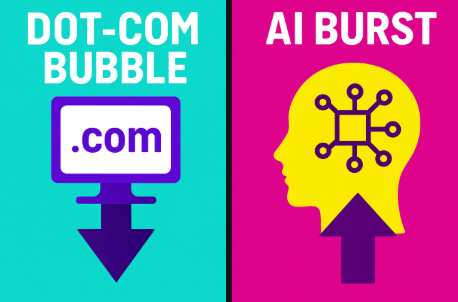
The question now is—are we reliving the dot-com bubble all over again, or is this just the growing pain of a revolution destined to reshape our future?
🌐 What Was the Dot-Com Bubble?
The dot-com phase (1995–2000) was one of the most dramatic periods in tech history—a time when the internet exploded into mainstream awareness and investors rushed to fund any company with a “.com” at the end of its name.
Fueled by optimism that the internet would transform every aspect of business and daily life, startups with little more than a website idea attracted millions in funding and soared to billion-dollar valuations overnight. Wall Street and venture capitalists believed the digital gold rush had begun, and growth mattered more than profit.
- Hype: Investors poured billions into startups just because they had “.com” in their name, regardless of real profits or business models.
- Easy money: Venture capital and IPOs fueled exponential valuations. Some firms with little more than a website raised hundreds of millions.
- Crash (2000–2002): When it became clear many firms couldn’t generate sustainable revenue, the bubble burst. Tech stocks collapsed, wiping out $5 trillion in market value.
- Survivors thrived: Despite the crash, companies like Amazon, Google, and eBay emerged stronger and eventually reshaped the digital economy.
🤖 What Is the AI Burst?
The AI burst refers to the explosive growth, hype, and investment wave that began after OpenAI released ChatGPT in November 2022.
🚀 The Spark: ChatGPT’s Viral Moment
- Within 5 days, ChatGPT crossed 1 million users, becoming the fastest-growing consumer app in history.
- Suddenly, AI wasn’t just for researchers—it was in the hands of students, professionals, and businesses worldwide.
🌍 The Chain Reaction
- Big Tech Frenzy
- Microsoft invested $10B in OpenAI and embedded GPT into Office and Bing.
- Google, caught off guard, launched Bard (later Gemini).
- Meta, Anthropic, Amazon, and Apple all accelerated AI plans.
- Startup Explosion
- Thousands of AI-first startups emerged, promising AI agents, copilots, and automation tools.
- Valuations skyrocketed—even for companies without real revenue.
- Funding Tsunami
- By 2025, global AI investment has already crossed hundreds of billions of dollars, mostly funneled into data centers, GPUs (Nvidia boom), and cloud infrastructure.
- Corporate Gold Rush
- Enterprises rushed to “AI-wash” their strategy decks.
- Surveys show 95% of executives claim to be “investing in AI”—but most projects fail to scale beyond pilots.
5 Reasons Why 95% of AI Projects Fail
🚨 The Shocking Reality:
A recent MIT study found that 95% of generative AI projects fail to show measurable business impact.
While AI looks revolutionary, despite billions in investment, most initiatives stall as most organizations don’t know how to implement it effectively.
1. No Clear Business Need
- Companies chase AI hype instead of solving a real problem.
- 🚩 “Let’s add AI because competitors are doing it.”
- Result: Expensive experiments with no measurable outcomes.
2. Poor ROI Definition
- Success isn’t defined in numbers (cost saved, revenue gained, risk reduced).
- Without KPIs, projects lose funding fast.
3. Lack of Integration
- AI is built as a separate tool, not embedded in daily workflows.
- Employees avoid using it → low adoption → wasted investment.
4. Over-Automation Without Human Oversight
- Companies expect AI to replace humans entirely.
- When errors occur, no human guardrails → broken trust, compliance risks.
5. No Governance or Scalability Plan
- Bias, data privacy, security, or compliance ignored.
- Even successful pilots can’t scale across departments → project dies.
💡 The Lesson: AI projects fail when they are tech-first instead of business-first.
The winners will be those that solve real needs, deliver ROI, integrate smoothly, keep humans in the loop, and scale responsibly.
📉 How This Mirrors the Dot-Com Bubble
1. Hype Over Substance
- Dot-Com Era: Companies with just a website and no business model raised millions.
- AI Era: Startups with little more than a demo or “agent” concept are valued at billions.
2. Massive Failure Rates
- Dot-Com: Nearly 80% of startups collapsed when profits failed to materialize.
- AI: Today, 95% of AI projects fizzle out before creating real value.
3. Infrastructure Overbuild
- Dot-Com: Billions were poured into underutilized fiber optics and servers.
- AI: Trillions are being spent on GPUs, data centers, and chips—without clear ROI beyond a few players.
4. Winner-Takes-All Dynamics
- Dot-Com Survivors: Amazon, Google, eBay rose from the ashes.
- AI Survivors: Microsoft, Google, OpenAI, Nvidia are positioned to dominate while smaller startups vanish.
⚡ Lessons From History
- Hype Doesn’t Equal Value — Technology revolutions always overpromise before reality sets in.
- Consolidation Is Inevitable — Just as only a few dot-coms survived, only a handful of AI leaders will thrive long-term.
- Focus on Real ROI — The winners won’t be those chasing headlines, but those delivering measurable business impact.
🚀 5-Step Framework to Ensure AI Project Success (with Business Value)
1. Start with Business Needs, Not Technology
- ❌ Mistake: Adopting AI because “it’s the future.”
- ✅ Solution: Every AI initiative must align with core business goals—growth, efficiency, customer experience, or risk management.
- Business Value: Ensures relevance, adoption, and measurable outcomes.
- Example: A retail chain uses AI to reduce inventory waste by 30%, directly boosting profits.
2. Define ROI Before Deployment
- ❌ Mistake: Fuzzy outcomes like “improving efficiency.”
- ✅ Solution: Set clear success metrics (cost saved, revenue generated, time reduced).
- Business Value: Focus on impact, not experiments.
- Example: AI chatbot to handle 70% of Tier-1 queries → saves $2M annually in support costs.
3. Integrate Into Workflows, Not as Add-Ons
- ❌ Mistake: Isolated AI tools employees avoid.
- ✅ Solution: Embed AI into day-to-day tools teams already use.
- Business Value: Smooth adoption, higher productivity.
- Example: AI sales coach inside CRM → improves win rates by 20%.
4. Human + AI Collaboration (Not Replacement)
- ❌ Mistake: Expecting AI to fully replace humans immediately.
- ✅ Solution: Use AI as a copilot—AI assists, humans decide.
- Business Value: Lower risk, higher trust, better outcomes.
- Example: AI drafts contracts → legal team reviews → 40% faster deal closures.
5. Governance & Scalability From Day 1
- ❌ Mistake: Ignoring compliance, ethics, and long-term scalability.
- ✅ Solution: Establish AI governance (bias checks, data rules, audit trails) and build for scale.
- Business Value: Risk control, reputation protection, future growth.
- Example: AI hiring tool audited for bias → ensures diversity + legal compliance.
⚡ Final Check: Will Your AI Project Succeed?
If it…
- Solves a real business need ✅
- Has clear ROI metrics ✅
- Fits into workflows ✅
- Works in human + AI partnership ✅
- Meets governance standards ✅
👉 Then it will survive the AI burst and deliver lasting value.
✅ Final Takeaway: The AI Burst and Beyond
The AI burst feels a lot like the dot-com bubble—a frenzy of investment, inflated promises, and inevitable failures. History tells us that most projects will collapse, not because AI lacks potential, but because companies chase hype instead of value.
⚡ The AI burst is not the end of AI—it’s the filter.
Only the 5% of projects that deliver sustainable business value will survive and shape the future.e. If history repeats, we may see many AI startups vanish, while a handful of giants define the next era of technology.
🚀 Call to Action: Navigating the AI Burst
- For Investors 💰: Don’t chase hype. Back startups and enterprises that solve real business problems with measurable ROI, not just flashy demos.
- For Business Leaders 🏢: Ask one question before any AI investment — “How does this serve my business need?” Build AI strategies that enhance customer value, cut costs, and drive growth.
- For Startups 🚀: Survive the AI burst by focusing on niche, pain-killer solutions, not broad promises. The market doesn’t reward cool tech—it rewards results.
- For Employees 👩💻👨💻: Treat AI as your copilot, not competitor. Learn how to work with it, not against it. Upskilling in AI-assisted workflows will make you future-proof.
⚡ The AI burst will separate hype from value. Be on the side that builds lasting impact.
Reference TOI news
Check our blogs on Corporate Governance here.