


An ESG Case Study for Boards, Investors & Risk Leaders
Table of Contents
ESG Crises: THE DAY THE CALL CAME
On a warm Monday morning in Mumbai, the leadership of PharmaPlus, India’s second-largest generic drug manufacturer, began their week like any other. The company was riding high: ₹4,500 crore annual revenue, exports to 72 countries, and a spotless reputation cemented over 35 years.
But at 10:18 AM, an email arrived that would shake the company’s very core.
Subject: URGENT – FDA INSPECTION FINDINGS ON METAFLOX API
Three attached documents.
One sentence in the body:
“Carcinogenic nitrosamine impurities detected. Supplier traced to PharmaPlus API source.”
The company’s world tilted.
By sunset, PharmaPlus’ share price had dropped 11%.
That was just the beginning.
What no one in the company understood yet was this:
This was not a contamination issue. This was a governance issue.
And only one person saw that clearly — the Independent Director who had joined the Board just five months earlier.
THE FIVE-WEEK MELTDOWN
The story of PharmaPlus’ supply-chain collapse unfolded like a slow, painful movie.
Week 1: The U.S. FDA Bombshell
FDA traced carcinogenic impurities to a Chinese API supplier, Qingdao BioChem, a key provider for Metaflox, PharmaPlus’ best-selling diabetes medication.
Qingdao BioChem had passed its certification audit last year.
PharmaPlus had trusted the certificate.
And now 1.8 million patients were potentially exposed.
Week 2: EMA Drops the Hammer
The European Medicines Agency (EMA) suspended import licences for 14 PharmaPlus products until supply-chain integrity was proven.
Revenue risk: ₹600 crore
Reputational risk: immeasurable.
The Board began to panic.
The CEO continued saying, “This is an isolated incident.”
Week 3: A Scandal at Home
A PharmaPlus supplier in Hyderabad, GreenMed Labs, was caught on drone video discharging untreated effluents into a stream leading to a village lake.
Local media ran with the headline:
“The Same Water That Makes Medicines Is Poisoning Us.”
Protests erupted.
The CSR head resigned.
Week 4: The Class-Action Tsunami
A U.S. law firm filed a $650 million class-action lawsuit for exposure to contaminated APIs.
Investors demanded answers.
Regulators demanded explanations.
Patients demanded justice.
Week 5: The Investor Revolt
Institutional investors holding ₹1,200 crore in shares wrote a fiery letter:
“This is not a supplier problem. This is a supply-chain governance collapse.
We demand board-level accountability.”
PharmaPlus had never seen anything like this in its history.
By this point, the company wasn’t just in trouble —
it was in free fall.
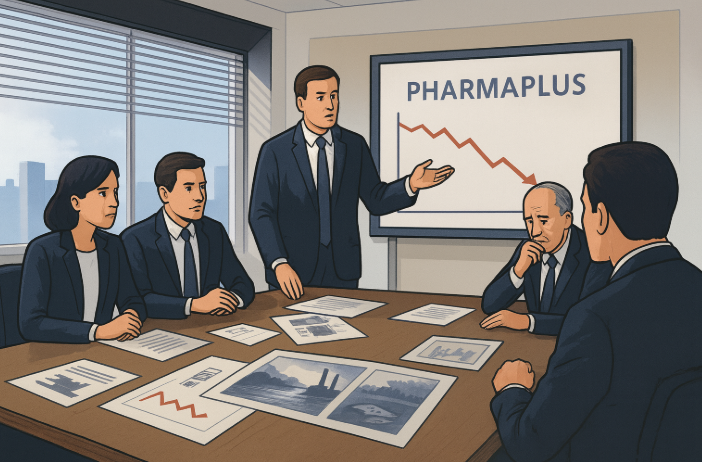
THE BOARDROOM SHOWDOWN
A storm gathered in the 16th floor boardroom overlooking the Arabian Sea. Senior leaders sat with files, numbers, excuses.
The CEO repeated his now-infamous line:
“This is isolated. Qingdao BioChem passed certifications. We cannot audit every reaction inside a factory.”
Some directors murmured agreement.
Then the Independent Director — a calm, observant man with 22 years’ experience in global pharma supply chains — cleared his throat.
He placed four photos on the table.
- Wastewater flowing from GreenMed Labs.
- The FDA impurity graph.
- The EMA import suspension list.
- A newspaper clipping showing crying villagers holding contaminated fish.
He looked around the table.
And spoke slowly:
“This is not a supplier lapse.
This is an ESG governance failure — a failure of visibility, accountability, and board oversight.”
For the first time, the Board went silent.
The Independent Director explained three brutal truths:
1. Certifications ≠ Control.
Certification is a snapshot, not a living picture.
A plant may pass on Monday and violate on Tuesday.
2. High-risk suppliers require high-risk governance.
60% of PharmaPlus’ APIs came from China — the high-risk geography with the weakest oversight — but they were audited only every 24 months.
3. The Board had no live visibility of supply-chain risk.
No monitoring dashboards.
No early warning system.
No ESG-linked controls.
It wasn’t one supplier.
It was an entire system that had cracked.
And unless the Board changed the system, PharmaPlus could collapse.
The Room Shifted. The CEO’s Face Fell.
The Independent Director then laid out immediate actions:
Emergency Board Actions:
- Launch a forensic audit of all 190 API suppliers
- Freeze procurement from high-risk clusters
- Establish a Board Crisis Taskforce with daily reporting
- Begin a transparent regulatory engagement strategy
- Build a 60-day Supply Chain Integrity Plan for FDA restoration
- Expand supplier audits from 35% to 100% risk-based audits
- Create a central digital risk dashboard
The Board — shaken, humbled — approved all recommendations.
A turning point had arrived.
THE FDA ULTIMATUM — 60 DAYS TO PROVE INTEGRITY
Three days later, the U.S. FDA delivered its official letter.
PharmaPlus had 60 days to submit a comprehensive:
“Pharmaceutical Supply Chain Integrity & Traceability Plan”
Failure to comply meant:
Immediate suspension of all US exports.
This could cripple the company for years.
The Independent Director stepped in to lead the design.
BUILDING PHARMAPLUS’ NEW SUPPLY CHAIN SYSTEM
Over the next eight weeks, PharmaPlus re-engineered its global supply chain — not from operations, but from risk, ESG, and governance principles.
The Independent Director outlined a three-part framework that would redefine PharmaPlus forever.
A. Categorizing All 190 API Suppliers by Real Risk
A total of 190 suppliers were sorted not by geography
not by volume
not by comfort
but by risk categories.
Category A – High Risk (28 suppliers)
- Critical APIs
- High impurity potential
- Weak environmental oversight
- History of deviations
- Incomplete batch traceability
Category B – Medium Risk (62 suppliers)
- Mid-volume APIs
- Moderate ESG maturity
- Partial digital systems
Category C – Low Risk (100 suppliers)
- Strong QMS
- Good ESG records
- Based in EU/US/Japan/India
- Transparent and digitally compliant
This was the first time anyone in the company had seen the system this clearly.
B. Audit Frequencies — Finally, Risk-Based
The Independent Director insisted:
“Audits should be proportional to risk, not convenience.”
A new schedule was implemented:
| Category | Audit Type | Frequency | Additional Controls |
|---|---|---|---|
| A – High Risk | Full forensic ESG + GMP | Twice yearly | 100% batch impurity profiling |
| B – Medium | Hybrid audits | Every 18 months | Quarterly document review |
| C – Low | Desktop audits | Every 2–3 years | Annual self-certification |
Executives protested the cost.
The Independent Director replied:
“Quality is expensive.
But not as expensive as negligence.”
Silence again.
Agreement followed.
C. Technology: The New Nervous System of PharmaPlus
Under the Independent Director’s guidance, PharmaPlus deployed an entirely new wave of digital infrastructure.
1. AI-Powered Supplier Risk Dashboard
Live integrations providing:
- FDA/EMA/WHO alerts
- COA deviations
- ESG violation reports
- Wastewater data
- Worker safety incidents
- Batch inconsistencies
For the first time, the Board had real-time visibility.
2. Blockchain Batch Traceability
Required under new EU regulations.
Tracked API identity from raw material → reactor → batch → dispatch → final formulation.
3. IoT Environmental Monitoring
Sensors placed at Tier-1 suppliers:
- pH
- COD/BOD
- VOC emissions
- Effluent discharge metrics
Alerts were auto-escalated to QA leadership.
4. Digital Due Diligence Repository
All supplier CAPAs, audits, improvement logs, and certifications were uploaded, time-stamped, and monitored.
PharmaPlus had never been this transparent — even internally.
THE STRATEGY CROSSROAD — 3 ROADS, 1 FUTURE
At the next board meeting, the CFO presented three stark choices:
OPTION A: EXIT HIGH-RISK SUPPLIERS
Buy only from EU/US suppliers.
Cost increase: ₹240 crore annually.
Independent Director’s Analysis:
- Looks clean, feels safe
- But it’s punitive
- Damages MSME suppliers
- Creates supply concentration risk
- Increases cost of essential medicines
- Violates ESG principles of shared progress
Verdict: Reject.
OPTION B: Build the strongest monitoring & capability ecosystem in the industry
Investment: ₹130 crore.
Independent Director’s Analysis:
- Sustainable
- Future-ready for EU 2026 rules
- Builds long-term resilience
- Reduces recurring risk
- Strengthens all 190 suppliers
- Aligns with “Collaboration over Punishment” philosophy
- Mirrors the Unilever model: lift your ecosystem.
Verdict: Adopt.
OPTION C: Acquire 2–3 critical API suppliers
Investment: ₹900 crore.
Independent Director’s Analysis:
- Great for strategic control
- Reduces dependency
- But capital-heavy
- Operational integration risks
- Useful but incomplete
Verdict: Selective adoption (only for critical APIs).
THE INDEPENDENT DIRECTOR’S FINAL RECOMMENDATION
The Board turned to him.
He spoke with clarity:
“We cannot escape risk.
We must learn to govern it.
The future is not in rejecting suppliers but in elevating them.”
His final recommendation:
- Adopt Option B as the core strategy
- Supplement with Option C for 2–3 mission-critical API suppliers
- Reject Option A completely
The Board voted.
Unanimous.
A transformation had begun.
HOW PHARMAPLUS EARNED BACK TRUST
Trust is rebuilt slowly. Carefully. Patiently.
But over the next 18 months, PharmaPlus did just that.
1. Regulators Took Notice
FDA acknowledged the strength of the Supply Chain Integrity Plan.
EMA reinstated licences after 4 months.
2. Investors Returned
The same institutional investors who wrote angry letters wrote a different one later:
“PharmaPlus is now a global benchmark for supply-chain governance.”
Share prices stabilized, then rose 17%.
3. Suppliers Became Partners
Small, MSME API vendors in India and China received:
- ESG training
- Emissions-control guidance
- Quality system upgrades
- Wastewater management support
PharmaPlus built a new ecosystem — not by firing suppliers, but by uplifting them.
4. The Company Culture Shifted
Employees understood ESG not as compliance but as identity.
Operators reported early deviations.
Quality teams enforced stricter controls.
Procurement aligned with sustainability, not price.
5. Patients Regained Confidence
When the new “TraceMyMedicine” QR system launched, patients could scan any PharmaPlus pack to see full traceability.
This transparency became a competitive advantage.
THE NEW PHARMAPLUS — STRONGER AFTER CRISIS
Two years after the meltdown, PharmaPlus had become:
- India’s most transparent pharma supply chain
- One of Asia’s first companies with end-to-end blockchain traceability
- A global case study for ESG-driven risk governance
- A trusted partner of FDA, EMA, and CDSCO
- A brand stronger than ever before
The Chairman called it:
“The greatest crisis in our history,
and the greatest transformation we ever achieved.”
But everyone on the Board knew one truth:
It started with the courage of one Independent Director who refused to accept the word “isolated.”
FINAL REFLECTION: THE LESSON FOR THE WORLD
PharmaPlus’ story is not unique.
Across the world, pharma supply chains are cracking under:
- weak oversight
- fragmented suppliers
- cost pressure
- ESG violations
- global regulatory demands
- rising patient expectations
The lesson from PharmaPlus is clear:
Quality is not born in laboratories.
Quality is born in supply chains.
A company is only as ethical as its lowest-tier supplier.
A brand is only as strong as its weakest oversight mechanism.
And a Board is only as competent as its governance of risk.
PharmaPlus nearly fell apart.
But it rose again —
because someone finally asked the right questions.
Read more ESG stories here.
External Reference:
🔗 https://www.who.int/publications/i/item/9789241503250
WHO – Guidelines on Quality Risk Management in Pharmaceutical Supply Chains