


Table of Contents
ESG India 2025 — A Year That Began With Confidence
At the beginning of 2025, ESG in India felt quietly optimistic.
There was a growing belief that the foundations were finally in place. Sustainability had moved beyond slogans and speeches. Board agendas carried ESG as a standing item. BRSR disclosures brought structure and comparability. Climate targets, social commitments, and governance frameworks appeared more disciplined than ever before.
In newspapers and business forums, ESG was largely reported as a success story. Indian corporates were portrayed as maturing — learning from past missteps and aligning with global expectations. Water stewardship, renewable energy, electric mobility, diversity goals — these were no longer peripheral ideas. They had entered the mainstream.
The narrative was reassuring. ESG had arrived.
Yet, as the year unfolded, that confidence was quietly tested.
Not through one dramatic collapse — but through a series of small, human, and operational moments that rarely dominate headlines. A workforce reduction described as restructuring. A supplier incident framed as operational disruption. A community concern deferred. A climate ambition stated without a visible transition pathway.
Individually, these moments appeared manageable. Collectively, they told a different story.
By the end of 2025, ESG in India no longer felt like a destination reached. It felt like a system under strain.
What changed was not intent — but pressure. Pressure from regulators asking sharper questions. Pressure from investors connecting disclosures with decisions. Pressure from employees and communities expecting consistency between values and behaviour.
2025 did not end with the failure of ESG.
It ended with a warning.
A warning that ESG cannot live only in reports.
A warning that governance determines whether sustainability survives stress.
A warning that trust, once tested, demands proof — not persuasion.
And yet, there is reason for hope.
Because 2025 clarified what truly matters. It revealed that ESG works when embedded in decisions, not narratives. It showed that accountability strengthens credibility. It reminded boards that sustainability is measured not by ambition — but by behaviour when choices are difficult.
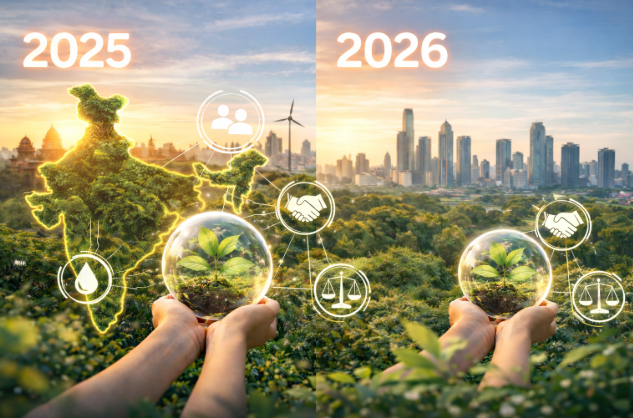
As India steps into 2026, ESG stands at a crossroads. One path leads back to comfort and optics. The other leads forward — toward discipline, honesty, and resilience.
1. 2025: When ESG Moved From Narrative to Governance Reality
As 2025 progressed, ESG stopped behaving like a reporting exercise and began asserting itself as a governance issue.
With SEBI’s Business Responsibility and Sustainability Reporting (BRSR) framework firmly in force, ESG disclosures now required:
- Formal board approval
- Cross-functional data ownership
- Explicit accountability for accuracy
From an Independent Director lens, the implication was unambiguous:
Once ESG disclosures are approved by the board, ESG risk becomes a fiduciary responsibility — not a sustainability team activity.
2025 did not simplify ESG.
It removed plausible deniability.
2. Environmental ESG: Where India Demonstrated Real Progress
2.1 ITC: Water Stewardship as Risk Management
ITC continued to be cited in public disclosures for its long-term leadership in water stewardship.
Initiatives publicly reported included:
- Large-scale watershed development
- Rainwater harvesting across manufacturing sites
- Integration of water security into agricultural supply chains
The governance lesson was clear: environmental leadership gains credibility when it protects business continuity, not just reputation.
2.2 Tata Group & Tata Motors: Climate Action Backed by Capital
Across Tata Group companies, climate ambition in 2025 was increasingly visible through investment decisions.
- Tata Power expanded renewable capacity.
- Tata Steel disclosed transition risks while piloting decarbonisation pathways.
- Tata Motors strengthened its EV roadmap, directly linking sustainability with future mobility and competitiveness.
Capital followed intent — and markets noticed.
2.3 Mahindra & Mahindra: EV Innovation as Strategic ESG
Mahindra & Mahindra (M&M) emerged as a strong example of ESG aligned with innovation.
Public announcements highlighted:
- Expansion of electric vehicle portfolios
- Investments in dedicated EV platforms
- Positioning sustainability as a growth opportunity rather than a compliance cost
This reinforced a central ESG truth: sustainability delivers value when embedded in core strategy.
2.4 Infosys: Carbon Neutrality With Disclosure Discipline
Infosys continued to receive attention for its progress toward carbon neutrality.
Public disclosures reflected:
- High renewable energy adoption
- Energy efficiency initiatives
- Transparent acknowledgement of Scope 3 limitations
Credibility was built through honesty, not perfection.
3. Environmental ESG: Where Gaps Became Visible
3.1 Heavy Industry and the Scope 3 Constraint
Industrial groups such as JSW demonstrated progress on emissions efficiency and renewable sourcing.
Yet public disclosures and analyst commentary continued to highlight:
- Supplier readiness gaps
- Inconsistent Scope 3 data
- Limited influence beyond direct operations
2025 reinforced a structural constraint:
Climate strategies limited to owned assets remain incomplete.
3.2 Net-Zero Without Transition Pathways
Across sectors, net-zero commitments often lacked:
- Interim milestones
- Clear capex linkage
- Operational accountability
By year-end, public scrutiny increasingly questioned ambition without execution.
4. Social ESG: Layoffs, Labour, and Livelihoods
If environmental ESG was tested by capital allocation, Social ESG in 2025 was tested by people decisions.
4.1 Layoffs: The Defining Social ESG Moment of 2025
Across IT, startups, and new-age companies, layoffs emerged as the most visible ESG stress test of the year.
Public disclosures and media reports revealed:
- Workforce reductions framed as efficiency or restructuring
- Limited transparency on decision criteria
- Inconsistent transition support for affected employees
From a governance lens, uncomfortable questions emerged:
- Were social impacts debated at board level?
- Were reskilling or redeployment meaningfully explored?
- Did workforce decisions align with stated ESG values?
2025 showed that how layoffs are executed matters as much as why they occur.
4.2 Supply Chains and the Vedanta-Type Reality
In extractive and heavy industries — illustrated by Vedanta-type ecosystems — social risks continued to originate in contractor and supplier networks.
Public reporting highlighted:
- Worker safety incidents
- Contract labour vulnerabilities
- Community trust deficits
A recurring lesson emerged:
Most social ESG failures occur where oversight is weakest — beyond direct payrolls.
4.3 Services Sector: Inclusion Beyond Numbers
In IT and services companies, gender diversity metrics improved.
However, public signals — attrition data, employee sentiment, and media reporting — pointed to unresolved challenges:
- Burnout
- Middle-management inclusion gaps
- Psychological safety concerns
Representation improved.
Inclusion maturity remained uneven.
5. Governance (G): Progress With Persistent Weaknesses
5.1 BRSR as a Structural Governance Win
BRSR fundamentally changed ESG oversight by enforcing:
- Formal ownership
- Board accountability
- Disclosure discipline
ESG could no longer be treated as optional.
5.2 ESG Data Quality: The Silent Governance Risk
At the same time, 2025 exposed weaknesses:
- Manual data collection
- Weak internal controls
- Inconsistent definitions
Boards increasingly faced discomfort signing off ESG disclosures without financial-grade assurance.
5.3 The Expanding Role of Independent Directors
Public scrutiny reshaped expectations from independent directors:
- Passive endorsement is no longer acceptable
- Inquiry and escalation are expected
- Silence increasingly carries reputational risk
Independence without engagement proved insufficient.
6. How ESG Looked at the End of 2025
By December 2025, ESG no longer felt reassuring.
Headlines shifted from commitments to consequences.
Layoffs questioned social credibility.
Supply-chain incidents unsettled investors.
Environmental claims faced sharper interrogation.
Boards recognised that ESG disclosures carried fiduciary exposure.
What changed was not policy — but pressure.
ESG did not fail in 2025.
It was exposed.
ESG Performance Across Indian Sectors in 2025: What Held, What Cracked, What Must Change
By the end of 2025, it became evident that ESG performance in India did not move uniformly. Each sector revealed a different relationship with environmental limits, social responsibility, and governance discipline.
From an Independent Director lens, ESG in 2025 looked less like a single journey—and more like many parallel stress tests.
1. Energy & Power: Strong Momentum, Uneven Transition
What went well
- Rapid expansion of renewable capacity (solar, wind, hybrid)
- Greater disclosure on transition risks and stranded assets
- Improved alignment between climate goals and capital allocation
Visible examples
- Tata Power’s renewable expansion
- Adani Green’s scale-driven clean energy push
- NTPC’s gradual but visible transition narrative
What struggled
- Coal dependence remained high
- Just transition planning for workers and communities was weak
- Grid stability and storage lagged ambition
ID lens takeaway
India’s energy transition progressed—but governance around social transition lagged behind environmental ambition.
2. Metals, Mining & Cement: Environmental Progress, Social Fragility
What went well
- Energy efficiency improvements
- Increased renewable sourcing
- Better emissions monitoring and disclosure
Visible examples
- JSW Steel’s efficiency measures
- Tata Steel’s decarbonisation pilots
- Cement majors investing in blended cement and waste heat recovery
What failed
- Contractor safety incidents
- Community trust deficits
- Labour and rehabilitation challenges (Vedanta-type situations)
ID lens takeaway
In heavy industry, ESG failure in 2025 was rarely environmental—it was social and governance-related.
3. Automobiles & EV Ecosystem: ESG as Growth Strategy
What went well
- EV adoption accelerated
- Sustainability aligned with product innovation
- Cleaner mobility positioned as future competitiveness
Visible examples
- Tata Motors’ EV leadership
- Mahindra & Mahindra’s EV platform investments
- Maruti Suzuki’s gradual shift narrative
What needs improvement
- Battery sourcing transparency
- End-of-life recycling infrastructure
- Supplier ESG readiness
ID lens takeaway
ESG worked best where sustainability directly shaped future revenue.
4. FMCG & Consumer Goods: Social Strength, Supply-Chain Risk
What went well
- Strong water stewardship
- Farmer engagement programs
- Packaging innovation
Visible examples
- ITC’s water positivity
- Hindustan Unilever’s supplier programs
- Nestlé India’s rural sourcing focus
What struggled
- Traceability beyond Tier-1 suppliers
- Contract labour vulnerabilities
- Plastic waste management at scale
ID lens takeaway
FMCG ESG credibility depends less on factories—and more on thousands of invisible suppliers.
5. IT & Technology: Environmental Leadership, Social Stress
What went well
- Carbon neutrality progress
- Renewable energy adoption
- Transparent ESG reporting
Visible examples
- Infosys’ carbon-neutral disclosures
- TCS and Wipro’s renewable sourcing
What cracked in 2025
- Layoffs and workforce rationalisation
- Burnout and attrition
- Inconsistent handling of employee exits
ID lens takeaway
In services, ESG credibility is judged not by emissions—but by how people are treated in downturns.
6. BFSI (Banking, Financial Services & Insurance): Governance Strength, Climate Lag
What went well
- Strong governance frameworks
- Improved ESG disclosures
- Risk management maturity
Visible examples
- Leading private banks strengthening ESG risk committees
- Increased green financing disclosures
What needs improvement
- Climate risk integration into credit decisions
- Exposure to high-carbon assets
- Social impact of loan recovery practices
ID lens takeaway
Financial institutions shape ESG outcomes indirectly—and must own that influence more explicitly.
7. Infrastructure & Real Estate: Environmental Risk, Governance Scrutiny
What went well
- Green building certifications
- Energy efficiency measures
- Smart infrastructure planning
What failed
- Land acquisition disputes
- Worker safety lapses
- Community engagement gaps
ID lens takeaway
ESG in infrastructure fails when speed overtakes consent.
8. Pharmaceuticals & Healthcare: Social Purpose, Environmental Blind Spots
What went well
- Access to affordable medicines
- Ethical positioning
- Strong compliance culture
What needs attention
- Effluent treatment
- Water usage
- Supply-chain environmental impact
ID lens takeaway
Healthcare ESG credibility is incomplete without environmental responsibility.
9. Startups & New-Age Companies: Intent Without Infrastructure
What went well
- Strong purpose-driven narratives
- Inclusion and innovation focus
What collapsed
- Layoffs without social buffers
- Weak governance
- Limited ESG systems
ID lens takeaway
ESG maturity cannot be postponed until scale—it must grow with the business.
Cross-Sector Pattern from 2025
Across all sectors, ESG performance in 2025 revealed a consistent pattern:
- Environmental goals advanced fastest where capital followed intent
- Social ESG cracked first under cost pressure
- Governance determined whether ESG survived scrutiny
Policies were common.
Execution was uneven.
Accountability made the difference.
Why This Matters for 2026
As India enters 2026, ESG maturity will no longer be judged sector by sector—but decision by decision.
The question will not be:
“Does this sector perform well on ESG?”
It will be:
“Does this board act responsibly when trade-offs are unavoidable?”
That answer will define the next phase of ESG in India.
7. Hope, Warning, and the Road to 2026
Despite the discomfort of 2025, there is genuine reason for optimism.
Boards now recognise ESG as a governance issue.
Management understands that ESG leaves evidence.
Investors increasingly reward substance over storytelling.
If 2025 exposed cracks, 2026 offers the opportunity to reinforce the foundation.
Not with louder commitments — but stronger systems.
Not with perfect narratives — but honest disclosures.
Not with fear — but accountability.
The warning is clear: ESG credibility will not survive comfort.
The hope is stronger: ESG integrity can still be rebuilt through discipline and courage.
Call to Action for 2026
For Boards & Independent Directors
Ask harder questions. Demand evidence. Treat ESG risk like financial risk.
For Management
Embed ESG into capital allocation, workforce decisions, and supply-chain governance.
For Investors
Reward transparency. Interrogate execution. Use capital responsibly.
For ESG Professionals
Choose integrity over optics. Build systems that withstand scrutiny. Speak up.
Conclusion: What 2026 Will Remember
ESG is not about image.
It is about impact.
It is revealed when growth slows, costs rise, and decisions hurt.
2025 showed how ESG behaves under pressure.
2026 will decide whether lessons were learned.
Because ESG’s future in India will not be written in reports.
It will be written in choices — made quietly, and judged publicly.
Read more blogs on sustainability here.
📌 Regulatory & Policy Context
- SEBI reviewing ESG disclosure requirements for listed firms — shows evolving regulatory scrutiny and capacity challenges in reporting. Reuters
- SEBI’s BRSR (Business Responsibility & Sustainability Reporting) has become mainstream reporting for top Indian companies (documented in various BRSR reports & manuals). ICSI
📊 Corporate ESG Actions & Performance
Automobile & Mobility Sector
- Tata Motors partners with TCS for digital ESG reporting and sustainability tracking, embedding real-time data and compliance with SEBI’s BRSR. Tataworld+1
- Tata Motors’ formal BRSR demonstrates environmental efforts including effluent processing and water recycling. Tata Motors
Brand & Sustainability Perceptions
- Tata Group leads Indian brands in sustainability perception value, highlighting strong ESG positioning among Indian corporates. Brand Finance
IT & Technology Sector
- Infosys outlines an updated ESG Vision 2030, including ongoing carbon neutrality and broader social/employment commitments. infosys.com
Manufacturing & Industrial Sector Recognition
- Business Today “Most Sustainable Companies 2025” lists firms such as JSW Steel/JSW Energy, Mahindra & Mahindra, Hindustan Unilever, Godrej Properties for sustainability performance. Business Today
Climate & Energy Transition Initiatives
- Indian corporates (e.g., L&T, Vedanta, RPG Group) expand sustainability programmes covering emissions, water, biodiversity and climate resilience. esgbroadcast.com
Trend & Commentary on ESG Reporting in India
- Articles highlight that Indian companies are accelerating ESG initiatives as climate risks grow, but also face challenges in reporting quality and supplier data. esgbroadcast.com
- Tech and automation (AI, blockchain, automation) are being explored to improve ESG data management and reporting quality in India. Times of India
- Analyses suggest net-zero and Scope 3 reporting gaps remain in many Indian corporate disclosures — a reality check on the pace of transition. The Indian Express