

BRSR, BRSR Core & Global Alignment**
Table of Contents
ESG Roadmap Options for Indian Companies
In 2025, ESG is no longer about “sustainability reporting.”
It is about access to cheaper capital, stronger supply chains, and long-term resilience.
Here’s the opportunity:
👉 Companies with strong ESG data qualify faster for ESG-linked loans at lower interest rates
👉 BRSR Core–ready organisations earn investor trust and attract ESG-linked bonds
👉 Transparent governance accelerates global customer approvals
👉 Integrated ESG systems reduce operational costs by 5–12%
👉 High-quality disclosures boost brand credibility and market valuation
India’s corporate ESG landscape is transforming rapidly. With SEBI mandating BRSR, phasing in BRSR Core assurance, and global investors demanding ISSB/TCFD/GRI alignment, the question for companies is no longer “Should we do ESG?” but:
“Which roadmap should we follow — Minimal, Mid-Level, or Full ESG Transformation?”
This blog begins with the three ESG roadmaps for Indian companies, followed by a complete deep-dive into implementation guidelines, frameworks, timelines, challenges, and best practices.
Companies in India fall into three maturity categories. Depending on your current capabilities and urgency, you can pick one of three transformation paths.
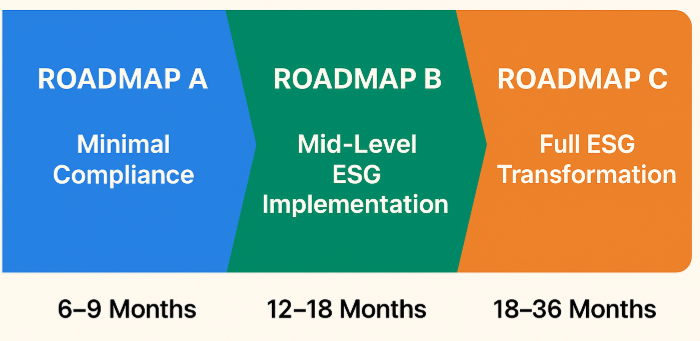
ROADMAP A: Minimal Compliance (6–9 Months)
For companies focused only on meeting SEBI’s minimum BRSR requirement
Objectives:
- Avoid regulatory non-compliance
- Implement basic ESG data collection
- Prepare for eventual BRSR Core requirements without full investment yet
Key Focus Areas:
- Basic BRSR disclosures (narrative + quantitative)
- Assign ESG data owners per metric
- Create simple monthly ESG MIS
- Identify gaps for BRSR Core, ISSB, TCFD (future needs)
Deliverables:
- BRSR report
- High-level sustainability policy
- ESG governance structure
- Initial materiality assessment
Who chooses this?
Small/mid-sized companies or large companies just starting ESG capability-building.
ROADMAP B: Mid-Level ESG Implementation (12–18 Months)
For companies ready to go beyond compliance & build assurance-grade systems
Objectives:
- BRSR + BRSR Core readiness
- Internal controls that auditors can validate
- Partial future-proofing for ISSB/TCFD
- Strengthen supplier value chain data
Key Focus Areas:
- Internal ESG control framework (evidence trails, monthly reconciliations)
- Audit-ready BRSR Core KPI processes
- Supplier ESG scorecard implementation
- Climate baseline (Scope 1,2, and starting 3)
Deliverables:
- BRSR (comprehensive)
- BRSR Core KPI readiness (49 metrics)
- ESG data platform / SSOT
- Limited assurance preparation
Who chooses this?
Companies preparing to meet investor expectations & regulatory assurance requirements in FY 2025–27.
ROADMAP C: Full ESG Transformation (18–36 Months)
For companies aiming to reach global standards and integrate ESG into business strategy
Objectives:
- Full BRSR + assured BRSR Core
- Global frameworks alignment (ISSB S1/S2, GRI, TCFD)
- Integrate ESG into enterprise risk management & financial reporting
- Climate strategy, SBTi targets, and digital ESG systems
- Enterprise-wide sustainability culture
Key Focus Areas:
- ESG strategy linked to business growth
- Decarbonization pathways
- Scope 1–3 value chain emissions
- AI/IoT-powered environmental data
- Integrated reporting
- Supplier decarbonization plans
Deliverables:
- ISSB-compliant sustainability disclosures
- TCFD-aligned climate risk reporting
- GRI-based Sustainability Report
- Full BRSR Core assurance
- ESG-linked remuneration
- Industry-leading sustainability performance
Who chooses this?
Large conglomerates, high-visibility brands, exporters, global-capital-dependent companies.
The ESG Transformation Journey for Indian Companies
After choosing the roadmap, companies must understand the detailed phases of implementation.
PHASE 1 — Foundation (3–6 Months)
Building the governance, policies & scope of ESG transformation
The Foundation phase establishes the organisational base required for an effective ESG journey. Companies begin by setting up governance structures such as an ESG Committee, defining roles, responsibilities, and cross-functional ownership. This is followed by conducting a double materiality assessment to identify ESG topics that matter most to both the business and its stakeholders. A detailed gap assessment highlights compliance requirements under frameworks like BRSR, GRI, SASB, and ISSB. In this phase, organisations also create core sustainability policies—covering areas such as human rights, diversity, ethics, safety, and supplier responsibility. By the end, the company has clarity on priorities, risks, and its ESG vision, which sets the stage for data and strategy work in the subsequent phases.
Key Activities
- Board-Level ESG Mandate
- Create a Sustainability Committee or embed ESG into Audit/Risk Committees.
- Define oversight responsibilities.
- ESG Steering Committee
- Leadership from Finance, HR, EHS, Supply Chain, CSR, IT, Operations, Legal.
- Materiality Assessment
- Double materiality approach (impact + financial).
- Stakeholder interviews/surveys (employees, investors, regulators, customers, communities).
- Gap Assessment
- Assess current data maturity vs:
- BRSR (mandatory)
- BRSR Core (assured KPIs)
- ISSB
- TCFD
- GRI
- Assess current data maturity vs:
- ESG Roadmap Definition
- Quick wins
- Year 1 compliance
- Year 2 assurance
- Year 3 global alignment
PHASE 2 — Data & Technology (6–12 Months)
Fixing data fragmentation — the biggest challenge for Indian companies
Common Problems in Indian Companies
- Information scattered across Excel, SAP, emails, PDFs
- No owner per KPI
- Non-standard units & inconsistent measurement
- No audit evidence trail
- Vendor/supplier data missing
Solutions
1. Assign ESG Data Owners per KPI
Examples:
- GHG → EHS & Facilities
- Health & Safety → HR + EHS
- Community → CSR
- Governance → Company Secretary
- Value Chain ESG → Procurement
- Compliance → Legal
- Controls, audit trail → Finance
2. Single Source of Truth (SSOT) Setup
- ESG platforms integrating SAP/S4HANA, HRMS, Energy Meters, Vendor Portals
- Master Data Management (MDM)
- Version-controlled evidence documents
3. Monthly Data Reconciliation
Proven best practice:
- Bharat Forge reduced ESG data variance from 18% → <2% with monthly reconciliation.
4. ESG Evidence Repository
For every KPI, store:
- Meters logs
- Bills & invoices
- Weight slips
- Emission factor references
- Compliance certificates
5. Control Framework
Mandatory for BRSR Core assurance:
- Maker-checker
- Review logs
- Document retention policy
- Internal audit sampling
In this phase, companies build the digital and data backbone that ESG requires. The process begins with mapping all ESG-relevant data sources—such as ERP systems, HRMS, supply chain tools, and operational logs—and identifying gaps, data owners, and controls. Standardised KPIs are designed in alignment with major reporting frameworks, enabling consistent measurement. Technology tools like SAP Sustainability Control Tower, Microsoft Sustainability Manager, or Enablon are implemented to automate data capture, ensure accuracy, and create real-time dashboards. This phase transforms ESG measurement from manual and spreadsheet-driven to an intelligent, scalable system that is audit-ready and capable of supporting investor-grade reporting.
PHASE 3 — ESG Strategy (3–6 Months)
Turning compliance into business strategy
Once data stabilizes, the company develops forward-looking targets.
ESG Strategy must come after the Data & Technology phase because strategy needs real numbers, not assumptions. For example, a company may believe its biggest issue is electricity use and set a target to cut energy by 30%. But once Phase 2 data is digitised and reconciled, it may discover that 75% of emissions actually come from suppliers (Scope 3), not its own plants. This completely changes the strategy—from energy projects to supplier engagement, low-carbon materials, and logistics optimisation. Without accurate data first, the company would set the wrong targets and fail audits later.
Strategic Components
1. Climate Strategy
- Scope 1–2–3 emissions baseline
- SBTi-aligned targets
- Renewable energy roadmap
- TCFD scenario modelling:
- Carbon tax risks
- Physical climate hazards
- Transition risk pathways
2. Social Strategy
- Workforce diversity
- Upskilling plans
- Worker wellbeing initiatives
- Community impact plan
3. Governance Enhancements
- Whistleblower processes
- Board independence & ESG skills
- Anti-corruption controls
- CEO/CXO scorecards linked to ESG
4. Supplier ESG Program
- Map top 100 suppliers
- Tiering approach: High-risk → deeper assessments
- Supplier code of conduct
- ESG compliance scorecard
- Value chain data model (needed for BRSR Core)
The ESG Strategy phase translates data insights and material topics into a structured strategic plan. Companies set measurable targets such as net-zero commitments, energy transition pathways, water positivity, waste reduction, or diversity goals. Scenario analysis, often aligned to TCFD, helps identify climate risks and business impacts. Based on this, organisations create a 3–5 year ESG roadmap outlining initiatives across operations, supply chains, products, and communities. Financial planning is a critical component—evaluating capex, ROI, cost savings, and ESG-linked financing options. This phase ensures ESG moves beyond compliance and becomes a driver of competitive advantage, efficiency, and long-term value creation.
PHASE 4 — Reporting & Assurance (6–12 Months)
The most demanding phase: public disclosures, audits & controls
1. BRSR (Comprehensive)
- Hundreds of metrics
- Qualitative + quantitative disclosures
- Governance + policies + value chain inputs
2. BRSR Core (49 KPIs)
These are the most material, high-impact, audit-focused metrics across:
- Emissions
- Water use
- Energy efficiency
- Workforce wellbeing
- Supply chain standards
- Responsible sourcing
- Governance integrity
Assurance Timeline (SEBI Mandate)
- FY 2023–24 → Top 150
- FY 2024–25 → Top 250
- FY 2025–26 → Top 500
- FY 2026–27 → Top 1000
3. Internal Controls & Audit Readiness
- Documented SOPs
- Control testing
- Quarterly internal audits
- Management assertions
- Evidence trail for each KPI
4. Global Framework Alignment
- ISSB S1/S2 for investor-grade reporting
- TCFD for climate governance & risk
- GRI for stakeholder impact
This phase focuses on converting ESG performance into transparent, credible, and compliant disclosures. Companies prepare sustainability reports aligned to BRSR, BRSR Core, GRI, SASB, or ISSB standards. Reporting requires robust internal validation, reconciliation with financial data, and clear narrative building around achievements and challenges. Independent assurance partners—such as Big 4 firms—verify emissions data, controls, and processes to ensure reliability and investor trust. Strong assurance not only reduces risks of greenwashing but also enhances the organisation’s ESG ratings, access to global markets, and stakeholder confidence.
PHASE 5 — Continuous Improvement (Year 2–3 Onwards)
ESG becomes an operating system, not a report
Leading Indian companies evolve into “ESG-centric enterprises”.
Key Advancements
- Integrate ESG with ERM
- ESG-linked bonuses for CEO/CXOs
- AI-driven Scope 3 calculations
- Industry benchmarking dashboards
- Supplier transition programs
- Integrated Reporting (IR)
The Continuous Improvement phase shifts ESG from a project to a long-term performance engine. Companies benchmark against peers, track year-on-year progress, and integrate ESG into business functions such as procurement, risk management, product design, and leadership KPIs. Innovation becomes central—driving circular economy projects, low-carbon technologies, supplier partnerships, and climate resilience strategies. ESG audits, periodic reassessments, and updated targets ensure momentum and accountability. Over time, ESG becomes deeply embedded in culture and operations, strengthening competitiveness, brand value, and long-term sustainability outcomes.
Integrating BRSR/BRSR Core with Global Frameworks
As India moves toward a more transparent, accountable sustainability regime, BRSR and BRSR Core have become mandatory foundations. But for companies operating in global supply chains, seeking international capital, or aiming to meet investor expectations, these Indian requirements alone are not enough. Integrating them with global frameworks—GRI, SASB, ISSB, TCFD, CDP—is now essential for both compliance and competitiveness.
| Purpose | Framework | Why it matters |
|---|---|---|
| Indian regulatory compliance | BRSR + BRSR Core | Mandatory for top 1000; assurance critical |
| Global investor access | ISSB S1/S2 | Finance-grade disclosures |
| Climate risk governance | TCFD | Required in global markets |
| Stakeholder transparency | GRI Standards | Impact-oriented reporting |
| Integrated Reporting | IR Framework | Value creation approach |
Best practice:
Use BRSR for India, ISSB for investors, GRI for stakeholders, and TCFD for climate risk.
Indian ESG Challenges & How to Solve Them
1. Fragmented Data
Fix: Integrated ESG platform + clear data owners + standard formats.
2. No Audit Trail
Fix: Monthly reconciliations, evidence repository, control logs.
3. Supplier Data Gaps
Fix: Supplier code of conduct, ESG scorecards, value-chain KPIs.
4. Complex Metrics
Especially in GHG Scope 3.
Fix: Start with 5 major categories → expand gradually.
5. Board Awareness Gaps
Fix: Board training, ESG risk dashboards, committee oversight.
6. Limited Resources
Fix: Create 200–500 “ESG Champions” across plants & functions.
What Indian Boardrooms Must Ask
Governance
- Who owns ESG? Is accountability clear?
Data Integrity
- Are ESG metrics audit-ready?
- Are controls equivalent to financial reporting?
Risk
- What climate, regulatory, and supply chain risks do we face?
Competitiveness
- Are we ahead or behind peers?
- What is the ROI of ESG initiatives?
Future Readiness
- How prepared are we for ISSB?
- Is our value chain decarbonization plan realistic?
ESG Is Now a Business Competitiveness Imperative
Indian companies are now expected to meet domestic compliance (BRSR), audited KPIs (BRSR Core) and global investor expectations (ISSB, GRI, TCFD).
The companies who adopt Roadmap C will lead markets.
Those who settle for Roadmap A risk being left behind as ESG becomes the next frontier of competitiveness.
Your ESG journey is not just about reporting.
It is about building a future-proof business model that attracts capital, talent, customers, and long-term growth.
✅ Call to Action: Your ESG Transformation Starts Today
ESG is no longer a reporting exercise — it’s a competitive advantage.
Whether your organisation chooses Minimal Compliance, Mid-Level ESG, or a Full Transformation, the real differentiator is starting early and building the right systems.
If your leadership team is asking:
- “Where do we begin with BRSR and BRSR Core?”
- “Which roadmap suits our company’s scale and maturity?”
- “How do we reduce compliance risk and move toward real value creation?”
- “How do we design ESG data architecture that actually works?”
Then it’s time to act — not wait.
👉 Book an ESG Roadmap Consultation
Get a customised, phase-wise ESG implementation blueprint tailored for your industry, size, and SEBI expectations.
👉 Request a BRSR/BRSR Core Readiness Assessment
Identify gaps, high-risk areas, and priority KPIs before the next reporting cycle.
👉 Download the ESG Roadmap Template
A practical, board-ready guide to help your leadership teams make informed decisions.
ESG will reshape Indian business in the next three years.
The question is — will your company lead the change or be forced to catch up?
Let’s build your transformation story.
Start today.
Read more blogs on sustainability here.
Reference SEBI Circular March 2025.