


Table of Contents
Introduction
Behind many corporate collapses lies not just bad decisions, but a culture of silence. While most businesses spend time and money on external audits, branding, and innovation — few recognize the danger posed by silent employees and agreeable managers who nod, agree, and comply, even when the business is heading toward a cliff. This blog dives deep into how such “yes-man” cultures breed stagnation, fear, and failure — and why nurturing dissent, open feedback, and critical thinking can save your company from self-destruction.
The Hidden Cost of Silence
Silence isn’t always golden. In boardrooms and management meetings, silence can translate to compliance, complacency, and missed warnings. Employees or managers who spot flaws, inefficiencies, or unethical practices but stay quiet due to fear, politics, or indifference enable a slow corporate death.
- Kodak ignored internal voices urging a pivot to digital.
- Enron thrived on a toxic culture of silence until its implosion.
- Boeing faced catastrophic issues after employees’ concerns were overridden by executive pressure.
Who Are the Yes-Men (and Why They Exist)


Yes-men (or women) are individuals who prioritize appeasing superiors over expressing concerns or ideas. They often:
- Fear retaliation or career damage.
- See disagreement as disloyalty.
- Work in rigid hierarchies discouraging challenge.
- Lack psychological safety to speak freely.
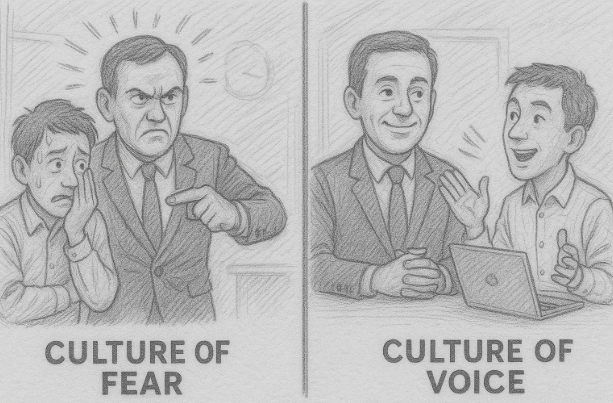
Culture of Fear vs. Culture of Voice
When a company penalizes dissent and rewards blind agreement:
- Innovation dies.
- Errors go uncorrected.
- Toxic behaviors fester.
- Valuable employees leave.
Silent Employees vs. Vocal Safeguards
While silent employees allow problems to grow unnoticed, those who raise concerns — the ethical whistleblowers, the honest analysts, the questioning minds — serve as a company’s true immune system. They detect and raise alarms before small issues turn into disasters.
Encouraging Open Feedback: A Leadership Imperative To prevent collapse from within, leaders must:
- Build psychological safety.
- Encourage anonymous feedback.
- Create regular review loops involving junior voices.
- Recognize and reward truth-tellers.
- Include dissent in decision-making processes.
Case Example: Toyota
Toyota’s “kaizen” (continuous improvement) culture allows all employees, even factory workers, to stop the production line if they notice an issue. This approach has saved billions in defects and built a culture of responsibility.
🔷 Case Study: Toyota – Kaizen Culture & the Power of Internal Voices


Company: Toyota Motor Corporation
Industry: Automotive
Founded: 1937
Headquarters: Toyota City, Japan
🎯 Background:
Toyota is globally recognized not just for its vehicles, but for pioneering “Kaizen”, a Japanese term meaning continuous improvement. This philosophy is deeply ingrained in Toyota’s corporate DNA, encouraging employees at every level—from engineers to factory floor workers—to contribute ideas, raise concerns, and stop operations if something is wrong.
🛠️ The System: Jidoka & Andon Cord
One of the most powerful implementations of Kaizen is the Andon Cord:
- It’s a physical or digital mechanism any employee can pull to stop the production line.
- If a defect or abnormality is found—even a minor one—workers are empowered to halt operations and trigger immediate investigation and support from supervisors.
- This is part of Jidoka: building quality into the process by allowing machines and people to detect issues automatically.
🧠 Why This Matters:
Toyota actively listens to its employees. Factory workers are not treated as cogs in a machine, but as critical quality guardians. Every worker is seen as a stakeholder in Toyota’s brand promise.
💡 Real-World Impact:
- Defect Prevention: Stopping production prevents defective vehicles from reaching the customer, saving billions in recalls and reputational damage.
- Cost Savings: Toyota’s global warranty costs remain significantly lower than many competitors due to this system.
- Employee Morale & Ownership: Workers feel heard and responsible, increasing loyalty and innovation.
- Faster Improvements: Continuous feedback leads to incremental innovations, such as layout optimization, reduced waste, and efficiency gains.
📉 Case Comparison: Toyota vs. GM
In contrast, General Motors (GM) faced massive recalls and lawsuits in the 2010s due to an ignition switch defect that engineers knew about years earlier but did not act on. The culture at GM discouraged speaking up, especially from lower ranks.
👉 Where Toyota’s culture rewards vigilance, GM’s culture at the time punished dissent, costing them over $2 billion and loss of consumer trust.
🔍 Case Study: General Motors – Ignition Switch Crisis
Company: General Motors (GM)
Industry: Automotive
Crisis Period: 2000s–2014
Public Source References:
- Valukas Report (2014)
- U.S. Congress hearings
- New York Times, Reuters, and NPR reports
🚨 What Happened:
GM recalled over 2.6 million vehicles due to a defective ignition switch that could unexpectedly shut off the engine, disabling power steering, brakes, and airbags. The defect was linked to at least 124 deaths and 275 injuries (as per GM compensation fund reports).
😷 Culture of Silence:
According to the Valukas Report, commissioned by GM’s board:
- Engineers and mid-level managers knew about the defect for years.
- Repeated attempts to raise concern were either ignored or buried in bureaucracy.
- GM had what the report called a “GM nod” (passive agreement without action) and a “GM salute” (deflecting responsibility).
Employees feared retribution or career stagnation if they challenged leadership or escalated safety concerns.
⚖️ Consequences:
- GM paid over $2 billion in fines, settlements, and recalls.
- Several executives were fired.
- Massive reputational damage led to a complete overhaul of safety and compliance systems.
💡 Lesson:
GM’s crisis wasn’t just about a faulty part—it was about a broken culture. A system where dissent is punished and responsibility is diffused can be lethal. The case underscores why empowering employees to speak up—and acting on their warnings—is a cornerstone of ethical corporate governance.
✅ Governance Reflection:
Toyota proves that good governance isn’t just board-level policies—it lives on the factory floor. By embedding ethical responsiveness and operational empowerment in everyday work:
- Risks are caught early.
- Reputation remains strong.
- Costs are minimized.
- Employee trust is maximized.
🟢 Key Takeaways for Other Companies:
- Empower Employees: Create systems where people can speak up without fear—like Toyota’s Andon cord.
- Listen Proactively: Feedback loops must be real, not performative.
- Reward Integrity: Recognize those who catch issues or propose improvements.
- Avoid Silence Culture: Don’t rely solely on leadership to spot problems.
🚀 Summary:
Toyota’s success isn’t accidental—it’s engineered by its people.
By treating every employee as a quality guardian, Toyota demonstrates how a voice on the factory floor can save a company billions and uphold its brand integrity.
✈️ The Boeing 737 MAX Crisis:
📌 What Happened:
- Two Boeing 737 MAX aircraft crashed:
- Lion Air Flight 610 (Indonesia, October 2018)
- Ethiopian Airlines Flight 302 (March 2019)
- 346 people died in total.
⚙️ Root Cause:
- Investigations revealed that a software system called MCAS (Maneuvering Characteristics Augmentation System) was defectively designed.
- Pilots were not properly trained on MCAS, and documentation was misleading.
- Internal Boeing communications revealed that some employees had expressed safety concerns about MCAS and the certification process, but their warnings were ignored or dismissed under executive and commercial pressure to meet delivery deadlines.
🧾 Official Proof & Accountability:
✅ U.S. Congressional Report (2020):
- Found that Boeing “made faulty assumptions about critical technologies” and pressured regulators.
- “Culture of concealment” identified within Boeing.
✅ FAA and Global Aviation Authorities:
- Grounded the entire 737 MAX fleet for 20 months (March 2019–November 2020).
✅ U.S. Department of Justice (DOJ):
- Boeing paid $2.5 billion in settlement for criminal charges of fraud related to the certification of the 737 MAX.
- Admitted employees withheld information from the FAA.
🚨 Catastrophic Impacts:
- Loss of 346 lives
- Boeing’s market value dropped by tens of billions
- Loss of global trust in Boeing’s safety culture
- Reputational damage still being addressed years later
- Thousands of orders for the 737 MAX were delayed or canceled
🔍 Sources:
📉 Case Study: Kodak – The Cost of Ignoring Internal Innovation
🏢 Company: Eastman Kodak Company
Industry: Photography & Imaging
Founded: 1888
Peak Era: 1970s–1980s
Downfall Milestone: Filed for bankruptcy in 2012
📌 What Happened:
Despite being a pioneer in photography, Kodak failed to adapt to the digital revolution—even though the technology was in its grasp.
- In 1975, Steve Sasson, a Kodak engineer, developed the first-ever digital camera prototype.
- Sasson presented the invention to Kodak executives, who dismissed it, fearing it would cannibalize their lucrative film business.
- Internal teams and other engineers continued to raise concerns about Kodak’s lack of digital direction through the 1980s and 1990s.
- But senior leadership refused to act, relying on their dominance in film.
❌ Key Mistakes:
- Short-term profits > Long-term innovation: Leadership clung to film margins.
- Suppressed dissent: Engineers and digital advocates were sidelined or unheard.
- No structural shift: Even when Kodak eventually entered the digital market in the late ’90s, it was too late. Competitors like Canon, Sony, and Nikon dominated.
🧨 Consequences:
- 2012: Kodak filed for Chapter 11 bankruptcy protection.
- It sold major parts of its patent portfolio and downsized drastically.
- Once the gold standard in photography, Kodak became a cautionary tale.
🧠 Lesson:
“Kodak didn’t fail because it missed the digital wave. It failed because it ignored its own people who spotted the wave early.”
This is a prime example where internal voices warning of change were not just ignored, but feared. A culture of denial and hierarchy led to missed transformation opportunities.
✅ Governance Insight:
- True innovation requires listening to internal challengers, even if they disrupt the status quo.
- Leadership that shuts down internal signals creates blind spots.
- Had Kodak embraced digital when it invented it, the company could have been the Apple of imaging.
Summary: Toyota vs GM vs Boeing vs Kodak Culture & Outcome


This table highlights how culture directly affects business resilience and public reputation. Companies that encourage internal voices and action tend to adapt and thrive, while those that suppress dissent often face crises or collapse.


🧭 Bonus: How Managers & Leaders Should Handle Conflicts for Improvement
1. Create a Safe Space for Dialogue
- Psychological safety is key. Employees should feel safe to express disagreement without fear of retaliation.
- Avoid power-play or instant judgement.
“Let’s explore all sides. I’m listening.” is more powerful than “That won’t work.”
2. Listen Actively & Without Bias
- Don’t interrupt. Allow team members to express fully.
- Ask clarifying questions: “What makes you feel that way?”
3. Focus on Issues, Not Personalities
- Encourage feedback that’s about the process, not the person.
- Example: “The approval delay slowed us down” vs “You’re always delaying things.”
4. Encourage Constructive Dissent
- Invite different viewpoints during discussions.
- Assign a “devil’s advocate” in meetings to challenge groupthink safely.
5. Acknowledge & Appreciate Feedback
- Publicly appreciate honest inputs—even if tough.
- Recognize whistleblowers and problem identifiers as solution enablers, not troublemakers.
6. Collaborative Conflict Resolution
- Let team members co-create solutions. This builds ownership.
- Use phrases like: “How can we fix this together?”
7. Train Managers in Emotional Intelligence
- Empathy, self-regulation, and awareness help leaders manage tensions with maturity.
8. Follow-Up & Take Action
- Nothing demotivates like ignored feedback. Always close the loop.
- Show what changed due to internal voices—transparency builds trust.
🛡️ Conflict Managed Right = Culture of Excellence
Organizations like Toyota encourage bottom-up suggestions and dissent. This has led to innovation, efficiency, and a culture of continuous improvement.
Conclusion: Raise the Right Voices
Silent teams don’t save companies. They bury problems until it’s too late. A culture that listens — truly listens — is a culture that leads. Businesses that foster open dialogue, protect whistleblowers, and respect critical thinking are more resilient, ethical, and future-ready.
Call to Action
- Employees: Speak up — your voice might be the one that saves your company.
- Boards: Make active dissent a boardroom virtue, not a threat.
- Leaders: Ask yourself — when was the last time someone disagreed with you?
“Am I listening deeply, or just hearing?”
Encourage feedback. Reward honesty. And remember:
Silence can bankrupt. Truth can build. Which will your company choose?
Read Blogs on Corporate Governance here.
Disclaimer:
The case studies and examples mentioned in this article are based on publicly available reports, media investigations, and corporate disclosures. The intention is to highlight the impact of corporate culture on business outcomes, not to defame or target any organization or individual. All opinions expressed are for educational and informational purposes only.