
Table of Contents
A Simple, Practical Guide for Boards, CEOs & Sustainability Leaders
Walk into any corporate headquarters today and the same scene repeats itself.
A leadership team proudly unveils a beautifully designed sustainability report — glossy charts, inspiring commitments, bold climate targets, and a vision for the future.
A few hours later, real life resumes:
- Procurement buys whatever is cheapest.
- R&D works on traditional product pipelines.
- HR doesn’t link performance reviews to diversity or wellbeing goals.
- Managers wonder whether ESG is actually their responsibility.
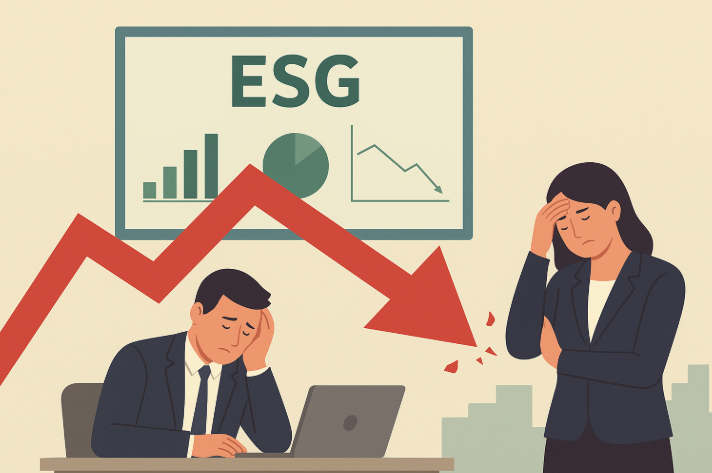
This is the ESG implementation gap — the space between what companies promise and what they are equipped to deliver.
🌩️ The ESG Strategies Gap: Big Plans, Little Execution
Across industries and countries, the story is familiar:
- ESG is seen as a reporting requirement, not a business priority
- Sustainability teams lack authority or resources
- Cultural resistance slows progress
- Core business units are not involved in designing commitments
- Ambitions rise faster than organisational capability
The result?
Sustainability becomes a presentation, not a practice.
⚠️ When Good Intentions Aren’t Enough: The H&M Example
H&M introduced an eco-friendly clothing line and talked a lot about sustainability — recycled fabrics, responsible sourcing, etc.
But the real world looked different:
- Fast fashion depends on huge volumes and quick turnover, which clashes with sustainability.
- Much of the supply chain beyond the first tier couldn’t be fully traced.
- Their clothing recycling program collected many garments — but very few could actually be turned into new ones.
- Operational teams weren’t aligned; sustainability stayed in marketing.
What happened next?
Watchdogs challenged some claims, regulators investigated, and H&M faced trust issues.
Simple insight:
If a company’s business model doesn’t support its sustainability goals, even strong intentions fall apart.
🌱 When ESG Is Real, Not Cosmetic: Patagonia
Patagonia shows what genuine sustainability looks like:
- They design products that last a long time and can be repaired.
- They tell customers to buy only what they need — rare for a retailer.
- They know exactly where their materials come from.
- Environmental experts work directly with product and operations teams, not separately.
Patagonia’s reward?
- Loyal customers
- Premium pricing
- Brand trust
- Consistent long-term growth
Simple insight:
When sustainability is built into the business model, it strengthens both impact and profits.
🧩 Five Common Reasons ESG Fails
1. Plans are created without the people who must deliver them
If business units aren’t involved, execution collapses.
2. Companies set huge targets but allocate tiny budgets
Ambition without resources leads nowhere.
3. No single owner for ESG outcomes
“Shared responsibility” often results in no responsibility.
4. ESG metrics go into external reports, but not internal dashboards
If it’s not measured daily, it won’t improve.
5. Culture quietly resists change
Employees comply on paper but continue business as usual.
🌍 A National-Scale Lesson: Guyana’s Rapid Growth Challenge
Guyana discovered massive offshore oil reserves, becoming one of the fastest-growing economies almost overnight. But their systems were not yet ready for such a leap.
Early challenges:
- Limited expertise to negotiate complex oil contracts
- Public expecting immediate wealth
- Environmental systems still developing
But Guyana also did several things right:
- Adopted global transparency standards
- Built a sovereign wealth framework
- Sought international expertise
- Implemented changes in phases
Simple insight for companies:
Don’t make big promises faster than your organisation can build the capability to support them.
🧭 How Successful Companies Make ESG Part of Strategy
Companies that excel treat ESG as a lens for financial decisions, innovation, operations, and risk — not as an add-on.
🔋 1. ESG in Investment Decisions: Ørsted
Over 10 years ago, Ørsted was a fossil fuel company.
Instead of investing more in coal and gas, they studied climate risks and renewable opportunities.
Their conclusion?
The future belonged to clean energy.
They sold most fossil assets and invested heavily in offshore wind.
Today, Ørsted is one of the world’s top renewable energy companies with strong growth and investor trust.
Simple insight:
Looking ahead and investing in low-carbon technologies early can completely transform a company’s future.
🔗 2. Fixing the Supply Chain: Interface
Interface makes carpet tiles — a product that usually involves a lot of plastic.
They discovered their biggest environmental impact came from materials, not manufacturing.
So they:
- Helped suppliers redesign materials
- Shared technology
- Offered fair pricing and long-term contracts
- Increased use of recycled materials
They reduced costs and emissions significantly.
Simple insight:
If you want a greener supply chain, you must help suppliers get there — not just demand it.
🚗 3. Using ESG to Drive Innovation: Tesla
Traditional car companies made electric vehicles mainly to satisfy regulations. They invested little and delivered basic products.
Tesla did the opposite:
- Made EVs faster, safer, and more exciting
- Built charging networks
- Integrated smart software
- Treated sustainability as a business opportunity, not a burden
The market rewarded them with a high valuation and a strong brand.
Simple insight:
When you treat sustainability as a chance to innovate, not a rule to follow, you create breakthrough products.
🔥 4. When ESG Failures Become Disasters: PG&E
PG&E operated ageing power lines in a region becoming hotter and drier due to climate change.
They didn’t update infrastructure fast enough.
One failing power line triggered a massive wildfire:
- 85 people died
- Huge financial losses
- The company went bankrupt
Simple insight:
Ignoring climate risk can lead to catastrophic business consequences.
🚢 5. Turning ESG Into Daily Performance: Maersk
Maersk, a global shipping giant, made ESG practical by putting sustainability metrics into:
- Daily operational dashboards
- Monthly reviews
- Investment decisions
- Procurement guidelines
- Product offerings (like low-carbon shipping options)
This helped them cut emissions, save fuel costs, and attract premium customers.
Simple insight:
ESG works only when it becomes part of everyday decision-making.
🧠 Culture: The Most Important ESG Tool
The companies that truly change focus on:
- Leadership behaviour
- Employee training
- Incentives tied to ESG
- Role-specific responsibilities
- Frequent communication
When people understand how their job connects to sustainability, real change finally happens.
🚀 A Realistic ESG Roadmap
Year 1 — Set the foundation
Governance, baselines, training, early integration steps.
Years 2–3 — Embed ESG across the business
Supply chain, product design, R&D, risk management, capital allocation.
Years 4–5 — Deliver results
Lower emissions, new revenue from green products, stronger brand trust, industry leadership.
⭐ The Final Question Every Leader Must Ask
Are we using ESG to protect the old business…
or to build the business the future demands?
Companies that choose the second path — and execute with discipline — are already gaining customer trust, investor confidence, and long-term advantage.
The examples are clear.
The lessons are simple.
The time to act is now.
Read more blogs here.
🔗 McKinsey – “Does ESG really matter—and why?”
https://www.mckinsey.com/capabilities/sustainability/our-insights/does-esg-really-matter-and-why