


Table of Contents
Women Empowerment:
Women empowerment refers to the process of increasing the social, economic, political, educational, and legal strength of women, enabling them to have equal rights, opportunities, and freedoms in all spheres of life.
Key aspects:
- Economic Empowerment: Giving women the means to earn a livelihood, own property, access financial resources, and become financially independent.
- Educational Empowerment: Ensuring equal access to quality education so women can pursue careers, become leaders, and make informed decisions.
- Social Empowerment: Eliminating gender-based discrimination, violence, and stereotypes, and allowing women to live with dignity and respect.
- Political Empowerment: Increasing women’s participation in politics, governance, and decision-making at all levels.
- Legal Empowerment: Ensuring that women know their rights and have access to justice, protection under the law, and equal treatment.
Why It Matters:
- Empowers families and communities.
- Reduces poverty and promotes development.
- Leads to better education and health outcomes for future generations.
- Builds a more just and equitable society.
In Simple Words:
Women empowerment means giving women the freedom to choose, the voice to speak, and the power to lead.
🌏 Global Gender Gap Report 2025
By World Economic Forum:
- Overall Rank: India is placed 131st out of 148 countries, slipping two places from its 2024 position of 129th.
- Gender Parity Score: 64.4% (an improvement of +0.3 percentage points over 2024).
Regional Comparison (South Asia 2025):
| Country | Global Rank |
|---|---|
| Bangladesh | 24 |
| Bhutan | 119 |
| Nepal | 125 |
| Sri Lanka | 130 |
| India | 131 |
| Maldives | 138 |
| Pakistan | 148 |
Here’s a visual comparison of South Asian countries based on the Global Gender Gap Index 2025. As shown:

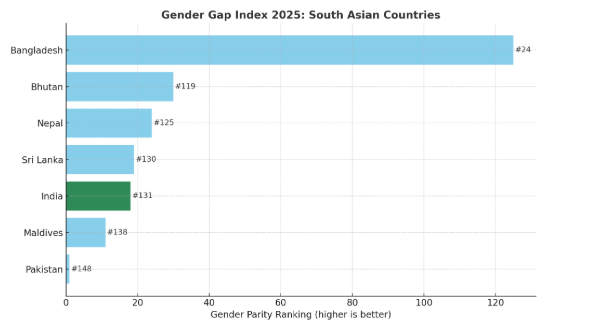
- India ranks 131st, lagging behind countries like Bangladesh (24th) and even Nepal (125th).
- Only Maldives and Pakistan rank lower in the region.
This highlights the significant room for improvement in gender parity efforts in India, especially in political and economic empowerment.
✅ Key Takeaways
- Despite marginal gains, India’s overall gender parity remains low, ranking among the bottom quarter globally.
- Strong performance in education (near parity) and health.
- Severe gaps persist in economic participation and particularly in political empowerment.
- While the gender parity score improved slightly, many neighbouring countries outperform India in closing the gap.
In summary:
India is currently ranked 131st globally on the WEF’s Gender Gap Index (64.4% parity), alongside moderate gains in economic participation, education, and health, but declines in political empowerment Reference.
Its position is among the lowest in South Asia. On the UN’s GII, India ranks 102nd, showing progress but still far from equality.
📉 Key Facts: India’s Gender Gap in Employment (2025)
India faces a significant gender gap in employment, with one of the lowest female labor force participation rates in the world. Despite improvements in education, women’s access to paid, secure, and dignified work remains limited and unequal.

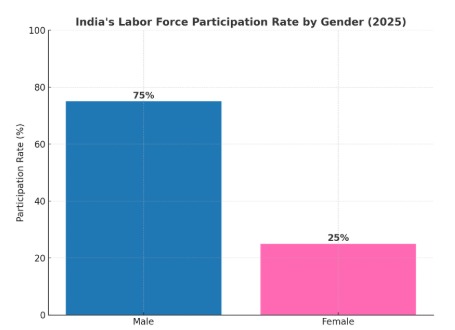
🚺 Female Labor Force Participation Rate (FLFPR):
- Only ~25% of Indian women (aged 15 and above) are part of the labor force.
- In contrast, ~75% of Indian men are economically active.
- Globally, India ranks among the bottom 10 countries in this metric.
⚙️ Employment Type:
- Most working women are engaged in informal, low-paid, and unprotected jobs, such as:
- Agricultural labor
- Domestic work
- Garment and textile industries
- Very few women hold formal jobs or leadership roles in corporate or government sectors.
🔍 Reasons Behind the Gender Gap:
| Factor | Impact |
|---|---|
| Cultural & Family Norms | Pressure to prioritize household duties, early marriage |
| Safety Concerns | Fear of harassment in workplaces and public transport |
| Lack of Childcare | Women leave jobs after childbirth due to poor family support |
| Gender Pay Gap | Women earn 20–30% less than men for the same work |
| Education-Employment Disconnect | Educated women still struggle to find suitable opportunities |
| Limited Skill Development | Many lack access to skill training or financial literacy |
📊 Recent Trends (NFHS-5, PLFS 2024):
- Women’s work in agriculture is declining.
- Female unemployment among graduates is nearly 4x higher than male graduates.
- Urban women’s participation (around 19%) is lower than in rural areas (around 27%), reflecting a lack of urban job inclusion.
✅ What Can Help Reduce the Gap?
- Safe and inclusive workplaces
- Maternity and childcare support
- Skill development programs
- Flexible and remote work policies
- Awareness campaigns to change mindsets
✊ In Summary:
India’s gender gap in employment is not just an economic issue—it’s a social, cultural, and structural challenge. Empowering women to participate equally in the workforce will unlock enormous potential for India’s growth and development. Reference.
💰 Gender Pay Gap in India – A Persistent Inequality
The gender pay gap refers to the difference in average earnings between men and women doing the same or similar work. In India, this gap remains wide and is a major barrier to gender equality and women’s economic empowerment.
📊 Key Facts: Gender Pay Gap in India (2025)
| Sector/Role | Women’s Earnings (as % of Men) |
|---|---|
| Overall (all sectors) | ~77% (i.e., 23% pay gap) |
| Formal private sector | ~80–85% |
| Corporate C-suite | ~52–70% |
| Agriculture & Informal sectors | <70% |
| Skilled professionals | 85–90% |
📌 On average, women earn ₹77 for every ₹100 earned by men for the same work.
🧩 Why Does the Gender Pay Gap Exist?
| Cause | Explanation |
|---|---|
| Occupational segregation | Women are overrepresented in low-paying jobs (teaching, caregiving, etc.) |
| Fewer women in leadership | Leadership roles with higher pay are mostly held by men |
| Unpaid care work | Women take career breaks for childcare or elder care |
| Discrimination | Women are often offered lower starting salaries than men |
| Lack of pay transparency | Salary structures are rarely open, making it hard to detect bias |
📉 Impact of the Gender Pay Gap:
- Reduces women’s lifetime earnings, savings, and retirement security.
- Reinforces economic dependence and inequality.
- Deters girls and women from entering high-value fields (STEM, business).
- Limits the country’s GDP potential—studies show that equal pay could boost India’s GDP by over 27%.
⚖️ What Can Help Close the Gap?
- Equal Pay for Equal Work enforcement (as per Equal Remuneration Act).
- Pay transparency and salary audits in companies.
- Promotion of women in leadership roles and high-paying industries.
- Flexible work policies to retain mid-career women.
- Encouraging women in STEM, finance, and entrepreneurship.
🛎️ In Summary:
India’s gender pay gap is a systemic issue, not just about individual choices. Closing the gap isn’t just fair—it’s smart economics. A more equal pay system will benefit women, families, and the nation as a whole.
🧨 Domestic Violence in India – A Deep Issue
Domestic violence in India is a serious and widespread issue affecting women across all classes, religions, and regions. It includes physical abuse, emotional torture, sexual violence, economic control, and verbal harassment, often behind closed doors.
⚖️ Legal Definition:
Under the Protection of Women from Domestic Violence Act, 2005, domestic violence is:
“Any act, omission or commission or conduct of the respondent that harms or threatens to harm the health, safety, life, limb or well-being of the woman.”
This includes:
- Physical abuse (hitting, slapping, pushing, etc.)
- Emotional abuse (insults, threats, humiliation)
- Sexual abuse
- Economic abuse (withholding money, controlling finances)
📊 Shocking Statistics (NCRB & NFHS-5 Data):
- 1 in 3 Indian women (aged 18–49) has experienced physical or sexual violence.
- Only ~14% of women who experience violence seek help, mostly from family, not police.
- During the COVID-19 lockdown, reports of domestic violence surged by over 50%.
🚨 Why It Continues:
- Deep-rooted patriarchy and gender inequality.
- Fear of social stigma and victim-blaming.
- Financial dependence on the abuser.
- Weak law enforcement or delayed justice.
- Lack of awareness about rights and support systems.
🛡️ Support & Helplines:
- National Commission for Women (NCW) Helpline: 7827-170-170
- Women’s Helpline Number (All India): 1091
- Legal aid and shelter homes (Mahila Shakti Kendras, One Stop Centres) exist but are underused.
🔔 What Needs to Change:
- More awareness and education on gender rights.
- Stronger implementation of laws and faster justice.
- Economic empowerment of women to walk away from abuse.
- Societal support—not silence.
✊ In Summary:
Domestic violence in India isn’t just a personal issue—it’s a human rights violation. Real change will come when society stops tolerating silence and starts supporting survivors with empathy and action.
The Inspiring Journey of Kalpana Saroj
From Child Bride to Business Tycoon
Background:
Born in 1961 in a Dalit family in a small village in Maharashtra, Kalpana Saroj faced caste discrimination, poverty, and gender bias from an early age. At just 12, she was married off and sent to live in a slum in Mumbai with her abusive in-laws. She attempted suicide at 16 after enduring severe emotional and physical abuse.
Turning Point:
Rescued by her father, Kalpana returned home and decided to rebuild her life. She learned tailoring and started a small business with the help of a government loan of ₹5,000. She faced numerous challenges but never gave up.

Rise to Power:
Through sheer determination and entrepreneurial spirit, she eventually took over a struggling company—Kamani Tubes—a sick industrial unit. Everyone doubted her, but she revived the company, turned it profitable, and became one of India’s most successful entrepreneurs.
Recognition:
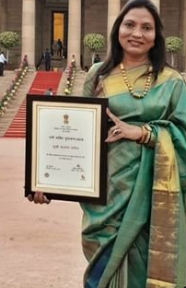
In 2013, she was awarded the Padma Shri, one of India’s highest civilian honors, for her contributions to trade and industry.
Why This Story Matters:
Kalpana Saroj’s story is a true example of women empowerment. She broke societal shackles, rose above poverty, fought against domestic violence, caste,gender discrimination, and proved that with courage and opportunity, women can lead with strength and purpose.
🌍 Why Women’s Day is Celebrated:
- To Recognize Women’s Contributions:
- It celebrates women’s achievements in various fields—science, business, politics, arts, education, and more.
- It honors trailblazers like Kalpana Chawla, Indira Gandhi, Kiran Mazumdar-Shaw, and countless others.
- To Raise Awareness:
- Highlights issues like gender pay gaps, domestic violence, lack of education, reproductive rights, and workplace discrimination.
- Reminds the world that true equality is still a work in progress.
- To Inspire Change:
- Encourages governments, organizations, and individuals to take action toward creating equal opportunities.
- Promotes initiatives that empower women economically, socially, and politically.
- To Celebrate Unity and Solidarity:
- Brings people of all genders together in support of a more inclusive, respectful, and fair world.
- Supports women’s movements around the globe that are pushing for lasting change.
🕊️ Historical Background:
- Originated from labor movements in the early 1900s in Europe and the US.
- Officially recognized by the United Nations in 1977.
- Every year has a different theme, like “Gender equality today for a sustainable tomorrow” or “DigitALL: Innovation and technology for gender equality”.
- Video link
💬 In Simple Words:
Women’s Day is not just a celebration—it’s a call for respect, equal rights, and opportunities for every woman, everywhere.
Happy Women’s Day
Women’s Day is more than a date on the calendar—it’s a reminder, a movement, and a mission. While we honor women on March 8th, true empowerment comes when we celebrate, support, and uplift women every single day.
Let us not wait for a special occasion to recognize the strength of a mother, the determination of a daughter, or the leadership of a colleague. Every day is a chance to break stereotypes, fight inequality, and build a world where women rise without fear, without limits.
💪 Strong Call to Action for Women Empowerment
It’s time to move beyond words and take action. Women’s empowerment isn’t just a cause—it’s a responsibility, a movement, and a foundation for a just society.
🔥 Stand Up. Speak Out. Step In.
- Raise your voice against inequality and discrimination.
- Support and mentor women in your workplace and community.
- Vote for and elevate women leaders in politics, business, and society.
- Educate the next generation to believe in equal rights and respect.
- Invest in women—their dreams, their businesses, their ideas.
- Challenge stereotypes, break glass ceilings, and create spaces where women thrive.
Enough of silent competition and hidden envy. It’s time for women to rise by lifting one another.
One woman supporting another is not weakness—it’s power in motion.
🌟 Stand up for a sister. Speak up for the silenced. Share your knowledge. Celebrate her win.
Because when one woman stands tall, others find the courage to rise too.
Let’s stand side by side and build a world where every woman shines.
✨ Start today. Support one woman—and watch the ripple change everything.
🌍 Because when one woman rises, she lifts an entire community.
Let’s build a world where every woman is seen, heard, safe, and unstoppable.
🚀 Don’t wait. Empower a woman today—because empowerment is the real revolution.
🌸 Top 10 Women’s Day Quotes
- “Here’s to strong women: May we know them, may we be them, may we raise them.”
- “A woman is the full circle. Within her is the power to create, nurture, and transform.”
— Diane Mariechild - “She believed she could, so she did.”
- “There is no limit to what we, as women, can accomplish.”
— Michelle Obama - “You don’t have to play masculine to be a strong woman.”
— Mary Elizabeth Winstead - “The future is female.”
- “A strong woman stands up for herself. A stronger woman stands up for everyone else.”
- “Empowered women empower the world.”
- “Women are the real architects of society.”
— Harriet Beecher Stowe - “Celebrate her for her strength, honor her for her resilience, and respect her for her voice.”
Read our post Tribute to Indian Women Warriors here.