


Table of Contents
🚩Priya’s Story


It started on Priya’s first day.
Priya already had a decade of diverse experience across industries, worked with different companies, full of data-backed ideas for customer engagement, she was upskilled with all the latest certifications & was thrilled to join one of the city’s most respected companies.
What she never imagined was stepping into a culture that felt less like a workplace and more like a guarded fortress of sameness. To her shock, long-tenured colleagues were elevated a full band above her — even without crucial certifications or real customer-facing experience — simply because they had “been around.”
The Closed Club: Long Tenure Over Merit
The company’s proudest claim?
“Majority of our workforce are long tenure employees. Most joined us as their first job after their college and never left“
The work anniversary culture — emails and company-wide shoutouts for every milestone — while intended to be positive, became a subtle tool of hierarchy.
- Those with 1- or 2-year tenures inside the company barely got noticed.
- For few lateral hires although they did bring decades of experience from outside,they were ignored, treated like outsiders in someone else’s house.
- Those with 15- or 20-year anniversaries were celebrated like royalty. Given lot of respect.
Company’s another proud claim –
“We promote 95% from within. We’re a family.”
But in practice, this “family” was a gated community.
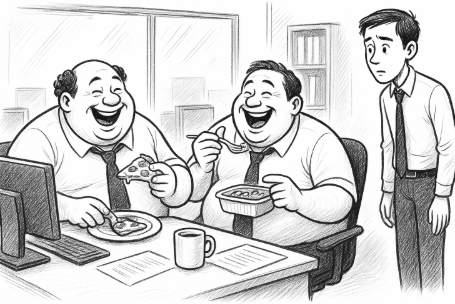
Majority had been there for over a decade. They knew each other’s families, routines, and inside jokes — and their biases ran deep. Respect was given based on tenure, because the company culture itself equated years served with worth. Old-timers were automatically valued and supported, while new joiners were subtly dismissed, ignored, or treated as outsiders — a hierarchy built not on merit, but on how long you’d been in the building.
The Inner Circle of Tenure
In every meeting, the long-tenured employees formed an unspoken circle of power. Colleagues lingered around them, offering flattery and agreement, knowing that siding with the veterans meant safety and influence. For new lateral hires bringing fresh ideas, there was no such support. Their suggestions were met with silence, eye-rolls, or quick dismissals — no one dared stand beside them. Over time, this loyalty-to-tenure culture crushed innovation and left talented newcomers isolated.
HR’s Tenure-First Policy
The company’s HR policies were designed to keep long-serving employees a full band above any external hires, no matter the skills or experience the new joiners brought. Lateral hires were denied authority to lead teams or take key decisions — all power remained in the hands of long-tenured staff. This was an intentional retention strategy, aimed at motivating employees to stay for decades and avoid replacement costs. But over time, it handed disproportionate influence to complacent veterans while silencing fresh, diverse perspectives. Customers’ needs were ignored, innovation stalled, and the business paid the price for protecting tenure over performance.
Manager’s Role: Protecting Comfort Over Progress
The real problem wasn’t just the employees — it was leadership’s bias.
Long-tenured staff were considered “safe bets” for promotions, their opinions weighed more heavily than fresh perspectives. Any idea that broke tradition was “too risky” or “not our culture.”
The result? An echo chamber where decisions were recycled, innovation stalled, and the market moved on without them.
When Managers Put Themselves Before the Company
The Dark Side of Pulse Surveys
Priya’s company ran pulse surveys twice a year to gauge employee sentiment and gather feedback on managers. While these surveys promised anonymity, some managers treated them like a personal threat. Instead of addressing the concerns raised, they tried to guess who had given critical feedback — not to improve, but to retaliate. Outwardly, they encouraged open feedback to appear compliant with company policy. Behind the scenes, they watched employee behavior closely, identifying potential critics and subtly pushing them out through constant harsh treatment and isolation.
Priya’s manager was one of them — quick to see her honesty and courage as a threat. Her habit of speaking her mind without fear wasn’t valued; it was seen as a danger to his personal survey ratings.
When Customer’s Voice Was Ignored
During a client workshop, a major customer highlighted a critical pain point that, if fixed, could significantly improve their experience. Priya took the request seriously — it was exactly the kind of market feedback she believed the company needed to act on.
But when she brought it to the project team, the old-tenure employees shrugged it off.
“We’ve heard that before. It’s not a priority,” one said, without even reviewing the details.
Priya escalated it to the team lead and manager, expecting them to back the customer’s needs. Instead, they sided with the old-timers. Their loyalty wasn’t to the customer or the company’s long-term success — it was to the comfort of their long-serving colleagues.
For weeks, Priya kept urging them to initiate work on the issue. Each time, her request was either postponed or ignored entirely. The result? The customer’s concern went unaddressed, and the company sent a quiet but dangerous message: internal harmony mattered more than market responsiveness.
In a company where pulse surveys asked teams to rate their managers — and most team members were complacent old-timers — the manager’s priority was keeping them happy for good feedback, choosing personal ratings over the customer’s needs and the company’s future.


Priya soon found herself isolated. The manager turned against her, labelling her “stubborn” and “not a team player” simply because she wouldn’t blindly follow the long-tenured clique. In one-on-ones, his relentless criticism chipped away at her confidence, leaving her anxious, sleepless, and physically drained. Every morning became a battle just to face the workday. In the end, Priya chose to walk away — not because she lacked commitment, but because the toxic culture was destroying her mental and physical health.
The manager’s treatment of Priya was neither just nor fair — it crossed into emotional and psychological abuse.
When a leader uses their authority to isolate, label, and repeatedly criticize an employee for holding a different view, it becomes toxic.
Abusive managers erode trust, harm mental and physical health, and push talented employees out — all while protecting their own image.
The Illusion of Success
Months after Priya left, the company was still posting glossy photos of promotional events — award nights, product launches, and work anniversary celebrations. The leadership beamed on stage, confident the business was thriving. What they didn’t see was the quiet erosion beneath the surface: loyal customers becoming unhappy, sincere, customer-focused employees like Priya walking out the door, disheartened by the bias and mistreatment from their managers.
The top leadership, far removed from day-to-day realities, never grasped that their trusted managers were shielding complacent old-timers, punishing dissent, and sidelining fresh thinking. The events looked good on social media, but behind the curtain, the company was losing the very talent that could have carried it into the future.
Governance Watch Alert: Internal Hiring Complacency
Red Flag: Over 80% hiring from within for years + long tenure dominance → Groupthink, resistance to change, loss of market agility.
Red Flag: Managers prioritizing personal image in employee surveys by siding with complacent old-timers, even at the cost of customer satisfaction and company growth.
Priya’s experience was more than just a workplace clash — it was a live demonstration of every warning sign in the Governance Watch Alert. A manager protecting complacent old-timers for personal survey scores, leadership ignoring customer needs, and a culture rewarding internal tenure over performance — all of it converged to push away a talented, customer-focused employee. In the end, the company didn’t just lose Priya; it lost trust, market responsiveness, and a piece of its future. That’s the true cost when governance fails.
Best Practice Ratios:
- Internal to External Hiring (senior roles): 60:40 for balanced continuity and fresh thinking.
- Diversity Representation in Workforce: At least 40% across gender, ethnicity, age, and educational background.
- Board Diversity: Minimum one-third independent directors with varied professional and cultural backgrounds.
Warning Signs to Watch:
- New hires Exit.
- Meetings dominated by long-timers.
- Decisions dominated by long-timers.
- Same decision-makers for 5+ years with no external rotation.
- Social recognition skewed toward tenure instead of innovation or results.
- Managers safeguarding old complacent employees to secure positive survey feedback, ignoring market needs.
🚩Why This is a Corporate Governance Red Flag
This isn’t just a culture issue — it’s a boardroom-level governance concern.
- Lack of independent thought – Like a board packed with loyalists, a workforce of long-timers can’t challenge flawed assumptions.
- Groupthink risk – Without outside viewpoints, blind spots grow until they become costly mistakes.
- Inertia in decision-making – Slow adaptation to market changes erodes competitive advantage.
- Hostile climate for diversity – New hires leave, taking innovation with them.
The Business Cost of This Blind Spot
- Innovation dies: Competitors outpace you in product, tech, and customer experience.
- Talent drain: High performers from diverse backgrounds leave for places where they can thrive.
- Brand erosion: Employer reputation suffers, making it harder to attract top talent.
- Market irrelevance: You’re the last to notice when customers’ needs change.
🚩Case Study 1: Nokia – A Lesson in Market Adaptation
Nokia, once the world’s leading mobile phone manufacturer, is now frequently cited in business schools as an example of how market leaders can lose ground.
According to multiple analyses, including reports in Harvard Business Review and The Guardian, Nokia’s leadership team was predominantly composed of long-serving executives who had grown within the company. While this brought stability, it also created a culture that favored established ways of working.
Industry analysts note that when smartphones with touch interfaces gained popularity in the late 2000s, internal decision-making processes were slow to adapt. New ideas and external insights reportedly struggled to gain traction in the company’s strategy discussions.
By the time Nokia shifted focus, Apple’s iPhone and Android competitors had captured significant market share. This case is often used as an illustration of how insularity and slow responsiveness can hinder even the most successful organizations.
Sources:
- Harvard Business Review, “The Real Reason Nokia Lost Its Way” (2016)
- The Guardian, “Nokia: Rise and Fall of a Mobile Phone Giant” (2013)
🚩Case Study 2: Air India – Cultural Transformation After Ownership Change
Prior to its acquisition by the Tata Group in January 2022, Air India faced challenges related to service standards, operational efficiency, and financial performance.
As reported by Economic Times and Business Standard, the airline had a workforce with a high proportion of long-serving employees. While this provided operational familiarity, experts and analysts observed that it also led to a deeply entrenched internal hierarchy.
Some industry commentators suggested that new hires and lateral entrants from outside the airline sometimes found it challenging to integrate and influence established processes. Customer satisfaction surveys during this period reflected ongoing concerns about delays and service quality.
Since the Tata Group takeover, Air India has embarked on a restructuring program aimed at modernizing operations, improving service quality, and introducing new leadership practices to refresh its culture.
Sources:
- Economic Times, “Air India Set for Makeover Under Tata Group” (2022)
- Business Standard, “Air India: From Maharaja to Turnaround Story” (2022)
🗣 Call to Action: Break the Echo Chamber
If you’re on a board, in senior management, or an HR decision-maker, treat cultural insularity as seriously as financial misreporting.
- Audit hiring patterns annually for internal vs. external ratios, ensuring a healthy balance.
- Tie leadership KPIs to diversity, inclusion, and innovation goals — not just tenure or internal harmony.
- Reform pulse surveys so they don’t become popularity contests; weight results with objective performance metrics and customer impact.
- Train managers to handle diverse opinions respectfully, rewarding those who prioritize customers and company goals over personal ratings.
- Assess and develop leaders for emotional and spiritual health, ensuring they don’t retaliate against dissent but instead keep company welfare and customer needs at the top of their ethical priority list.
- Create structured onboarding with internal advocates to support new hires.
- Reward openness — make the adoption of new ideas part of performance reviews.
- Rotate roles and responsibilities to prevent entrenched comfort zones.
Final Word:
Loyalty is an asset — but blind loyalty is a liability. When everyone thinks alike, it’s not teamwork — it’s groupthink. The best-run companies know that stability and fresh thinking are not enemies. They’re the twin engines of sustainable growth.
Companies must implement zero-tolerance policies for retaliation, train leaders in emotional intelligence, and create truly anonymous reporting channels so employees can speak up without fear of being targeted.
When managers shield complacent old-timers for personal gain and leadership rewards tenure over results, it’s not just a culture issue — it’s a corporate governance failure that drives away talent, customers, and the company’s future.
Read our blogs on Corporate Governance here.
Reference: Harvard Business Review – Why Diverse Teams Are Smarter link