



A practical, story-driven guide with real-world examples
Table of Contents
In today’s fast-changing world, companies are under unprecedented pressure—from regulators, investors, customers, employees, and even the planet—to act responsibly and transparently. But the challenge is real:
How do you decide which ESG issues truly matter?
Which ones deserve board attention?
And how do you manage stakeholders with conflicting priorities?
This is where materiality assessment and stakeholder engagement become the strategic backbone of ESG leadership.
Let’s explore them through stories, real-world examples, and lessons from companies that got it right—and those that paid the price for ignoring them.
1. What Is Materiality? The Art of Choosing What Really Matters
Materiality is about identifying the ESG issues that can significantly impact a company’s financial performance and/or create substantial impact on stakeholders.
Think of it as corporate triage:
What could truly make or break your business?
Most companies face dozens of ESG issues—climate, labor, waste, cybersecurity, human rights, diversity, water, supply chain ethics. But only some are material, meaning:
- They influence long-term value creation
- They affect critical stakeholder groups
- They pose strategic, reputational, or regulatory risk
A robust materiality assessment cuts through the noise.
2. Why Materiality Matters: Lessons From the Real World
Volkswagen Emissions Scandal — Ignoring a Material Issue
VW treated emissions compliance as a technical issue, not a material governance risk.
Outcome?
- €30 billion in fines
- Years of reputational damage
- Loss of investor trust
Materiality blind spot: Ethics of engineering & transparent reporting.
Tesla’s Labor Relations Blind Spot
Tesla focused heavily on innovation and safety but underestimated labor issues—union tensions, worker fatigue, injuries.
Materiality blind spot: Workforce welfare.
Lesson: Social issues can become as financially material as environmental ones.
Wells Fargo — Culture Is Material
The bank ignored its toxic sales culture until it became a multi-billion-dollar crisis.
Materiality blind spot: Employee incentives, ethics, and governance.
Lesson: Internal culture is not “soft”—it can bankrupt trust.
Ørsted — Materiality as a Strategic Weapon
Once a fossil-heavy energy company, Ørsted used materiality to pivot toward offshore wind.
Outcome?
- 87% emissions reduction
- A complete brand transformation
- Global clean energy leadership
Materiality strength: Long-term strategic alignment.
3. Building a Materiality Matrix: A Simple, Powerful Tool

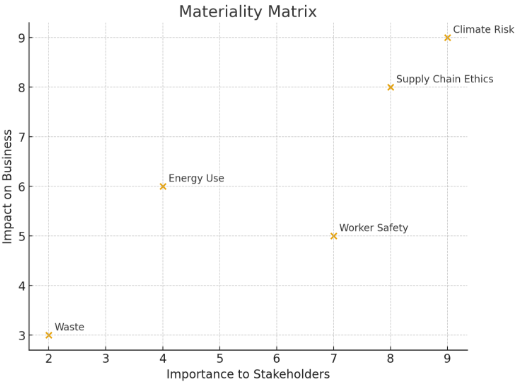
A materiality matrix maps ESG issues across two key dimensions:
1. Business Impact (Financial & Operational Risk)
- Does it affect costs, revenue, supply chain stability, or compliance?
2. Stakeholder Importance (Social & Reputational Impact)
- Do regulators, customers, communities, employees, or investors deeply care?
Example:
In the auto sector, battery safety, supply chain ethics, and worker reskilling sit in the top-right quadrant—high business impact, high stakeholder interest.
That’s where board focus is needed.
4. Double Materiality: When Impact Matters as Much as Financials
Europe’s CSRD introduced the concept of double materiality:
- Financial Materiality: Could this ESG issue affect the company’s value?
- Impact Materiality: Could the company’s actions harm society or the environment?
Example:
For a beverage company in India, water scarcity is both:
- Financial risk (plant shutdowns)
- Social risk (community protests, environmental impact)
But in Norway, with abundant water, the materiality changes.
Context matters. Geography matters. Stakeholders matter.
5. Stakeholder Engagement: Turning Friction into Strategy
Identifying what matters is only half the battle.
The real challenge: Stakeholders rarely agree.
Different stakeholders = Different concerns = Conflicting priorities.
A mature company maps them using a Power–Interest Grid:
- High power, high interest: Regulators, governments, major investors
- High power, low interest: Large institutional shareholders
- Low power, high interest: Communities, NGOs, employees
- High influence groups: Media, civil society, activists
Each group sees risk differently.
6. Real-World Stakeholder Conflict Examples
1. Apple & Supplier Labor Practices (China)
Stakeholders involved:
- Workers (interest in conditions)
- NGOs (interest in human rights)
- U.S. government (power due to geopolitical tension)
- Investors (concerned about brand risk)
Materiality outcome:
Labour rights + supply chain ethics become high-priority issues.
2. Nestlé & Palm Oil Sourcing
Conflicting views:
- NGOs: Deforestation and biodiversity
- Farmers: Income security
- Consumers: Ethical products
- Governments: Land use policies
Materiality outcome:
Deforestation became a top-tier risk, leading to stricter supplier requirements.
3. Auto Manufacturers & EV Battery Supply Chains
Example from India:
Choosing Chinese suppliers triggers:
- National security concerns
- Investor ESG scrutiny
- Customer safety worries
- Worker job concerns
- NGO pressure on mineral ethics
Stakeholder engagement becomes a strategic tool, not a communication exercise.
7. Why Companies Fail at Materiality & Stakeholder Engagement
Most failures come from:
- ❌ Treating ESG as compliance
- ❌ Assuming stakeholders have the same priorities
- ❌ Underestimating ethics and human rights
- ❌ Focusing on technology but ignoring people
- ❌ Not updating materiality regularly
The world changes. Stakeholders change.
Materiality must evolve too.
8. A 5-Step Blueprint: How Companies Can Get It Right
1. Identify potential ESG issues
Use sector benchmarks, peer analysis, standards (SASB, GRI, CSRD).
2. Engage stakeholders early
Before announcing strategies—not after.
3. Map issues on a materiality matrix
Highlight the top-right quadrant (board focus areas).
4. Integrate into strategy & KPIs
Tie material issues to budgets, executive KPIs, risk systems.
5. Communicate transparently
Regular disclosures, dashboards, and honest updates build trust.
9. The Big Insight: ESG Is Not About Reporting—It’s About Risk, Trust & Growth
Materiality assessment is not an ESG “task.”
It is strategic risk management.
Stakeholder engagement is not “PR.”
It is conflict resolution, trust-building, and future-proofing.
Companies that understand this become leaders.
Companies that ignore it learn the hard way.
10. Final Thought: The Future Belongs to the Materiality-Mature
In a world of climate shocks, social tensions, geopolitical uncertainty, and rapid technology shifts—materiality is the compass. Stakeholder engagement is the map.
Together, they help businesses answer the only question that matters:
“What do we need to focus on today to be trusted, resilient, and relevant tomorrow?”
The companies that master this will not just survive the ESG era—they will define it.
🔔 Call to Action: Let’s Build the Future Together
Whether you are an investor, employee, customer, supplier, community partner, or regulator, your voice shapes what truly matters.
Join us in co-creating a transparent, resilient, and responsible future—participate in our materiality conversations, share your expectations, and help guide our sustainability priorities.
Together, we can turn shared insights into meaningful impact.
Read blogs on sustainability here.
Reference:
Global Reporting Initiative (GRI). GRI 3: Material Topics 2021. GRI Standards.
Available at: https://www.globalreporting.org/standards/gri-standards-download-center/