


Table of Contents
The Story Beneath the Surface
It was supposed to be just another day in the Gulf of Mexico.
On April 20, 2010, BP’s Deepwater Horizon rig exploded — a single failure in a vast chain of contractors, subcontractors, and safety systems.
What followed was one of the worst environmental disasters in history: 11 lives lost, 4.9 million barrels of oil spilled, and $65 billion in cleanup and penalties.
The cause wasn’t only a technical malfunction — it was a supply chain governance failure.
Multiple suppliers had cut corners on testing, oversight was fragmented, and sustainability risks were treated as peripheral.
In the aftermath, BP’s reputation sank, its stock price plummeted by 55%, and its name became synonymous with environmental negligence.
Halfway across the world, in 2013, another tragedy unfolded in Bangladesh.
The Rana Plaza garment factory collapsed, killing over 1,100 workers, many of whom made clothes for some of the world’s biggest brands — companies that had never set foot in that building, but had outsourced manufacturing to suppliers who did.
Those brands — from Primark to H&M — faced global outrage, consumer boycotts, and urgent pressure to prove they cared about the people behind their products.
Fast-forward to Germany, 2015.
Volkswagen’s Dieselgate scandal erupted when it was discovered that emissions testing software had been manipulated — not only internally, but with the knowledge of component suppliers.
The fallout? Over $30 billion in fines and recalls, and a massive trust deficit that still shadows the brand today.
Each of these events began far from corporate headquarters — in oil rigs, garment workshops, and automotive testing labs — but their impacts were seismic.
They reshaped balance sheets, destroyed brand equity, and forced a global reckoning on what it really means to be responsible.
Because in today’s interconnected world, what happens in the farthest corner of your supply chain can rewrite the story of your brand, your balance sheet, and your legacy.
Sustainable & Ethical Sourcing: From Cost to Conscience
Once upon a time, sourcing was all about the lowest cost per unit. Today, it’s about the highest integrity per decision.
Sustainable and ethical sourcing means looking beyond price tags to ask deeper questions — Who made this? Under what conditions? At what environmental cost?
True leadership in sourcing now lies in aligning procurement strategy with planetary and social responsibility. This means:
- Choosing suppliers who uphold fair wages, safe working conditions, and respect for human rights.
- Preferring materials that minimize environmental impact — recycled, renewable, or responsibly certified.
- Encouraging local sourcing to cut emissions and strengthen community economies.
Companies like Unilever, Patagonia, and Tata Steel have shown that ethical sourcing is not a trade-off — it’s a competitive advantage. By embedding sustainability into supplier selection, they’ve built resilience against regulatory shocks, enhanced brand trust, and attracted purpose-driven investors and customers.
In an era when transparency defines reputation, every purchase order is a moral statement — about what your brand stands for and the future it’s helping build.
The Invisible Giant in Your Supply Chain
Enter Scope 3 emissions — the silent majority of corporate carbon footprints.
For most industries, these indirect emissions account for up to 90% of total environmental impact, stemming from suppliers, logistics, product use, and end-of-life disposal.
Yet, they remain the least visible and hardest to control.
Companies may manage their own factories and fleets efficiently, but if their suppliers burn coal, waste water, or exploit labor, those risks — environmental and ethical — still belong to the brand.
Scope 3 is not just an emissions category.
It’s the mirror that reflects the true reach of your business responsibility.
♻️ Supply Chain ESG Is Now Strategic
The global conversation has shifted.
Supply chains are no longer cost centers — they are strategic assets defining brand credibility, investor confidence, and access to global markets.
- Regulations like the EU’s CSDDD and India’s BRSR Core are forcing companies to disclose ESG risks in their supply chains.
- Investors now price sustainability into valuation and risk premiums.
- Consumers are voting with their wallets, demanding ethical and traceable sourcing.
ESG isn’t about compliance anymore — it’s about competitive advantage and resilience.
🧭 The Board’s Dilemma: Visibility vs. Control
For most boards, the challenge isn’t awareness — it’s accountability without control.
Companies are expected to manage ESG risks that often lie several tiers deep in supplier networks they don’t own, don’t audit regularly, and sometimes don’t even know exist.
This is the modern boardroom paradox:
You’re held responsible for what happens across your value chain — but your visibility ends long before your accountability does.
🔍 The Visibility Gap
Even large enterprises often lack real-time insight into the ESG performance of Tier 2, 3, and 4 suppliers. These distant nodes — small subcontractors, raw material extractors, or local logistics providers — are where violations and disruptions most often originate.
Yet, they remain the hardest to monitor due to fragmented reporting, data silos, and opaque intermediaries.
As a result, boards face blind spots that can become reputational or financial landmines.
When a crisis surfaces — child labor in a Tier 3 supplier, a pollution leak in an offshore vendor’s facility — the public doesn’t differentiate between “our supplier” and “our responsibility.”
⚙️ The Control Challenge
Traditional governance frameworks were never designed for today’s hyper-connected supply chains. Boards must now think beyond financial oversight and integrate sustainability risk governance into strategic decision-making:
- ESG-linked KPIs embedded into procurement and vendor performance reviews
- Technology-backed monitoring systems that provide dynamic, verifiable supply chain data
- Cross-functional ESG committees that bridge sustainability, finance, and risk management
The goal isn’t total control — it’s credible oversight built on transparency, data, and accountability.
🧩 The Path Forward
Progressive boards are redefining governance by demanding visibility as a strategic asset. They invest in supply chain traceability tools, mandate supplier ESG training, and link executive pay to sustainability metrics.
The future board will not just ask, “Are our numbers right?”
It will ask, “Are our values visible — all the way down the supply chain?”
ESG-Compliant Sourcing Process: Building Integrity Into Every Purchase
Embedding ESG principles into sourcing isn’t a one-time compliance task — it’s an ongoing process of alignment, assessment, and accountability. A structured ESG-compliant sourcing process helps companies turn ethical intentions into measurable actions.

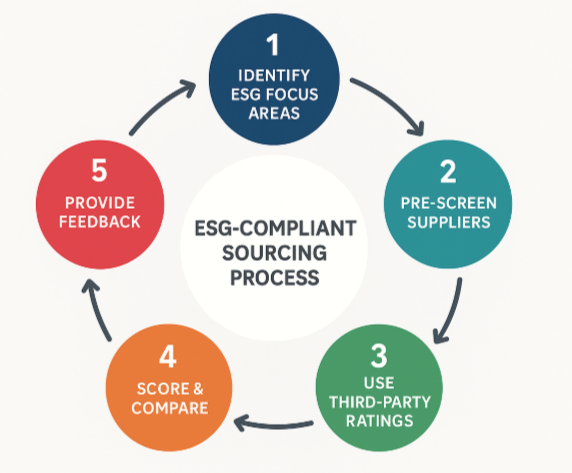
1. Identify ESG Focus Areas
Start by defining what ESG means for your business. For a mining company, it may mean carbon emissions and worker safety; for a consumer brand, fair labor and sustainable packaging. Align ESG priorities with both your industry context and your company’s core values.
2. Pre-Screen Suppliers
Before onboarding, request transparency. Ask suppliers to disclose ESG data — such as environmental policies, energy and water usage, diversity practices, and third-party certifications. This step sets expectations from day one and builds a culture of openness.
3. Use Third-Party Ratings
To ensure credibility, validate supplier claims using trusted data platforms like EcoVadis, MSCI, or Sedex. These rating systems provide independent verification and help benchmark performance across industries and regions.
4. Score & Compare
Integrate ESG performance into your supplier evaluation model — alongside traditional parameters like cost, quality, and delivery. This ensures procurement decisions balance value creation with values alignment. A supplier with a lower carbon footprint or better governance should score higher, even if slightly costlier.
5. Provide Feedback & Support
ESG sourcing is about partnership, not punishment. Offer clear, time-bound feedback and improvement plans for suppliers who fall short. Encourage knowledge sharing and capacity building — because when your suppliers improve, your entire value chain becomes more resilient and responsible.
The best supply chains aren’t just efficient — they’re ethical, transparent, and built on shared purpose.
🚩 Sourcing Red Flags To Watch For
| Red Flag | What It Signals | Why It Matters |
|---|---|---|
| Prices significantly below market | Possible exploitation or cost-cutting corners | Indicates unethical or unsustainable practices that may trigger reputational and compliance risks |
| Reluctance to allow facility visits | Supplier may be hiding poor labor or environmental conditions | Blocks transparency and prevents proper due diligence |
| High supplier turnover | Transactional or unstable relationships | Limits long-term collaboration and continuous improvement |
| Single-country sourcing for critical materials | Overdependence on one region or political system | Creates vulnerability to geopolitical, climate, or supply disruptions |
| No visibility into Tier 2/Tier 3 suppliers | Lack of transparency beyond direct vendors | Allows hidden ESG violations (e.g., forced labor, unsafe sourcing) to persist undetected |
🌍 ESG Risks in Global Supply Chains: Hidden Vulnerabilities
No matter how polished a company’s sustainability report looks, the true ESG risk often hides deep within its supply chain — in places where oversight is weakest and stakes are highest. Every industry has its ESG hotspots — regions, materials, and processes where violations are most likely to occur. The smartest boards don’t spread resources thin; they focus risk management where it matters most.
| Industry | Key Risks | Examples / Hotspots | Strategic Focus Areas |
|---|---|---|---|
| Apparel & Textiles | Child labor, unsafe conditions, water pollution | Bangladesh, China, Vietnam | Factory safety programs, fair wages, wastewater management |
| Electronics & Technology | Conflict minerals, forced labor, toxic e-waste | DRC (cobalt), Xinjiang (labor), Malaysia | Ethical mineral sourcing, supplier audits, circular design |
| Food & Agriculture | Deforestation, pesticide overuse, unfair labor | Brazil, Indonesia, India | Sustainable land use, regenerative farming, farmer livelihood programs |
| Automotive | Mineral extraction risks, high carbon footprint in manufacturing | Chile (lithium), China (battery metals) | Battery supply chain traceability, energy efficiency, recycling & reuse |
Why It Matters
Global supply chains are complex ecosystems — and one weak link can undermine an entire ESG strategy.
A factory fire in Bangladesh can expose a fashion giant. A forced labor scandal in Xinjiang can stall electronics shipments worldwide. A deforestation-linked supplier can cost a food brand its ESG credibility overnight.
Understanding where vulnerabilities lie — and acting before regulators or activists do — is now a hallmark of resilient, responsible enterprises.
In the age of transparency, your ESG risk map is your business map.
🧾 Supplier Due Diligence & ESG Audits: What Boards Must Know
Traditional supplier due diligence once meant ticking boxes — reviewing financials, technical capability, and compliance certificates once a year. That model no longer works. In today’s environment, ESG due diligence is as critical as financial due diligence — and far more complex. The old approach relied on static questionnaires and annual audits that detected problems only after damage was done. The new model is dynamic, data-driven, and partnership-oriented. Boards are now expected to ensure risk-based assessments tailored to supplier geography, material sensitivity, and social context — supported by real-time monitoring technologies and continuous engagement.
Instead of punishing suppliers post-violation, leading companies collaborate to build capacity and improve standards. In essence, ESG due diligence has evolved from a compliance checkbox into a strategic governance tool — one that defines not just how responsibly a company buys, but how sustainably it grows.
🧩 Multi-Layered ESG Assessment Framework
Effective ESG assurance needs more than a one-time audit — it demands a multi-layered approach. It starts with a Desktop Review of financials, certifications, and public ESG data to flag risks. On-Site Audits then verify realities on the ground through inspections and worker interviews. Third-Party Verification adds credibility via independent assessors, NGO inputs, and satellite data. Finally, Continuous Monitoring ensures real-time visibility through AI alerts and environmental sensors. Together, these layers create a dynamic, always-on ESG due diligence system that keeps risks visible and integrity intact.
🌐 ESG and Global Trade: Regulatory Pressures and Market Access
Global trade is entering an era where ESG compliance defines market access. Regulations across major economies are rewriting the rules of cross-border business, making sustainability not just an ethical choice — but a trade requirement. The EU Deforestation Regulation (effective December 2024) bans the sale of products linked to deforestation after 2020, mandating GPS-based traceability. The US Uyghur Forced Labor Prevention Act presumes all goods from Xinjiang involve forced labor unless proven otherwise, demanding robust supplier mapping and third-party audits. And starting 2026, the EU Carbon Border Adjustment Mechanism (CBAM) will impose carbon costs on imports like steel, cement, and fertilizers. For global companies, this means ESG is now a passport — without transparency and traceability, market access itself is at risk.
Transparency Is the Foundation
You can’t fix what you can’t see.
That’s why leading enterprises are investing in supply chain mapping, real-time monitoring, and digital visibility platforms.
Technologies like SAP Sustainability Control Tower (SCT), blockchain traceability, and AI-driven supplier analytics are helping companies identify hidden ESG risks before they become public crises.
Transparency turns supply chains from liabilities into levers of trust.
Tech Enablers of Responsible Supply Chains
The future of ESG-driven supply chains is digital, data-led, and decision-ready.
Technology is transforming what used to be blind spots into actionable insights.
Here’s how leading companies are using next-gen tools to make their supply chains more transparent, accountable, and resilient:
| Technology | What It Does | Business Value / Real-World Example |
|---|---|---|
| 🗺️ Supply Chain Mapping | Digitally visualizes every tier of the supply chain, from raw materials to finished goods. | Nike maps over 700 factories across 40 countries, identifying high-risk regions for labor and environmental impact before issues arise. |
| 📡 Real-Time Monitoring | Uses IoT sensors, satellite data, and live dashboards to track emissions, waste, and compliance in real time. | Unilever employs satellite monitoring to detect deforestation linked to its palm oil suppliers, enabling immediate corrective action. |
| 🧠 SAP Sustainability Control Tower (SCT) | Integrates ESG metrics directly into enterprise systems like procurement, logistics, and finance. | Larsen & Toubro (L&T) uses digital ESG dashboards to assess supplier carbon footprints and safety compliance before awarding contracts. |
| 🔗 Blockchain Traceability | Creates tamper-proof transaction records, ensuring ethical sourcing and full material traceability. | IBM & Ford use blockchain to verify that cobalt used in EV batteries is sourced responsibly, eliminating links to child labor. |
| 🤖 AI-Driven Supplier Analytics | Predicts ESG risks by analyzing supplier history, local conditions, and global trends. | Walmart uses AI tools to flag suppliers with high carbon intensity or poor human rights track records, prioritizing engagement and remediation. |
| 🌍 Digital Product Passport (DPP) (emerging trend) | Provides full transparency on a product’s lifecycle — from origin to end-of-life recycling. | The EU’s upcoming DPP framework will make product traceability mandatory in sectors like textiles, electronics, and batteries. |
Why It Matters
These tools are turning sustainability into a data discipline.
Companies can now:
- Detect ESG risks before they become public crises.
- Prove compliance to investors and regulators with credible, auditable data.
- Build resilience against geopolitical, environmental, and reputational shocks.
In short, technology is helping businesses move from reactive reporting to predictive sustainability — from finding problems to foreseeing them.
Supply Chain Mapping: Your First Line of Defense
You can’t manage risks you can’t see.
Most companies have solid visibility into their Tier 1 suppliers — the direct partners they contract with. But beyond that first layer lies a complex web of subcontractors, raw material providers, and logistics intermediaries that often operate in the shadows.
And that’s where most ESG risks hide — in the deeper tiers where oversight is weakest, yet reputational and operational impact can be greatest.
Think of supply chain mapping as building an X-ray of your value chain — exposing every connection, dependency, and hidden hotspot that could threaten sustainability performance.
Why Supply Chain Mapping Matters
When companies fail to see beyond Tier 1, they risk being blindsided by issues like:
- Illegal sourcing of raw materials (e.g., conflict minerals, deforestation)
- Human rights violations at subcontracted sites
- Environmental hazards from unregulated waste or emissions
- Overdependence on a single supplier or country
A clear map helps companies shift from reactive to preventive ESG management — identifying where to focus audits, resources, and partnerships before a crisis erupts.
Essential Mapping Elements
| Element | What It Means | Why It Matters |
|---|---|---|
| 🌍 Geographic Concentration | Understand where your suppliers and their facilities are located. | Overreliance on one region (like Southeast Asia for textiles or China for electronics) creates climate, political, and trade disruption risks. Example: COVID-19 exposed global vulnerability to single-country dependencies. |
| 🔄 Material Flow | Track how raw materials move through your value chain — from source to finished product. | Certain materials carry high ESG risk — such as cobalt (human rights), palm oil (deforestation), or cotton (forced labor). Mapping material flow highlights risk hotspots. |
| 💰 Value Concentration | Identify which suppliers represent the largest portions of your procurement spend. | High-spend suppliers have the biggest leverage and risk exposure. Focusing ESG engagement here maximizes impact and efficiency. |
| ⚠️ Risk Concentration | Pinpoint where high-value and high-risk suppliers overlap. | This intersection is your ESG red zone — where disruptions, reputational crises, or compliance failures can cause the greatest damage. Prioritize monitoring and mitigation here first. |
From Blind Spots to Business Intelligence
Modern supply chain mapping uses data analytics, AI, and visualization platforms to turn millions of supplier data points into actionable intelligence.
By layering geographic, financial, and ESG data, companies can predict disruptions before they occur and allocate sustainability resources strategically.
Supply chain mapping isn’t just a compliance tool — it’s your first line of defense against financial, environmental, and ethical risk.
Real-World Example
Apple has over 200 suppliers across 43 countries. Through comprehensive supply chain mapping, it identified regions with high energy intensity and labor risk, enabling targeted renewable energy programs and supplier training.
This proactive approach not only cut carbon intensity but also reduced long-term supply volatility — turning transparency into a strategic advantage.
Integration Drives Success
The next evolution of supply chains will make ESG a decision filter — not an afterthought.
- Procurement teams now assess carbon intensity and labor ethics alongside price.
- Operations optimize logistics for lower emissions and circularity.
- Finance ties credit terms and investments to supplier sustainability performance.
This integration transforms ESG from a report to a business capability.
The Path Forward: Building Tomorrow’s Responsible Supply Chains
- Measure What Matters: Map and quantify Scope 3 emissions.
- Engage, Don’t Exclude: Help suppliers meet ESG expectations through collaboration.
- Digitize for Visibility: Use technology to track, predict, and mitigate risks.
- Align with Global Standards: Follow GRI, ISSB, and BRSR Core frameworks for comparability.
- Continuously Improve: Treat ESG as a living system that evolves with innovation.
Final Thought
“The companies that understand supply chains are about moving the world toward a more sustainable, equitable, and resilient future will thrive. Those that don’t will find themselves increasingly isolated.”
The message is clear:
Lead on Scope 3 and supply chain ESG — or be left behind.
Is your supply chain ready for the ESG future?
Read more blogs on sustainability here.
Reference “Supply chain visibility in the digital age” — KPMG report. assets.kpmg.com