


How SBTi, TCFD, GRI, SASB & ISSB Evolved From Chaos to Clarity**
If ESG frameworks were characters in a movie, this would be the blockbuster:
full of disasters, revolutions, heroes, conflicts, mergers, and defining moments.
This is the real story of how SBTi, TCFD, GRI, SASB, CDP, ISSB, BRSR & CSRD came to life — not as boring standards, but as the world’s desperate attempt to fix a broken system.
Grab a coffee.
You’re entering the ESG multiverse.
Table of Contents
🌑 CHAPTER 1 — Before ESG: The World That Looked Away (1960s–1990s)
There was a time when companies only cared about two things:
profits and quarterly results.
No one asked:
- How much waste do you dump?
- How unsafe are your factories?
- How toxic is your supply chain?
It was a world where growth was worshipped and consequences ignored.
Then the world started sending warnings — slowly, painfully.
Rivers changed color.
Cities drowned in smog.
Workers died in preventable accidents.
But the biggest wake-up call was yet to come.
🌊 CHAPTER 2 — 1989: The ESG Evolution
The year was 1989.
The Alaskan sea was calm, quiet.
Then the tanker Exxon Valdez hit a reef.
In hours, 11 million gallons of oil darkened the ocean.
Birds suffocated.
Communities choked.
An entire ecosystem collapsed.
The world watched in horror.
And for the first time, people asked:
“Why don’t companies report the damage they cause?”
Silence.
No standards.
No sustainability reporting.
Nothing.
This tragedy planted the seeds of ESG reporting.
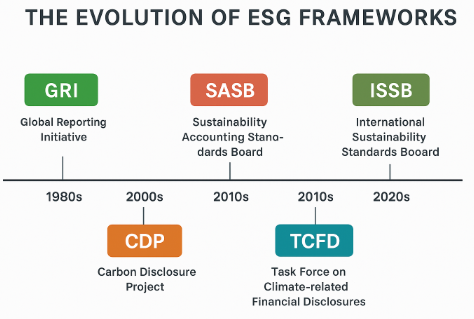
🌱 CHAPTER 3 — 1997: The Birth of GRI, The First Framework of Hope
A small team in Boston, backed by the UN and environmental groups, had a wild idea:
“What if companies publicly report their environmental and social impact?”
It felt impossible.
Corporations would never agree.
No one had ever done it.
But they tried anyway.
In 1997, they launched:
🌍 GRI — Global Reporting Initiative
The world’s first real ESG standard.
It introduced bold ideas:
- Report your emissions
- Report your waste
- Report how you treat workers
- Report your governance
- Report your social impact
GRI became the first global language of sustainability.
For the first time…
the world saw what companies were hiding.
🔥 CHAPTER 4 — 2000: CDP Sparks a Transparency Revolution
The early 2000s brought another shift.
Climate change suddenly became an investor concern.
Pension funds, banks, and insurers asked:
“If climate risks affect business, how do we know which companies are exposed?”
There was no data.
So in 2000, CDP sent a simple questionnaire asking companies:
“How much carbon do you emit?”
No rules.
No obligations.
Yet companies responded.
CDP’s annual scores (A to D-) became a global pressure system.
Boards cared.
Investors cared.
Media cared.
This was the moment ESG became competitive.
CDP = Carbon Disclosure Project
A global environmental disclosure system where companies report climate, water, and forests impact.
🏦 CHAPTER 5 — 2011: SASB — Wall Street Wants Its Own ESG Language
Even after GRI and CDP, investors weren’t satisfied.
They said:
“Not all ESG issues matter financially.
Give us only what impacts valuation.”
So in 2011, SASB was born.
It wasn’t built by activists.
It was built by analysts.
SASB introduced:
- Financial materiality
- Industry-specific standards (77 industries)
- ESG KPIs linked directly to business performance
Airlines had different KPIs than banks.
Tech had different KPIs than mining.
SASB gave ESG a Wall Street dictionary.
Now ESG wasn’t just about impact — it was about value.
SASB = Sustainability Accounting Standards Board
Industry-specific sustainability disclosure standards focused on financially material ESG issues.
(Now consolidated into ISSB)
🌡️ CHAPTER 6 — 2015–2017: TCFD — Climate Walks Into the Boardroom
Then came a dramatic twist. The story of TCFD doesn’t begin in sustainability.
It begins in fear — the fear that climate change could crash the financial system just like the 2008 economic meltdown.
In 2015, the Financial Stability Board (FSB) — the global guardian of financial stability — created a task force.
Not a sustainability group.
Not an environmental body.
But a finance-driven task force.
Its mission was bold:
“Tell us how climate change can destabilize the global economy — and how companies should report it.”
Thus, the Task Force on Climate-related Financial Disclosures (TCFD) was born..
🔥 TCFD — Task Force on Climate-related Financial Disclosures
This wasn’t another sustainability report.
This was risk management.
TCFD introduced four simple but revolutionary pillars:
1️⃣ Governance – Who is responsible for climate oversight?
2️⃣ Strategy – How will climate impact the business model?
3️⃣ Risk Management – What climate risks could harm the company?
4️⃣ Metrics & Targets – How are you measuring progress?
For the first time, climate risk entered the boardroom.
TCFD released its landmark recommendations — simple, principle-based, and designed for global use.
Companies were encouraged to disclose:
✔ Physical risks (storms, floods, heatwaves)
✔ Transition risks (policies, shifting markets, carbon pricing)
✔ Opportunities (energy savings, new markets)
✔ Forward-looking scenarios (what happens if the world warms by 2°C or 4°C?)
For investors, this was a breakthrough.
For companies, a wake-up call.
This pushed climate into the C-suite.
Boards could no longer ignore climate.
Slow Start… Then a Surge (2018–2020)
At first, adoption was slow.
Companies said: “This seems too complicated.”
But as climate disasters surged globally — wildfires, floods, extreme heat — investors got louder:
💼 “We cannot price climate risk if companies don’t disclose it.”
BlackRock, State Street, banks, insurers, stock exchanges — all began endorsing TCFD.
By 2020, TCFD had become the gold standard for climate disclosure.
Regulations Arrive (2021–2022)
Countries started adopting TCFD into law.
🌏 UK — first to mandate TCFD reporting
🇯🇵 Japan — mass adoption across financial institutions
🇳🇿 New Zealand — mandatory for large companies
🇨🇦 Canada — mandatory for banks and insurers
🇸🇬 Singapore — stock exchange requires TCFD-aligned reporting
TCFD had moved from “nice to have” to “mandatory compliance.”
🌍 CHAPTER 7 — 2015–2020: SBTi & the Rise of Net-Zero Commitments
But something was still missing.
Transparency is good.
But transparency without action is hollow.
So four organizations joined forces:
- WWF
- CDP
- WRI
- UN Global Compact
They launched:
🌱 SBTi — Science Based Targets initiative
This was not disclosure.
This was action.
SBTi forced companies to:
- Calculate full emissions (Scope 1, 2, 3)
- Align targets to 1.5°C
- Set net-zero pathways
- Get validation from climate scientists
SBTi became the global credibility stamp.
Not just:
“We commit.”
But:
“We commit based on science.”
🌪️ CHAPTER 8 — 2020: ESG Chaos — Too Many Standards
By 2020, companies were drowning in frameworks.
A typical sustainability team had to handle:
- GRI
- SASB
- CDP
- TCFD
- SBTi
- Integrated Reporting
- Local government rules
- SDGs
- Ratings like MSCI, Sustainalytics
Companies screamed:
“Give us ONE global ESG standard!”
“We can’t handle 200 questionnaires!”
Investors agreed.
Regulators agreed.
The world was ready for a merger.
🌐 CHAPTER 9 — 2021–2023: The Great Convergence — Birth of ISSB
Then, in a historic moment at COP26, the IFRS Foundation announced:
“We will unify global sustainability reporting.”
They created:
🌎 ISSB — International Sustainability Standards Board
ISSB became the global baseline, merging:
- SASB
- TCFD
- Integrated Reporting Framework
- CDSB
- VRF
They launched two global standards:
- IFRS S1 — General Sustainability
- IFRS S2 — Climate Disclosure (built on TCFD)
ISSB adopted TCFD’s four pillars entirely and embedded them into its new global standards, IFRS S1 and IFRS S2.
This meant:
✨ TCFD became the foundation of the world’s new sustainability reporting system.
For the first time in history:
Sustainability reporting stood beside financial reporting.
This was not evolution.
This was revolution.
2024 Onward — TCFD Officially Handed Over
By late 2023–2024, ISSB announced:
✔ IFRS S1 + S2 supersede TCFD
✔ Countries adopting ISSB automatically fulfill TCFD
✔ TCFD will be phased out as a standalone framework
But TCFD didn’t die.
It evolved — and lives inside ISSB.
🌱 In Simple Words: How TCFD Evolved
- 2015: Born from financial crisis concerns
- 2017: Issued world’s first climate-risk reporting blueprint
- 2018–2020: Became the global voluntary standard
- 2021–2022: Adopted into regulations worldwide
- 2023–2024: Absorbed into ISSB as the global sustainability baseline
TCFD started as a framework.
It ended as the foundation of the world’s first global sustainability reporting standard.

🇮🇳 CHAPTER 10 — 2021–2024: India Writes Its Own ESG Chapter — BRSR
India watched the chaos and clarity unfold.
It decided to build something unique:
robust like GRI,
investor-friendly like SASB,
climate-aligned like TCFD.
SEBI launched:
🇮🇳 BRSR — Business Responsibility & Sustainability Report
Mandatory for top 1000 listed companies.
BRSR blended:
- GRI
- SDGs
- NVG Principles
- SASB
- TCFD
By 2023, BRSR Core introduced assured KPIs.
India stepped onto the global ESG stage with confidence.
🇪🇺 CHAPTER 11 — Europe Goes Bold — CSRD & ESRS
Meanwhile, Europe did something unprecedented.
It launched the most ambitious ESG law ever:
🇪🇺 CSRD — Corporate Sustainability Reporting Directive
With ESRS standards that demanded:
- Double materiality
- Value chain transparency
- Mandatory assurance
- Massive data depth
CSRD wasn’t reporting.
It was transformation.
Europe didn’t just set the bar.
It built a new one.
🌈 FINAL CHAPTER — The World Today
📊 Comparison Table: ESG Frameworks vs Standards vs Platforms
| Framework / Standard | Type | Focus Area | Mandatory? | Best For |
|---|---|---|---|---|
| SBTi | Target-setting | GHG reduction | No | Net-zero targets |
| TCFD | Framework | Climate risk | Becoming mandatory globally | Climate risk reporting |
| CDP | Disclosure platform | Environment | Voluntary | Climate scoring |
| GRI | Reporting standards | Full ESG, stakeholder impact | Voluntary; basis for many | Sustainability teams |
| SASB | Standards | Financial material ESG | No (now merged) | Investors |
| ISSB (IFRS S1/S2) | Standards | Climate + financial material ESG | Becoming mandatory | Investors & regulators |
| BRSR (India) | Mandatory reporting | Full ESG | Yes for top 1000 | Indian companies |
| CSRD | Mandatory reporting | Full ESG (double materiality) | Yes (EU) | EU companies & subsidiaries |
🎯 How They Fit Together (Simple Mapping)
If you need:
- Climate targets → Use SBTi
- Climate risk disclosures → Use TCFD / IFRS S2
- Full ESG impact reporting → Use GRI / BRSR / CSRD
- Investor-grade ESG reporting → Use SASB / ISSB
- Submit disclosures & get a score → Use CDP
ESG Has a Clear Map
After decades of chaos, the ESG city finally has a roadmap.
What began as scattered ideas after a tragic oil spill is today a global movement shaping:
- how companies operate,
- how investors invest,
- and how the world fights climate change.
This journey was not perfect.
But it was necessary.
And now we all stand at the next chapter —
where ESG is no longer a side report…
…it is the story of how businesses impact the world,
and how the world impacts business.
🌍 Call to Action: Your Sustainability Journey Starts Now
The story of ESG frameworks isn’t just history — it’s a mirror.
A reminder that every crisis changed us. Every wake-up call pushed humanity to do better.
But the next chapter is unwritten… and it’s waiting for leaders like you.
If TCFD could rise from the ashes of the financial crisis,
If SBTi could ignite a global movement for science-based accountability,
If GRI, CDP, SASB, ISSB could reshape transparency itself…
Then imagine what your organization can spark today.
👉 Don’t wait for the next crisis to define your sustainability strategy.
👉 Become the company that adapts before it is forced to.
👉 Turn ESG from compliance into competitive advantage.
Start now. Audit your ESG maturity.
Choose the right frameworks.
Align with global standards.
And write the chapter where your company becomes a sustainability leader.
📩 Need help mapping ESG frameworks for your business?
Message me — let’s co-create your future-ready ESG roadmap.
Because the world doesn’t just need better reporting.
It needs courageous organizations who choose to lead. 🌱✨
Read blogs on sustainability here.
Reference – KPMG Report