Ruchika was the only woman in a twelve-member project team — bright, precise, and brimming with ideas. She spoke softly but with insight. Yet in every meeting, her words seemed to vanish mid-air. A louder male colleague would echo her point moments later — and be applauded. Soon, she stopped trying.
Weeks turned into months. The project began missing deadlines, creativity dipped, and collaboration turned mechanical. The team leader wondered why productivity was falling, but the answer was sitting right there — unheard.
When voices like Ruchika’s are ignored, it’s not just a person who suffers. The business does too.
🚨 The Hidden Cost of Silence
Ruchika’s story isn’t rare. Across industries, women — especially in male-dominated teams — often find themselves present but powerless. They’re in the room, but not in the conversation. They contribute, but are overlooked. And the consequence? Burnout, disengagement, and eventually — departure.
McKinsey’s research shows that companies with gender-diverse leadership are 39% more likely to financially outperform peers. Yet most organizations still lose talented women mid-career because their culture wasn’t designed to let them lead.
Alarmingly, 63% of Indian companies reportedly have zero women in key managerial positions (“KMPs”). India Today
🧩 Team 2: When Inclusion Is Cosmetic
In another division, a few women were hired “for balance.” They handled operations, reports, admin — but not decisions. Every strategic choice was made by male leads. The women were present, but their roles were ornamental.
When they raised valid concerns about process inefficiencies, their ideas were politely “noted” — and quietly dismissed.
That team’s performance stagnated. Morale dropped. Innovation froze. Because diversity without equity and inclusion isn’t progress — it’s performance theatre.
💬 Team 3: When Inclusion Dies in Silence
Then there was Priya — a senior analyst in Team 3. She wasn’t afraid to voice different opinions. She believed that a team grows when ideas clash and evolve. But her manager didn’t see it that way.
He liked “yes-men.” Every time Priya offered a new angle or asked tough questions, she was called for a “feedback chat.” He told her she was being “too aggressive”, “too emotional”, “not a team player.” The message was clear: conform, or be crushed quietly.
Weeks of subtle criticism turned into months of tension. Priya’s confidence faded. She began doubting her own instincts — the very instincts that had made her a top performer. Eventually, she resigned.
After she left, the team’s creativity and energy dropped. The remaining members stopped challenging ideas, stopped experimenting, stopped speaking up. Within a quarter, the project underperformed and client feedback turned negative.
That’s what happens when Inclusion dies — innovation dies with it.
🌍 What DEI Really Means
Diversity brings different voices into the room.
Equity ensures those voices have equal weight and fair opportunity.
Inclusion makes sure everyone feels safe, valued, and empowered to speak up.
DEI isn’t charity. It’s not HR lip service. It’s a business strategy rooted in empathy and evidence.
McKinsey’s landmark “Diversity Wins” report revealed that inclusive teams are:
2x more likely to meet financial targets,
3x more likely to be high-performing, and
8x more likely to achieve better overall business outcomes.
Those numbers aren’t about optics — they’re about results.
⚖️ The Real Need: Keeping Women in Leadership
When women rise, organizations don’t just look better — they think better. Female leaders bring collaboration, empathy, and balanced risk-taking — qualities that drive long-term success.
Yet many leave just when they’re most valuable, citing “culture” as the reason. Not pay. Not workload. Culture.
Because being constantly ignored is more exhausting than being overworked.
💡 The Turning Point
When Ruchika finally left, her exit interview was short:
“I didn’t leave for another job,” she said. “I left because no one listened.”
Her departure became a wake-up call. The company launched mentorship programs for women, trained male managers in inclusive leadership, and started tracking who spoke — and who got interrupted — in meetings.
Six months later, engagement rose, innovation returned, and productivity recovered. The data proved what McKinsey had long said — DEI isn’t a social goal; it’s a strategic lever.
🌈 Beyond Gender: The True Spectrum of Diversity
Diversity isn’t only about men and women. It’s about different thinking, different abilities, different experiences.
It includes people who are differently abled, neurodiverse, from varied ethnicities, economic backgrounds, and belief systems — all bringing unique perspectives that strengthen the organization’s collective intelligence.
True diversity means valuing the whole human experience, not fitting everyone into a single mold.
Because innovation doesn’t happen when everyone agrees — it happens when everyone belongs.
🔔 Call to Action: Build Cultures That Listen
If you’re a leader, ask yourself — who’s not speaking in your meetings, and why? If you’re in HR, track not just who you hire, but who stays — and who feels safe to disagree. If you’re part of a team, be the voice that amplifies another’s.
Change begins when we stop treating DEI as a checkbox — and start living it as a core value.
Because in the end, diversity counts heads, but inclusion makes those heads count.
It was supposed to be just another day in the Gulf of Mexico. On April 20, 2010, BP’s Deepwater Horizon rig exploded — a single failure in a vast chain of contractors, subcontractors, and safety systems. What followed was one of the worst environmental disasters in history: 11 lives lost, 4.9 million barrels of oil spilled, and $65 billion in cleanup and penalties.
The cause wasn’t only a technical malfunction — it was a supply chain governance failure. Multiple suppliers had cut corners on testing, oversight was fragmented, and sustainability risks were treated as peripheral. In the aftermath, BP’s reputation sank, its stock price plummeted by 55%, and its name became synonymous with environmental negligence.
Halfway across the world, in 2013, another tragedy unfolded in Bangladesh. The Rana Plaza garment factory collapsed, killing over 1,100 workers, many of whom made clothes for some of the world’s biggest brands — companies that had never set foot in that building, but had outsourced manufacturing to suppliers who did. Those brands — from Primark to H&M — faced global outrage, consumer boycotts, and urgent pressure to prove they cared about the people behind their products.
Fast-forward to Germany, 2015. Volkswagen’s Dieselgate scandal erupted when it was discovered that emissions testing software had been manipulated — not only internally, but with the knowledge of component suppliers. The fallout? Over $30 billion in fines and recalls, and a massive trust deficit that still shadows the brand today.
Each of these events began far from corporate headquarters — in oil rigs, garment workshops, and automotive testing labs — but their impacts were seismic.
They reshaped balance sheets, destroyed brand equity, and forced a global reckoning on what it really means to be responsible.
Because in today’s interconnected world, what happens in the farthest corner of your supply chain can rewrite the story of your brand, your balance sheet, and your legacy.
Sustainable & Ethical Sourcing: From Cost to Conscience
Once upon a time, sourcing was all about the lowest cost per unit. Today, it’s about the highest integrity per decision. Sustainable and ethical sourcing means looking beyond price tags to ask deeper questions — Who made this? Under what conditions? At what environmental cost?
True leadership in sourcing now lies in aligning procurement strategy with planetary and social responsibility. This means:
Choosing suppliers who uphold fair wages, safe working conditions, and respect for human rights.
Preferring materials that minimize environmental impact — recycled, renewable, or responsibly certified.
Encouraging local sourcing to cut emissions and strengthen community economies.
Companies like Unilever, Patagonia, and Tata Steel have shown that ethical sourcing is not a trade-off — it’s a competitive advantage. By embedding sustainability into supplier selection, they’ve built resilience against regulatory shocks, enhanced brand trust, and attracted purpose-driven investors and customers.
In an era when transparency defines reputation, every purchase order is a moral statement — about what your brand stands for and the future it’s helping build.
The Invisible Giant in Your Supply Chain
Enter Scope 3 emissions — the silent majority of corporate carbon footprints. For most industries, these indirect emissions account for up to 90% of total environmental impact, stemming from suppliers, logistics, product use, and end-of-life disposal.
Yet, they remain the least visible and hardest to control. Companies may manage their own factories and fleets efficiently, but if their suppliers burn coal, waste water, or exploit labor, those risks — environmental and ethical — still belong to the brand.
Scope 3 is not just an emissions category. It’s the mirror that reflects the true reach of your business responsibility.
♻️ Supply Chain ESG Is Now Strategic
The global conversation has shifted. Supply chains are no longer cost centers — they are strategic assets defining brand credibility, investor confidence, and access to global markets.
Regulations like the EU’s CSDDD and India’s BRSR Core are forcing companies to disclose ESG risks in their supply chains.
Investors now price sustainability into valuation and risk premiums.
Consumers are voting with their wallets, demanding ethical and traceable sourcing.
ESG isn’t about compliance anymore — it’s about competitive advantage and resilience.
🧭 The Board’s Dilemma: Visibility vs. Control
For most boards, the challenge isn’t awareness — it’s accountability without control. Companies are expected to manage ESG risks that often lie several tiers deep in supplier networks they don’t own, don’t audit regularly, and sometimes don’t even know exist.
This is the modern boardroom paradox: You’re held responsible for what happens across your value chain — but your visibility ends long before your accountability does.
🔍 The Visibility Gap
Even large enterprises often lack real-time insight into the ESG performance of Tier 2, 3, and 4 suppliers. These distant nodes — small subcontractors, raw material extractors, or local logistics providers — are where violations and disruptions most often originate. Yet, they remain the hardest to monitor due to fragmented reporting, data silos, and opaque intermediaries.
As a result, boards face blind spots that can become reputational or financial landmines. When a crisis surfaces — child labor in a Tier 3 supplier, a pollution leak in an offshore vendor’s facility — the public doesn’t differentiate between “our supplier” and “our responsibility.”
⚙️ The Control Challenge
Traditional governance frameworks were never designed for today’s hyper-connected supply chains. Boards must now think beyond financial oversight and integrate sustainability risk governance into strategic decision-making:
ESG-linked KPIs embedded into procurement and vendor performance reviews
Technology-backed monitoring systems that provide dynamic, verifiable supply chain data
Cross-functional ESG committees that bridge sustainability, finance, and risk management
The goal isn’t total control — it’s credible oversight built on transparency, data, and accountability.
🧩 The Path Forward
Progressive boards are redefining governance by demanding visibility as a strategic asset. They invest in supply chain traceability tools, mandate supplier ESG training, and link executive pay to sustainability metrics.
The future board will not just ask, “Are our numbers right?” It will ask, “Are our values visible — all the way down the supply chain?”
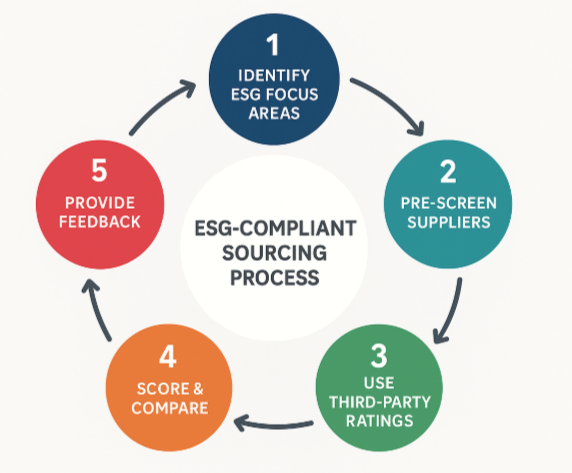
ESG-Compliant Sourcing Process: Building Integrity Into Every Purchase
Embedding ESG principles into sourcing isn’t a one-time compliance task — it’s an ongoing process of alignment, assessment, and accountability. A structured ESG-compliant sourcing process helps companies turn ethical intentions into measurable actions.
1. Identify ESG Focus Areas
Start by defining what ESG means for your business. For a mining company, it may mean carbon emissions and worker safety; for a consumer brand, fair labor and sustainable packaging. Align ESG priorities with both your industry context and your company’s core values.
2. Pre-Screen Suppliers
Before onboarding, request transparency. Ask suppliers to disclose ESG data — such as environmental policies, energy and water usage, diversity practices, and third-party certifications. This step sets expectations from day one and builds a culture of openness.
3. Use Third-Party Ratings
To ensure credibility, validate supplier claims using trusted data platforms like EcoVadis, MSCI, or Sedex. These rating systems provide independent verification and help benchmark performance across industries and regions.
4. Score & Compare
Integrate ESG performance into your supplier evaluation model — alongside traditional parameters like cost, quality, and delivery. This ensures procurement decisions balance value creation with values alignment. A supplier with a lower carbon footprint or better governance should score higher, even if slightly costlier.
5. Provide Feedback & Support
ESG sourcing is about partnership, not punishment. Offer clear, time-bound feedback and improvement plans for suppliers who fall short. Encourage knowledge sharing and capacity building — because when your suppliers improve, your entire value chain becomes more resilient and responsible.
The best supply chains aren’t just efficient — they’re ethical, transparent, and built on shared purpose.
🚩 Sourcing Red Flags To Watch For
Red Flag
What It Signals
Why It Matters
Prices significantly below market
Possible exploitation or cost-cutting corners
Indicates unethical or unsustainable practices that may trigger reputational and compliance risks
Reluctance to allow facility visits
Supplier may be hiding poor labor or environmental conditions
Blocks transparency and prevents proper due diligence
High supplier turnover
Transactional or unstable relationships
Limits long-term collaboration and continuous improvement
Single-country sourcing for critical materials
Overdependence on one region or political system
Creates vulnerability to geopolitical, climate, or supply disruptions
🌍 ESG Risks in Global Supply Chains: Hidden Vulnerabilities
No matter how polished a company’s sustainability report looks, the true ESG risk often hides deep within its supply chain — in places where oversight is weakest and stakes are highest. Every industry has its ESG hotspots — regions, materials, and processes where violations are most likely to occur. The smartest boards don’t spread resources thin; they focus risk management where it matters most.
Ethical mineral sourcing, supplier audits, circular design
Food & Agriculture
Deforestation, pesticide overuse, unfair labor
Brazil, Indonesia, India
Sustainable land use, regenerative farming, farmer livelihood programs
Automotive
Mineral extraction risks, high carbon footprint in manufacturing
Chile (lithium), China (battery metals)
Battery supply chain traceability, energy efficiency, recycling & reuse
Why It Matters
Global supply chains are complex ecosystems — and one weak link can undermine an entire ESG strategy. A factory fire in Bangladesh can expose a fashion giant. A forced labor scandal in Xinjiang can stall electronics shipments worldwide. A deforestation-linked supplier can cost a food brand its ESG credibility overnight.
Understanding where vulnerabilities lie — and acting before regulators or activists do — is now a hallmark of resilient, responsible enterprises.
In the age of transparency, your ESG risk map is your business map.
🧾 Supplier Due Diligence & ESG Audits: What Boards Must Know
Traditional supplier due diligence once meant ticking boxes — reviewing financials, technical capability, and compliance certificates once a year. That model no longer works. In today’s environment, ESG due diligence is as critical as financial due diligence — and far more complex. The old approach relied on static questionnaires and annual audits that detected problems only after damage was done. The new model is dynamic, data-driven, and partnership-oriented. Boards are now expected to ensure risk-based assessments tailored to supplier geography, material sensitivity, and social context — supported by real-time monitoring technologies and continuous engagement.
Instead of punishing suppliers post-violation, leading companies collaborate to build capacity and improve standards. In essence, ESG due diligence has evolved from a compliance checkbox into a strategic governance tool — one that defines not just how responsibly a company buys, but how sustainably it grows.
🧩 Multi-Layered ESG Assessment Framework
Effective ESG assurance needs more than a one-time audit — it demands a multi-layered approach. It starts with a Desktop Review of financials, certifications, and public ESG data to flag risks. On-Site Audits then verify realities on the ground through inspections and worker interviews. Third-Party Verification adds credibility via independent assessors, NGO inputs, and satellite data. Finally, Continuous Monitoring ensures real-time visibility through AI alerts and environmental sensors. Together, these layers create a dynamic, always-on ESG due diligence system that keeps risks visible and integrity intact.
🌐 ESG and Global Trade: Regulatory Pressures and Market Access
Global trade is entering an era where ESG compliance defines market access. Regulations across major economies are rewriting the rules of cross-border business, making sustainability not just an ethical choice — but a trade requirement. The EU Deforestation Regulation (effective December 2024) bans the sale of products linked to deforestation after 2020, mandating GPS-based traceability. The US Uyghur Forced Labor Prevention Act presumes all goods from Xinjiang involve forced labor unless proven otherwise, demanding robust supplier mapping and third-party audits. And starting 2026, the EU Carbon Border Adjustment Mechanism (CBAM) will impose carbon costs on imports like steel, cement, and fertilizers. For global companies, this means ESG is now a passport — without transparency and traceability, market access itself is at risk.
Transparency Is the Foundation
You can’t fix what you can’t see.
That’s why leading enterprises are investing in supply chain mapping, real-time monitoring, and digital visibility platforms. Technologies like SAP Sustainability Control Tower (SCT), blockchain traceability, and AI-driven supplier analytics are helping companies identify hidden ESG risks before they become public crises.
Transparency turns supply chains from liabilities into levers of trust.
Tech Enablers of Responsible Supply Chains
The future of ESG-driven supply chains is digital, data-led, and decision-ready. Technology is transforming what used to be blind spots into actionable insights. Here’s how leading companies are using next-gen tools to make their supply chains more transparent, accountable, and resilient:
Technology
What It Does
Business Value / Real-World Example
🗺️ Supply Chain Mapping
Digitally visualizes every tier of the supply chain, from raw materials to finished goods.
Nike maps over 700 factories across 40 countries, identifying high-risk regions for labor and environmental impact before issues arise.
📡 Real-Time Monitoring
Uses IoT sensors, satellite data, and live dashboards to track emissions, waste, and compliance in real time.
Unilever employs satellite monitoring to detect deforestation linked to its palm oil suppliers, enabling immediate corrective action.
🧠 SAP Sustainability Control Tower (SCT)
Integrates ESG metrics directly into enterprise systems like procurement, logistics, and finance.
Larsen & Toubro (L&T) uses digital ESG dashboards to assess supplier carbon footprints and safety compliance before awarding contracts.
🔗 Blockchain Traceability
Creates tamper-proof transaction records, ensuring ethical sourcing and full material traceability.
IBM & Ford use blockchain to verify that cobalt used in EV batteries is sourced responsibly, eliminating links to child labor.
🤖 AI-Driven Supplier Analytics
Predicts ESG risks by analyzing supplier history, local conditions, and global trends.
Walmart uses AI tools to flag suppliers with high carbon intensity or poor human rights track records, prioritizing engagement and remediation.
🌍 Digital Product Passport (DPP)(emerging trend)
Provides full transparency on a product’s lifecycle — from origin to end-of-life recycling.
The EU’s upcoming DPP framework will make product traceability mandatory in sectors like textiles, electronics, and batteries.
Why It Matters
These tools are turning sustainability into a data discipline. Companies can now:
Detect ESG risks before they become public crises.
Prove compliance to investors and regulators with credible, auditable data.
Build resilience against geopolitical, environmental, and reputational shocks.
In short, technology is helping businesses move from reactive reporting to predictive sustainability — from finding problems to foreseeing them.
Supply Chain Mapping: Your First Line of Defense
You can’t manage risks you can’t see.
Most companies have solid visibility into their Tier 1 suppliers — the direct partners they contract with. But beyond that first layer lies a complex web of subcontractors, raw material providers, and logistics intermediaries that often operate in the shadows. And that’s where most ESG risks hide — in the deeper tiers where oversight is weakest, yet reputational and operational impact can be greatest.
Think of supply chain mapping as building an X-ray of your value chain — exposing every connection, dependency, and hidden hotspot that could threaten sustainability performance.
Why Supply Chain Mapping Matters
When companies fail to see beyond Tier 1, they risk being blindsided by issues like:
Illegal sourcing of raw materials (e.g., conflict minerals, deforestation)
Human rights violations at subcontracted sites
Environmental hazards from unregulated waste or emissions
Overdependence on a single supplier or country
A clear map helps companies shift from reactive to preventive ESG management — identifying where to focus audits, resources, and partnerships before a crisis erupts.
Essential Mapping Elements
Element
What It Means
Why It Matters
🌍 Geographic Concentration
Understand where your suppliers and their facilities are located.
Overreliance on one region (like Southeast Asia for textiles or China for electronics) creates climate, political, and trade disruption risks. Example: COVID-19 exposed global vulnerability to single-country dependencies.
🔄 Material Flow
Track how raw materials move through your value chain — from source to finished product.
Certain materials carry high ESG risk — such as cobalt (human rights), palm oil (deforestation), or cotton (forced labor). Mapping material flow highlights risk hotspots.
💰 Value Concentration
Identify which suppliers represent the largest portions of your procurement spend.
High-spend suppliers have the biggest leverage and risk exposure. Focusing ESG engagement here maximizes impact and efficiency.
⚠️ Risk Concentration
Pinpoint where high-value and high-risk suppliers overlap.
This intersection is your ESG red zone — where disruptions, reputational crises, or compliance failures can cause the greatest damage. Prioritize monitoring and mitigation here first.
From Blind Spots to Business Intelligence
Modern supply chain mapping uses data analytics, AI, and visualization platforms to turn millions of supplier data points into actionable intelligence. By layering geographic, financial, and ESG data, companies can predict disruptions before they occur and allocate sustainability resources strategically.
Supply chain mapping isn’t just a compliance tool — it’s your first line of defense against financial, environmental, and ethical risk.
Real-World Example
Apple has over 200 suppliers across 43 countries. Through comprehensive supply chain mapping, it identified regions with high energy intensity and labor risk, enabling targeted renewable energy programs and supplier training. This proactive approach not only cut carbon intensity but also reduced long-term supply volatility — turning transparency into a strategic advantage.
Integration Drives Success
The next evolution of supply chains will make ESG a decision filter — not an afterthought.
Procurement teams now assess carbon intensity and labor ethics alongside price.
Operations optimize logistics for lower emissions and circularity.
Finance ties credit terms and investments to supplier sustainability performance.
This integration transforms ESG from a report to a business capability.
The Path Forward: Building Tomorrow’s Responsible Supply Chains
Measure What Matters: Map and quantify Scope 3 emissions.
Engage, Don’t Exclude: Help suppliers meet ESG expectations through collaboration.
Digitize for Visibility: Use technology to track, predict, and mitigate risks.
Align with Global Standards: Follow GRI, ISSB, and BRSR Core frameworks for comparability.
Continuously Improve: Treat ESG as a living system that evolves with innovation.
Final Thought
“The companies that understand supply chains are about moving the world toward a more sustainable, equitable, and resilient future will thrive. Those that don’t will find themselves increasingly isolated.”
The message is clear: Lead on Scope 3 and supply chain ESG — or be left behind.
As sustainability becomes a boardroom priority, companies are navigating a growing maze of ESG reporting frameworks. Two names frequently surface — Global Reporting Initiative (GRI) and Business Responsibility and Sustainability Report (BRSR).
While both aim to enhance transparency and accountability, they serve distinct purposes and audiences. Understanding their practical differences — and knowing when to use each strategically — can help companies turn compliance into a value-creation opportunity.
🔍 GRI vs BRSR in Brief
Framework
Developed by
Scope
Applicability
GRI (Global Reporting Initiative)
Independent international organization
Global
Voluntary for most companies worldwide
BRSR (Business Responsibility and Sustainability Report)
SEBI, India
India-specific
Mandatory for top 1,000 listed Indian companies (by market cap)
⚙️ Key Practical Differences
Aspect
GRI Standards
BRSR Framework
Purpose
Designed for global stakeholder communication on sustainability performance.
Designed for regulatory compliance and corporate accountability in India.
Focus Areas
Broad ESG focus — covers material issues from emissions to human rights, aligned with UN SDGs.
Rooted in India’s National Guidelines on Responsible Business Conduct (NGRBC) — focuses on 9 principles of responsible business.
Materiality
Impact materiality — focuses on environment, society – stakeholder interest.
Regulatory materiality — emphasizes compliance and responsibility rather than global stakeholder prioritization.
Disclosure Type
Highly detailed narrative and quantitative disclosures, allowing flexibility in reporting scope.
Structured, standardized questionnaire format (BRSR Core has defined metrics).
Assurance
Voluntary but increasingly expected by global investors.
BRSR Core mandates limited assurance on key performance indicators.
Audience
Global investors, rating agencies, sustainability analysts, NGOs.
Indian regulators, domestic investors, and policymakers.
Interoperability
Can be aligned with frameworks like SASB, TCFD, and CDP.
Partially aligned with GRI and TCFD, but primarily regulatory in nature.
🎯 When to Use Each Strategically
1. BRSR: For Compliance and National ESG Positioning
Use BRSR if your company is:
Listed on Indian stock exchanges (mandatory for top 1,000 companies).
Primarily serving Indian investors or regulators.
Looking to benchmark performance locally against peers.
Beginning its ESG journey and needs a structured starting point.
Strategic Value: BRSR builds foundational ESG discipline and ensures compliance with SEBI norms — the first step toward investor confidence and responsible governance.
2. GRI: For Global Visibility and Investor Engagement
Use GRI if your company is:
Targeting international markets or global supply chains.
Seeking foreign investment or ESG-linked financing.
Aiming to showcase impact and transparency to global stakeholders.
Already mature in ESG practices and ready for narrative-driven disclosures.
Strategic Value: GRI enhances global credibility and aligns your disclosures with international expectations — often unlocking access to ESG indices and sustainability-linked funding.
3. Combined Approach: The Smart Strategy
Leading Indian companies like L&T, Tata Steel, and Infosys now use both. They comply through BRSR and communicate through GRI, creating a dual advantage:
BRSR ensures regulatory confidence in India.
GRI builds reputation and investor trust abroad.
✅ Tip: Use your BRSR Core data as the base, and layer GRI-aligned narrative reporting on top — saving effort and ensuring consistency.
🔗 Example: How a Dual Framework Adds Value
Objective
Best Fit
Strategic Outcome
Regulatory compliance
BRSR Core
Satisfies SEBI and Indian ESG requirements
Global investor communication
GRI
Enhances ESG ratings and international perception
Supply chain transparency
GRI
Aligns with global buyer requirements
Benchmarking & data consistency
BRSR
Provides standardized metrics for comparison
ESG-linked finance
GRI + BRSR
Builds confidence among lenders and investors
💡 The Bottom Line
BRSR is the “license to operate”, GRI is the “license to grow.”
BRSR ensures compliance and builds a responsible foundation. GRI communicates sustainability leadership and unlocks global capital and brand value.
The most forward-looking companies are not choosing between the two — they’re integrating both into a unified ESG storytelling strategy.
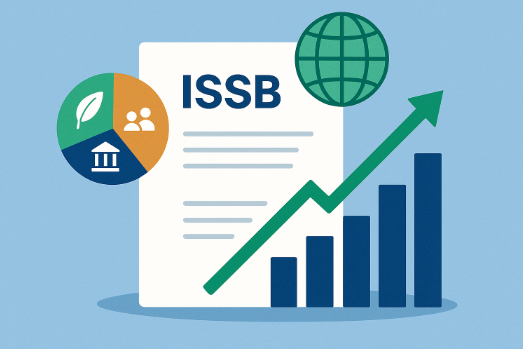
🌐 The Emerging ISSB Framework — The Next Step in ESG Evolution
As companies mature in their ESG journey, the next evolution is already underway: the ISSB (International Sustainability Standards Board).
ISSB aims to create a global baseline for sustainability disclosures, focusing on financial materiality — how ESG risks and opportunities affect enterprise value. It complements GRI’s impact lens and BRSR’s compliance lens, offering a bridge between regulatory reporting and investor-grade sustainability data.
Forward-looking companies are beginning to align their BRSR and GRI data with ISSB standards (IFRS S1 and S2), ensuring consistency, credibility, and comparability in both domestic and international markets.
In short:
BRSR ensures compliance
GRI builds credibility
ISSB enables global confidence
While GRI and ISSB both deal with sustainability reporting, they serve very different purposes and audiences:
Aspect
GRI
ISSB
Purpose
To report how the company impacts the economy, environment, and society (impact materiality).
To report how sustainability issues affect the company’s enterprise value (financial materiality).
Audience
All stakeholders — investors, employees, communities, regulators.
Primarily investors, analysts, and financial markets.
Link to Finance
Separate sustainability report.
Integrated with financial statements under IFRS.
Nature
Qualitative and narrative — broad ESG coverage.
Quantitative and disclosure-based — focus on value relevance.
Governance Body
Global Reporting Initiative (independent, NGO).
IFRS Foundation (same body that issues IFRS accounting standards).
🌍 Is ISSB Mandatory?
As of 2025, the ISSB (International Sustainability Standards Board) is not yet mandatory globally. However, it is being adopted or integrated by several countries and stock exchanges as the global baseline for sustainability-related financial disclosures.
✅ Current Status:
Voluntary globally, but regulators are moving toward adoption.
Countries like the UK, Singapore, Canada, Japan, and Australia have already announced plans to align national ESG reporting with ISSB standards.
India (SEBI) has also indicated that future updates to BRSR Core may harmonize with ISSB, to improve international comparability.
In short — ISSB is not mandatory yet, but it’s becoming the direction of travel for global ESG disclosure.
🇮🇳 If a Company Already Has BRSR — Does It Need GRI and ISSB?
So, while BRSR is mandatory, GRI and ISSB are strategic upgrades — not legally required (yet), but increasingly important for investor confidence, global recognition, and ESG-linked financing.
⚙️ 1. Why BRSR Alone Isn’t Enough
BRSR (Business Responsibility and Sustainability Report) is India’s regulatory baseline — mandatory for the top 1,000 listed companies. It ensures disclosure on social, environmental, and governance practices under SEBI’s NGRBC framework.
But:
BRSR is designed for domestic compliance, not for international comparability.
Its data structure is standardized, not narrative or impact-focused.
Global investors and rating agencies often cannot directly map BRSR data to global benchmarks (like CDP, MSCI, or Sustainalytics).
So while BRSR shows you are compliant, it doesn’t yet show you are competitive globally.
🌍 2. Why Add GRI (Global Reporting Initiative)
GRI helps you tell your sustainability story beyond compliance.
Purpose
Reason to Adopt
Broaden your stakeholder reach
GRI is recognized by 150+ countries and aligns with UN SDGs.
Build credibility with global supply chains
Many multinational buyers require GRI-aligned reporting.
Benchmark globally
Investors and ESG analysts use GRI metrics to compare across regions.
Complement BRSR
Much of BRSR data can directly feed into GRI disclosures.
Think of GRI as the “international passport” for your ESG data. It converts your local compliance (BRSR) into a global language of sustainability.
💰 3. Why Prepare for ISSB (International Sustainability Standards Board)
ISSB is the future of ESG-financial integration.
While not mandatory yet, it’s fast becoming the global baseline for investor-grade sustainability disclosures. ISSB (IFRS S1 & S2) focuses on financial materiality — i.e., how climate and sustainability issues affect enterprise value.
Why It Matters
For Indian Companies
Aligns with global capital markets
Foreign investors and lenders are beginning to request ISSB-aligned data.
Builds investor confidence
Integrates ESG risks with financial statements.
Future-ready
SEBI is expected to gradually harmonize BRSR Core with ISSB standards.
If your company seeks global investors, sustainability-linked loans, or ESG ratings, aligning with ISSB early builds trust and reduces future reporting friction.
⚙️ In Summary
Framework
Focus
Mandatory?
Best For
BRSR
Compliance & accountability (India)
✅ Mandatory for top 1,000 listed firms
Indian-listed companies
GRI
Stakeholder impact & transparency
❌ Voluntary
Global ESG communication
ISSB
Financial materiality & investor relevance
🚧 Emerging (soon-to-be baseline)
Multinationals, investor-driven firms
Call to Action
Take the Next Step in Your ESG Journey Don’t stop at compliance — transform it into competitive advantage. Start with BRSR to meet India’s mandate, expand through GRI to build global credibility, and prepare for ISSB to speak the language of investors.
It’s time to align your disclosures with the future of sustainable finance — where transparency drives trust and trust attracts capital.
Introduction to ISSB and the IFRS Sustainability Disclosure Standards: IFRS Foundation
Overview of IFRS S1 (general sustainability disclosures) and IFRS S2 (climate-related disclosures), effective from 2024: Grant Thornton International Ltd.
SEBI mandates BRSR for the top 1,000 listed companies from FY 2022-23 onwards: ICAI
In 2023, as Indian companies scrambled to meet SEBI’s new BRSR Core assurance requirements, many saw it as yet another compliance hurdle. Spreadsheets, audits, and data reconciliations became a corporate headache.
But one company — Larsen & Toubro (L&T) — saw something others didn’t. They saw a strategic opportunity hidden in the fine print of ESG compliance.
What began as a regulatory necessity turned into one of India’s most compelling stories of how ESG can drive growth, trust, and profitability.
🧭 The Backdrop: SEBI’s BRSR Core Disruption
In July 2023, SEBI mandated that India’s top 250 listed companies must obtain limited assurance for 49 Key Performance Indicators (KPIs) under the BRSR Core framework.
This meant ESG data had to be:
Accurate
Verifiable
Auditable
For the first time, ESG numbers carried the same weight as financial data.
For L&T — a 85-year-old engineering powerhouse operating across construction, manufacturing, and energy — this was no small task. Data was scattered across hundreds of project sites, 47 business units, and multiple legacy systems.
Each vertical — cement, infrastructure, hydrocarbon, heavy engineering — reported ESG metrics differently. When the first assurance trial was conducted, auditors found 18% variance between internal data and published sustainability reports.
L&T faced a choice: Patch the system to pass the audit — or rebuild ESG from the ground up.
They chose the latter. And that decision changed everything.
⚙️ Phase 1: Diagnosing the ESG Data Problem
The first step was brutal honesty. An internal ESG data review revealed key issues:
47 spreadsheets used for energy and emissions tracking — no common format.
Inconsistent emission factors across divisions.
Safety metrics reported manually with no central validation.
Supplier ESG data incomplete or unverifiable.
In short, ESG data wasn’t investment-grade.
🧩 L&T’s realization:
“If data isn’t trusted, sustainability can’t be strategic.”
So, the company launched Project E³ — short for Empowered ESG & Efficiency. Its mandate: make ESG data as reliable, integrated, and insightful as financial data.
🔧 Phase 2: Building the ESG Control Tower
L&T approached ESG like an engineering challenge — with precision and process discipline.
Key initiatives:
Digital Integration:
Implemented the SAP Sustainability Control Tower, connecting 18 legacy systems.
Real-time data pipelines from HR, energy, procurement, and environment management.
Data Governance Framework:
Defined ownership for every KPI — each had a Data Owner, Reviewer, and Assurance Gatekeeper.
Created Standard Operating Procedures (SOPs) for all 49 BRSR KPIs (measurement units, frequency, boundaries).
Automation & Analytics:
Automated data validation and anomaly detection using ML models.
Installed smart meters and IoT sensors at manufacturing units to capture real-time energy data.
Blockchain for Assurance:
Piloted blockchain-based ESG records for water and waste data to ensure immutability.
Human Capital:
Trained 350 ESG Data Champions across India — ensuring ownership and accuracy at the source.
📊 Phase 3: Assurance That Builds Trust
By mid-2023, L&T had something few Indian firms could claim: An assurance-ready ESG data ecosystem.
Assurance Model:
Internal pre-assurance every quarter by the internal audit team.
External limited assurance annually by SEBI-registered ESG auditors.
Continuous data validation dashboards for management oversight.
L&T’s CFO called it their “dual control tower” — one for finance, one for sustainability.
“We treat ESG data with the same rigor as our balance sheet,” said the Group Controller during an internal town hall.
💰 Phase 4: Turning Compliance Into Value
Once ESG data became reliable, L&T unlocked its hidden value.
🔹 1. Financial Impact
The company issued a ₹12,000 crore sustainability-linked bond, one of the largest in India.
Interest rate reductions (coupon step-downs) were tied to verified ESG KPIs — particularly energy efficiency and diversity targets.
Because of verified BRSR Core compliance, the bond attracted top-tier ESG funds.
Result: Lower cost of capital and stronger investor confidence.
🔹 2. Operational Efficiency
With real-time ESG analytics, L&T identified:
5% of plants consuming 20% more energy than benchmark.
Fixing these inefficiencies led to ₹145 crore in energy savings in one year.
🔹 3. Risk Reduction
Before BRSR Core, ESG data inconsistencies were a reputational risk. Now, with verified ESG systems:
L&T avoided greenwashing allegations.
Reduced audit exceptions to near zero.
Strengthened board confidence and stakeholder trust.
🔹 4. Market Reputation
L&T’s transparency led to:
Inclusion in S&P Global Sustainability Index.
Higher ESG ratings (MSCI ESG: upgraded from BBB to A).
Recognition by SEBI as a “first-mover on ESG assurance.”
🏢 How L&T Embedded ESG Into Culture
Technology was only half the story — mindset was the other.
L&T linked ESG KPIs to leadership scorecards, ensuring sustainability performance affected bonuses. Every site manager had to report monthly on:
Energy intensity
Safety performance
Diversity and welfare initiatives
Employees no longer saw ESG as “extra work” — it became part of how performance was measured.
“When sustainability enters performance metrics, it becomes part of DNA,” noted L&T’s HR Head.
🌱 ESG as an Engineering Mindset
L&T’s engineers approached ESG the same way they approach construction:
Design systems that scale.
Build for precision and durability.
Measure everything.
Their motto became:
“If we can measure it, we can improve it — and if it’s assured, it’s trusted.”
That engineering discipline turned ESG from compliance paperwork into a data-driven growth enabler.
🧠 Lessons for Indian Companies
Lesson
Meaning
Impact
1. Compliance is a foundation, not a finish line.
Use mandatory ESG reporting as a launchpad for better business insights.
Turn obligation into opportunity.
2. Data is the new ESG currency.
Investors trust what’s verified, not what’s promised.
Access cheaper capital and new funds.
3. Integrate, don’t isolate.
ESG must be part of finance, HR, procurement, and operations.
Break silos and enhance accuracy.
4. Train people, not just systems.
Cultural buy-in drives sustainability success.
Builds ownership and pride.
5. Link ESG to rewards.
Tie metrics to leadership bonuses and reviews.
Sustains momentum.
💬 CFO’s Perspective
L&T’s CFO summarized the transformation perfectly:
“We didn’t invest in ESG because regulators forced us to. We did it because verified sustainability data reduces cost, improves efficiency, and builds investor trust. That’s not compliance — that’s competitive advantage.”
📈 The ROI of Responsibility
💸 Investment: ₹38 crore in ESG systems & training
⚙️ Savings: ₹145 crore in one year through efficiency
📊 ROI: 10.6× over five years
🏦 Capital Access: ₹12,000 crore sustainability-linked bond
🌿 Impact: 18% carbon intensity reduction in core operations
In a world where investors, regulators, and customers all demand transparency, L&T didn’t just comply — it led.
🌟 Conclusion: The ESG Opportunity
L&T’s story is more than corporate transformation — it’s a blueprint for India’s ESG future. It proves that when companies stop seeing sustainability as a burden and start seeing it as a business strategy, everything changes.
ESG isn’t about ticking boxes — it’s about unlocking better data, deeper trust, and smarter decisions.
L&T’s journey shows that the future of compliance is opportunity. And the future of opportunity — is sustainable. 🌱
In 2021, India took a historic step that quietly changed the DNA of corporate accountability. For years, sustainability reports in India were glossy, voluntary, and often inconsistent — filled with aspirations rather than auditable data.
But when SEBI introduced the Business Responsibility and Sustainability Report (BRSR), the story changed. What was once a CSR narrative became a compliance obligation. What was once optional storytelling became data-driven, verifiable accountability.
Let’s dive deep into what BRSR really means, how it works, and why it’s transforming India Inc. — from compliance to competitive advantage.
🏛️ 1. The Origin: From BRR to BRSR
🌱 A decade of evolution
Phase
Regulation
Year
Key Focus
BRR (Business Responsibility Report)
SEBI mandated top 100 listed companies to report on CSR and ethics
SEBI Circular SEBI/HO/CFD/CFD-SEC-2/P/CIR/2023/122
2023
Mandatory assurance for 49 KPIs
The shift was radical: India went from “tell us your CSR stories” to “show us your sustainability data, prove it, and get it assured.”
🧭 2. The Foundation: NGRBC Principles
BRSR is built on the National Guidelines for Responsible Business Conduct (NGRBC) — a 9-principle framework that defines what “responsible business” means in the Indian context.
Principle
Theme
P1
Ethics, transparency, and accountability
P2
Sustainable goods and services
P3
Employee well-being
P4
Stakeholder engagement
P5
Human rights
P6
Environment protection
P7
Policy influence responsibly
P8
Inclusive growth and equitable development
P9
Customer value and transparency
These nine principles serve as the moral and operational compass for Indian corporates — blending environmental, social, and governance (ESG) ethics with India’s development agenda.
📊 3. Structure of BRSR
The BRSR framework is divided into three sections:
🧩 Section A: General Disclosures
Covers company overview, products, operations, and financial footprint. ➡️ Why it matters: establishes organizational boundaries and value chain scope.
⚙️ Section B: Management & Process Disclosures
Explains governance, policies, stakeholder engagement, grievance redressal, and ethics systems. ➡️ Why it matters: shows how sustainability is managed, not just what is measured.
📈 Section C: Principle-wise Performance
Detailed KPIs under each of the 9 principles — now quantitative, comparable, and assurable. ➡️ Why it matters: this is where ESG becomes measurable, auditable, and actionable.
🧾 4. Enter BRSR Core: The Assurance Revolution
In July 2023, SEBI introduced the BRSR Core, tightening the screws on reliability. For the first time, India’s ESG data had to be verified by external auditors — just like financial numbers.
🔍 Key Features of BRSR Core:
49 Key Performance Indicators (KPIs) selected from BRSR — most critical, quantifiable metrics.
Mandatory limited assurance by an independent third-party auditor.
BRSR reporting is now mandatory for India’s top 1,000 listed companies by market cap as of 2026-27.
Scope 3 emissions, supply chain, safety, and diversity metrics included.
🎯 Objective:
To ensure ESG disclosures are consistent, comparable, and credible across companies and sectors.
BRSR Core ensures that what companies disclose in sustainability reports is:
Quantifiable
Standardized across sectors
Externally verified
Linked to India’s NGRBC principles
🧱 5. The Structure of BRSR Core
The 49 KPIs are grouped across the three ESG pillars — Environmental, Social, and Governance, aligned with the nine principles of the NGRBC.
Let’s decode them 👇
🌿 A. Environmental Indicators (15 KPIs)
(Aligned with Principle 2: Sustainable Goods and Services, and Principle 6: Environment Protection)
These metrics assess how companies use natural resources, manage emissions, and protect ecosystems.
Category
KPI Focus
Example Metric
Why It Matters
Energy
Total energy consumption (renewable & non-renewable), intensity per ₹ revenue
UltraTech Cement reports a 14% reduction in specific carbon emissions and 23% use of alternative fuels under BRSR Core, verified by third-party auditors — directly linking data quality to climate strategy credibility.
👥 B. Social Indicators (24 KPIs)
(Aligned with Principles 3–5 & 8–9: Employee Well-being, Human Rights, Inclusive Growth, and Customer Value)
Social KPIs assess how responsibly a company treats its employees, communities, and customers.
Category
KPI Focus
Example Metric
Why It Matters
Diversity & Inclusion
Women employees in workforce, leadership, board
% women employees
Shows gender equity progress
Health & Safety
Lost Time Injury Frequency Rate (LTIFR), fatalities
Cases per million hours
Critical for workforce well-being
Training & Development
Average training hours per employee
Hours/year
Measures employee empowerment
Wages & Benefits
% of employees paid at or above minimum wage
%
Social equity and ethical practices
Grievance Redressal
Number and resolution rate of employee grievances
% resolved
Measures workplace culture & governance
Contract Labor Data
% of contract workforce covered under benefits
%
Reflects fair treatment and compliance
Community Investment
CSR spend as % of profit, beneficiaries reached
₹ crore, people impacted
Shows commitment to SDG-linked outcomes
Human Rights & Supply Chain
Suppliers screened for human rights and ESG criteria
%
Extends ESG accountability beyond corporate walls
Customer Safety & Privacy
Product recalls, data breaches
Count
Protects brand trust and consumer value
💡 Example:
Apollo Hospitals links energy efficiency with health outcomes: better climate control in operating theatres led to 23% fewer infections — a real example of ESG translating into impact.
⚖️ C. Governance Indicators (10 KPIs)
(Aligned with Principles 1, 7 & 9: Ethics, Transparency, and Responsible Policy Influence)
Governance KPIs evaluate integrity, oversight, and accountability at the board and leadership levels.
Category
KPI Focus
Example Metric
Why It Matters
Board Diversity
% of independent & women directors
%
Strong proxy for ethical oversight
ESG Committee
Presence & frequency of ESG committee meetings
Count/year
Measures governance commitment
CEO Pay Ratio
CEO pay vs. median employee pay
Ratio
Indicator of fairness and equity
Whistle-blower Mechanism
Complaints received, resolved, and pending
% resolved
Tests corporate ethics in practice
Policy Advocacy Disclosure
Political contributions or lobbying
₹
Ensures transparency in influence
Tax Transparency
Country-wise tax paid
₹ crore
Emerging global metric of fair play
Cybersecurity Incidents
Number of breaches, impact
Count
Links governance with resilience
ESG-linked Compensation
Share of variable pay tied to ESG goals
%
Drives accountability through incentives
🏢 Example:
Vedanta added an independent ESG committee and started publishing live dashboards of safety incidents and emissions. Their transparency helped regain investor confidence, upgraded ESG ratings (BB → BBB), and attracted new ESG funds.
⚖️ 6. The Legal & Governance Shift
Under BRSR Core, ESG data isn’t just “soft” disclosure anymore — it carries legal accountability. Boards and CFOs are now directly responsible for ESG assurance quality, just as they are for financial statements.
Key legal implications:
Companies Act, 2013: Directors must ensure a true and fair view of financial and non-financial disclosures.
SEBI (LODR) Regulations: Misreporting or omissions in BRSR can attract fines up to ₹1 crore.
RBI Guidelines: Banks and NBFCs must assess climate and ESG risks in lending decisions.
In essence, bad ESG data = regulatory risk. Boards now need directors with ESG literacy and audit committees with sustainability oversight.
🧠 7. How to Become BRSR-Ready: A Practical Roadmap
Stage
Key Actions
Tools / Enablers
1. Gap Assessment
Map current ESG disclosures vs. BRSR Core KPIs
Internal Audit, ESG Consultant
2. Data Architecture
Build centralized ESG database
SAP, IBM Envizi, ESG Data Warehouse
3. Governance Setup
Define ownership for each KPI
ESG Committee, Data Owners
4. Assurance Planning
Engage auditors early
Limited assurance scope definition
5. Integration with Strategy
Align ESG KPIs with business goals
Balanced Scorecard, SBTi targets
6. Continuous Monitoring
Use dashboards, analytics
Power BI / Tableau ESG dashboards
7. Stakeholder Communication
Publish integrated, GRI-mapped reports
Investor Relations & Sustainability Teams
📈 8. Challenges Companies Face
Challenge
Impact
How to Overcome
Data fragmentation
Inconsistent ESG metrics
Create one ESG data platform
Lack of ESG-skilled auditors
Delayed assurance
Build internal pre-assurance team
Scope 3 complexity
Underreporting supply chain emissions
Phased data collection & estimation models
Cultural resistance
ESG seen as extra work
Link ESG KPIs to leadership incentives
🌟 9. Why BRSR Is India’s ESG Turning Point
Unlike many global ESG frameworks that evolved from the West, BRSR is Indian by design and global in ambition. It aligns with:
GRI Standards (impact materiality)
TCFD (climate financial disclosure)
ISSB / IFRS S2 (sustainability reporting)
And crucially, it brings ESG accountability under SEBI’s regulatory net — making it mandatory, standardized, and investor-grade.
💬 10. The Bigger Picture: ESG as an Economic Strategy
BRSR is not just compliance — it’s India’s entry ticket to the global sustainable capital market. Already, ESG-themed AUM in India has crossed ₹15,000 crore and growing. Global investors now assess Indian companies through the BRSR Core lens before investing.
Companies that master ESG data today will access:
Cheaper capital (through green and sustainability-linked bonds)
Better valuations (ESG index inclusion)
Stronger trust (with regulators, customers, and employees)
❤️ Final Takeaway
The BRSR isn’t about filling forms — it’s about building trust with data.
It’s a wake-up call for Indian corporates to move from “compliance mode” to “competitive mode.” As companies like HDFC Bank, L&T, and Vedanta have shown — when ESG reporting is done right, it doesn’t slow you down; it accelerates you.
The winners in India’s next decade of growth won’t be those who just meet SEBI’s requirements — They’ll be the ones who use ESG data to build smarter systems, attract better capital, and earn deeper trust.
There are moments in business when the ground quietly shifts under our feet — no loud announcements, no dramatic headlines — just a silent transformation that changes everything.
For India Inc., that moment came in 2023. And it was about three letters that once sounded like corporate jargon but now define credibility: ESG — Environmental, Social, and Governance.
🕰️ The Morning Everything Changed
It was a humid March morning in Mumbai. The CFO of a ₹12,000 crore manufacturing company walked into the boardroom expecting another routine meeting — perhaps a discussion about the quarterly results, or the upcoming investor roadshow.
Instead, sitting across the table was the company’s statutory auditor, laptop open, face calm but serious.
“I can’t provide assurance on 23 of your 49 ESG KPIs,” the auditor said quietly. “Your gender diversity data doesn’t reconcile with HR records. Your Scope 3 emissions are outdated. Your supplier ESG claims have no audit trail.”
The CFO froze. Until that moment, ESG reporting had been a PR function — a glossy PDF in the CSR section of the annual report. The team wrote feel-good stories, added photos of smiling children and tree plantations, and moved on.
But this time, the numbers mattered. An international investor had demanded assured ESG data for a green bond issuance worth ₹500 crore. Without the assurance, the financing collapsed.
That was the morning ESG stopped being “nice to have” — and became a business necessity.
💡 From Storytelling to Accountability
For decades, sustainability reports were corporate storytelling. No one verified them. No one questioned them. They were the corporate equivalent of a school annual day program — full of good intentions, light on reality.
But then the world changed.
By 2023, BRSR Core was born — with independent assurance, board-level accountability, and real consequences for inaccurate reporting.
India had its “Sarbanes–Oxley moment” — but for ESG.
Phase 1: The CSR Era (2000–2015)
ESG reports were optional and promotional. Companies published sustainability stories that were rarely checked. A 2012 Indian conglomerate’s report proudly displayed CSR projects but hid ₹150 crore in environmental cleanup costs.
Phase 2: The Investor Awakening (2016–2020)
Global investors started asking tougher questions. BlackRock’s 2020 letter declaring “Climate risk is investment risk” triggered a paradigm shift. ESG became material to financial performance, and investors demanded data, comparability, and verification.
Phase 3: The Regulatory Tsunami (2021–Present)
As investor pressure mounted, regulators stepped in. The EU launched the CSRD, the US SEC proposed climate disclosures, and Japan and Singapore aligned with TCFD frameworks.
India followed suit.
2012 – BRR (Business Responsibility Report): Narrative-style disclosures for top 100 companies.
2021 – BRSR (Business Responsibility and Sustainability Report): Mandatory for top 1,000 listed firms, introducing quantitative KPIs.
2023 – BRSR Core: India’s “Sarbanes–Oxley moment” for ESG — assured, auditable ESG data with director accountability.
🏦 HDFC Bank: When Good Intentions Meet Regulatory Reality
No one expected HDFC Bank — the gold standard of Indian governance — to face ESG challenges. Yet when BRSR Core became mandatory, cracks began to show.
HR records showed 177,000 employees, but the ESG report listed 180,000 — contractors were inconsistently counted.
Their carbon disclosures included Scope 1 and 2 emissions, but not financed emissions — the footprint of companies they lent to.
Supplier data ended abruptly at Tier 1 — the second and third layers of vendors were invisible.
Instead of patching the report, HDFC decided to rebuild from the ground up.
They invested ₹45 crore in ESG data infrastructure — integrating HR, procurement, and carbon accounting into a single digital backbone. They created an ESG Data Governance Committee, chaired by the CFO. Every business head became accountable for the accuracy of ESG data — just like financial data.
A year later, the results were stunning:
✅ India’s first bank with full assurance on all 49 BRSR Core KPIs. ✅ ₹15,000 crore in sustainability-linked loans at lower interest rates. ✅ ₹8,000 crore in passive ESG fund inflows.
These metrics show how HDFC Bank turned ESG reporting into a competitive advantage — not just to “look good,” but to raise cheaper capital, attract responsible investors, and grow sustainably.
But the biggest gain wasn’t financial. It was trust.
Investors began to see ESG not as a checkbox — but as a window into a company’s integrity.
🌐 GRI: Speaking the Global Language of Sustainability
While India perfected BRSR, the rest of the world spoke the language of GRI — the Global Reporting Initiative.
Founded in 1997, GRI became the world’s most widely used sustainability framework, focusing on double materiality — not just how the world affects a business, but how the business affects the world.
Instead of seeing sustainability as a one-way risk, double materiality recognizes a two-way relationship:
The environment and society affect your business, and
Your business affects the environment and society.
Both matter — because both have financial, ethical, and reputational consequences.
💡 Example: Mahindra Group
When Mahindra conducted a GRI-based materiality study, it found:
“EV transition” was financially material to investors (impacting growth and competitiveness).
“Farm mechanization for small farmers” was impact-material to rural communities.
Both topics were prioritized — one for financial resilience, the other for social impact. That’s double materiality in action. This inclusive, double-lens approach made their reporting richer — and their purpose clearer.
🧭 Why It Matters Now
EU’s CSRD (Corporate Sustainability Reporting Directive) makes double materiality mandatory from 2024.
GRI 3 Standard (2021) requires companies to explain both lenses in their materiality process.
It aligns ESG with the real-world impact + financial value — ensuring reports aren’t greenwashing or one-dimensional.
✅ In Short
Lens
Question
Purpose
Example
Financial Materiality
How sustainability issues affect us
Investor risk view
“How will carbon pricing affect profits?”
Impact Materiality
How we affect sustainability
Stakeholder impact view
“How much are we emitting or polluting?”
Double Materiality
Both
Balanced ESG view
“How do our emissions affect the planet — and how will that affect our business?”
But even GRI had its limits — different companies interpreted it differently, making comparisons difficult. That’s where BRSR Core stepped in with standardized, auditable KPIs.
Today, the best companies — like Hindustan Unilever and ITC — report under both frameworks, merging global comparability with Indian regulatory precision.
🪞 Vedanta: When Disclosure Meets Reality
Few companies illustrate the gap between “reporting” and “reality” better than Vedanta Limited.
For years, Vedanta published thick, beautiful sustainability reports aligned with GRI standards. Yet on the ground, protests, environmental violations, and community conflicts persisted. The paradox was painful: the company disclosed everything — but no one believed them.
By 2022, Vedanta decided to change not its report — but its philosophy.
They commissioned independent assurance for all ESG disclosures. Reconstituted their board with ESG experts. Created a real-time dashboard displaying daily emissions, safety incidents, and community grievances — visible to the public. Their new reports didn’t hide weaknesses. They embraced them. “38% of local communities report negative perceptions of our operations,” one report admitted — followed by concrete action plans and timelines for improvement. The impact? ESG rating improved from BB to BBB. ₹8,500 crore sustainability-linked bond issued successfully. Community conflict incidents dropped by nearly half. The lesson: In the age of transparency, honesty is more valuable than perfection.
⚙️ L&T: Turning Compliance Into Competitive Advantage
When Larsen & Toubro (L&T) began preparing for BRSR Core assurance, they realized something shocking — their ESG data lived in 47 different spreadsheets.
Energy, HR, and safety data were scattered across divisions, impossible to reconcile.
So L&T did what it does best — engineered a solution.
They invested ₹38 crore in a central ESG data system built on SAP’s Sustainability Control Tower. Every piece of ESG data now flowed through one verified digital pipeline.
Within a year, they achieved:
Unqualified assurance on all 49 KPIs,
₹145 crore in energy savings,
₹12,000 crore in green bond financing at favorable rates.
Their 5-year ROI on ESG data systems? 10x.
Compliance became strategy. Data became power.
💖 Apollo Hospitals: The Human Side of ESG
Not all ESG battles are fought in data rooms — some begin in hospital corridors.
When Apollo Hospitals Group tried implementing ESG data systems, they faced resistance.
Doctors said, “We’re here to save lives, not count carbon.” Nurses argued, “Patient care comes first — not energy logs.”
Then someone noticed something fascinating: Hospitals with unstable room temperatures (due to poor energy monitoring) had 23% higher infection rates.
Suddenly, energy efficiency became a matter of patient care — not compliance.
By reframing ESG as a tool for excellence, not paperwork, Apollo transformed its culture. Data quality jumped from 61% to 94%, and employee engagement in sustainability doubled.
ESG found its heartbeat.
⚖️ The Legal Wake-Up Call
Today, ESG disclosures aren’t just moral — they’re legal.
Under SEBI’s BRSR mandate, misleading disclosures can lead to penalties up to ₹1 crore, suspension, or delisting. The Companies Act holds directors personally liable for “true and fair” reporting — which now includes non-financial data.
Globally, courts have begun ordering corporations to reduce emissions (Shell, Netherlands 2021) and investors are suing boards for poor climate governance (ClientEarth vs. Shell, 2023).
In short: ESG negligence is now a boardroom risk.
🧭 The Questions Every Board Must Ask
Are we confident our ESG data would withstand external assurance?
Are we using ESG data to make better business decisions — or just ticking boxes?
Where are our blind spots?
Is our legal team involved in ESG disclosures?
Are we ready for the next wave of global ESG standards?
🌟 The True ESG Opportunity
Here’s the paradox of our time: The companies that will gain most from mandatory ESG reporting aren’t the ones that talked about it for years — they’re the ones that quietly do it right now, with rigor and authenticity.
Because ESG isn’t about compliance — it’s about competitiveness.
When done right, it:
Reduces cost of capital,
Improves operational efficiency,
Builds investor trust,
Attracts talent, and
Strengthens brand equity.
But more importantly, it creates trust — a currency far more valuable than capital.
💬 The Closing Thought
Three years from now, every board will face one question:
“Did our ESG investment create business value — or just satisfy regulators?”
Those who answer “value” will lead industries, attract global investors, and earn the loyalty of customers and communities alike.
Those who answer “compliance” will be left explaining why they fell behind.
ESG isn’t a checkbox. It’s a mirror. It reflects who we are as companies, as leaders, as citizens of this planet.
And in that reflection lies not just responsibility — but an extraordinary opportunity. The ESG Opportunity.
🌍 Call to Action: Turning ESG from Obligation to Opportunity
The ESG era isn’t on the horizon — it’s here.
It’s redefining how capital flows, how reputations are built, and how leaders are remembered. In boardrooms across India, the question is no longer “Should we report ESG?” but “How credible is our data?”
Every organization now faces a choice:
Treat ESG as a compliance burden, doing the bare minimum to satisfy regulators, or
Treat ESG as a strategic opportunity — to build trust, attract capital, and lead with purpose.
💡 Here’s how to start:
Audit your ESG data — ensure it’s verifiable, not just presentable.
Engage your board and CFO — ESG assurance now carries financial and legal weight.
Integrate ESG into business intelligence — move from static reports to decision-making dashboards.
Train your teams — from HR to procurement to investor relations — ESG is everyone’s responsibility.
Tell the truth boldly — transparency earns more trust than perfection ever could.
Because in the new economy, trust is the strongest currency — and ESG is how you earn it.
🌱 The companies that embrace ESG with authenticity today will be the industry leaders tomorrow. Those who don’t will be explaining their excuses to shareholders, regulators, and communities alike.
So, as you leave this page, ask yourself and your leadership team:
“Is our ESG data building trust — or just ticking boxes?”
🌍 The Invisible Blanket We Built: How Greenhouse Gases Are Rewriting Earth’s Future
You can’t see it. You can’t touch it. But it’s choking our planet — an invisible blanket of gases slowly trapping more heat than Earth can bear.
Every puff from a factory, every car ride, every light we switch on adds to it — turning balance into chaos. These are the greenhouse gases (GHGs) — the real currency of climate change.
🌫️ What Are Greenhouse Gases?
Greenhouse gases are the heat-trapping gases in our atmosphere that make Earth warm enough for life. The main ones are:
Carbon dioxide (CO₂) — from burning coal, oil, and gas
Methane (CH₄) — from livestock, rice fields, and landfills
Nitrous oxide (N₂O) — from fertilizers
Fluorinated gases — from industrial coolants and manufacturing
They let sunlight in but trap outgoing heat — just like the glass of a greenhouse. That’s why we call it the greenhouse effect.
🌡️ The Greenhouse Effect — Nature’s Balancing Act
The greenhouse effect is what keeps our planet alive. Without it, Earth’s average temperature would be –18°C — too cold for life. Thanks to this natural process, it stays around +15°C, allowing oceans to flow and life to thrive.
But humans have been thickening this blanket since the Industrial Revolution — burning fossil fuels, cutting forests, and overproducing waste.
We’ve already warmed the planet by +1.1°C, and that small rise is enough to melt glaciers, fuel heatwaves, and flood cities.
Scientists warn:
Keeping warming below +1.5°C means a manageable future.
Beyond +2°C, the planet changes in ways we can’t reverse.
Global warming refers to the overall phenomenon — the steady rise in Earth’s average temperature due to greenhouse gases.
The 1.5°C rise is a critical threshold within that phenomenon — a danger limit set by scientists (in the Paris Agreement) to avoid the most severe climate impacts.
So:
🌡️ Global warming = the ongoing temperature rise.
⚠️ 1.5°C = the red line we must not cross.
On average, Earth’s temperature is rising by about 0.2°C per decade — that’s roughly 0.02°C per year. 🌡️
It may sound small, but over decades it adds up fast — enough to intensify heatwaves, floods, and storms worldwide.
As of 2025, Earth’s average surface temperature has risen about 1.2°C above pre-industrial levels (1850–1900). 🌍 Scientists warn that crossing 1.5°C could trigger irreversible climate tipping points — melting ice sheets, rising seas, and extreme weather surges.
🔥 Life at +2°C to +3°C: The Breaking Point
A rise of just 2 or 3 degrees may not sound like much — but for our planet, it’s the line between stress and collapse.
Every extra degree traps more heat, charging up storms, drying out rivers, and throwing nature off balance. The result? A world that feels less like home every year.
Global Warming: Impact
Here’s what life could look like if the planet keeps heating up.
🌾 1. Food and Water in Crisis
When it gets too hot, plants stop growing. Crops like rice, wheat, and maize fail more often, while floods and droughts wipe out what survives.
Yields could drop by 10–30% in India and Africa.
Water shortages will hit as Himalayan glaciers shrink — rivers like the Ganga and Indus may run dry in summer.
Rising temperatures make groundwater vanish faster and push food prices up.
👉 The world’s dinner plate will shrink, even as millions more mouths need to be fed.
🌊 2. Sinking Cities, Rising Seas
As the oceans warm, they expand — and melting ice from the poles adds even more water.
Sea levels could rise half to one meter by 2100.
Cities like Mumbai, Kolkata, Chennai, and Jakarta could face flooding every year.
Saltwater could creep into farmlands and wells, destroying crops and drinking water.
Millions may be forced to move inland, becoming climate refugees.
👉 Imagine losing your city not to war, but to the tide.
☠️ 3. Deadly Heat, Unlivable Days
Some places will simply become too hot for survival. When humidity rises with heat, our bodies can no longer cool down — even in the shade.
India, Pakistan, and Bangladesh could see days when stepping outside is deadly.
Heat will kill crops, animals, and people — especially the poor and elderly.
Diseases like malaria and dengue will spread wider as mosquitoes thrive in warmer zones.
👉 It’s not just a hotter world — it’s a more dangerous one.
🌪️ 4. Disasters Without a Break
A warmer atmosphere holds more moisture, creating stronger storms and heavier rains — while other places dry out completely.
Expect more cyclones, floods, wildfires, and droughts.
Infrastructure will struggle to recover before the next disaster hits.
Economic losses could reach trillions each year.
👉 The “once in a century” flood could become a yearly event.
🌿 5. Nature in Free Fall
Nature’s balance depends on stable temperatures — and it’s unraveling fast.
99% of coral reefs could disappear at +2°C.
The Amazon rainforest could dry out, releasing carbon instead of storing it.
Polar ice loss will speed up warming even more — a deadly feedback loop.
Thousands of species may vanish forever.
👉 When nature collapses, so does everything that depends on it — including us.
💸 6. Inequality on Fire
Climate change doesn’t strike evenly. The poorest, who contribute the least, suffer the most.
Developing countries could lose 5–10% of GDP every year to climate damage.
Rising food and water costs will deepen poverty.
Conflicts and migrations will increase as people fight to survive.
👉 The climate crisis isn’t just about weather — it’s about justice.
🌍 The Choice Is Still Ours
We’re already at +1°C — and the cracks are showing. At +2°C, life gets harder. At +3°C, it becomes unrecognizable.
But every fraction of a degree we prevent saves lives, crops, forests, and futures. Each act — using clean energy, restoring forests, demanding climate action — cools our planet a little more.
This isn’t just about the Earth’s temperature. It’s about our children’s tomorrow.
But who’s really responsible? The answer isn’t one villain — it’s a handful of industries that have powered progress while quietly changing the planet’s thermostat.
Let’s uncover the biggest emitters — globally and right here in India 🇮🇳 — and how we can rewrite the story.
⚡ The Global Picture: Who’s Emitting the Most?
According to the IPCC and World Resources Institute, over 80% of global GHG emissions come from just a few industrial sectors:
Sector
Share of Global GHG Emissions
Key Gases
Energy & Power Generation
~35%
CO₂, CH₄
Industry & Manufacturing
~20%
CO₂
Agriculture & Land Use
~18%
CH₄, N₂O
Transportation
~15%
CO₂
Buildings
~6%
CO₂
Waste Management
~3%
CH₄, CO₂
💡 Together, these six sectors form the “Carbon Six” — the backbone of our modern life and the frontline of climate change.
⚙️ Energy: The Power That Pollutes
Every time we switch on a light, charge a phone, or run a factory, we draw power — and most of that power still comes from fossil fuels like coal, oil, and natural gas.
These fuels have powered human progress for centuries, but they come with a hidden cost: when burned, they release carbon dioxide (CO₂) and methane (CH₄) — the gases that trap heat in our atmosphere.
The result? The energy sector alone contributes more than one-third of global greenhouse gas emissions, making it the single largest source of climate pollution.
From coal-fired power plants to diesel generators and industrial furnaces, energy drives our economies but also fuels global warming, smog, and health hazards.
The challenge is not that we use energy — it’s how we produce it.
🌞 The Moral Revolution of Renewables
The shift from fossil fuels to renewables — solar, wind, hydro, and green hydrogen — isn’t just about technology or economics. It’s about ethics, equity, and survival.
Every solar panel installed, every wind turbine that spins, every home powered by clean energy is a quiet act of defiance against pollution and a vote for a livable future.
It means cleaner air, healthier communities, and freedom from dependence on depleting resources. It’s the kind of power that doesn’t just light up homes — it lights up hope.
🏭 Industry: The Giants Beneath Our Cities
Cement, steel, and chemicals — the building blocks of progress — are also the heaviest polluters.
Cement alone emits 8% of the world’s CO₂.
Steel adds another 7%. From skyscrapers to smartphones, every product leaves a carbon footprint unless redesigned to be circular and clean.
Every product we use — from the cement under our feet to the steel in our cars — begins in a factory. But behind every spark of industry lies a cloud of emissions.
Factories burn coal, oil, and gas to generate heat for smelting metals, producing cement, and manufacturing chemicals. Together, industrial processes and energy use account for roughly 25% of global GHG emissions.
Cement alone is responsible for nearly 8% — because when limestone is heated, it releases carbon dioxide as part of the chemical process itself. Even fertilizers, plastics, and paper — all depend on fossil fuels somewhere in their production chain.
Innovation here isn’t optional — it’s essential. The next industrial revolution must be green, where carbon capture, green hydrogen, and circular manufacturing replace smoke stacks and waste. Because every clean factory built today is a promise to tomorrow’s children that progress doesn’t have to poison.
🌾 Agriculture: The Methane Story No One Talks About
Cows, rice fields, and fertilizers sound harmless — yet agriculture contributes nearly one-fifth of global GHGs.
Livestock release methane (25× more potent than CO₂).
Fertilizers emit nitrous oxide (300× stronger than CO₂).
Our dinner plates are quietly shaping the planet’s climate story. Shifting diets and smarter farming can be game-changers.
Here’s how each part contributes:
🐄 Cows (Livestock) – Methane from Digestion
Cows, sheep, and goats release methane (CH₄) during digestion through a process called enteric fermentation.
Methane is about 25 times more powerful than CO₂ in trapping heat in the atmosphere.
With over 1 billion cattle worldwide, livestock methane is a major driver of global warming.
🌾 Rice Fields – Methane from Flooded Soils
Rice paddies are often flooded to control weeds and pests.
This creates anaerobic (oxygen-free) conditions, where microbes produce methane as they break down organic matter in the soil.
Rice farming alone contributes about 10% of global methane emissions.
🌿 Fertilizers – Nitrous Oxide from Soil Chemistry
Synthetic nitrogen fertilizers and manure release nitrous oxide (N₂O) during microbial reactions in soil.
N₂O is 300 times more potent than CO₂ in global warming potential.
Overuse of fertilizers makes this one of the fastest-growing sources of emissions.
So, while farming sustains life, its methods — livestock rearing, flooded rice cultivation, and heavy fertilizer use — generate powerful GHGs. The challenge is to make agriculture climate-smart — through better feed for livestock, alternate wetting and drying in rice fields, and precision fertilizer use — to feed the world without overheating it.
🚗 Transportation: Moving Fast, Emitting Faster
Cars, trucks, ships, and planes together emit around 15% of global GHGs. A single long-haul flight can equal the yearly emissions of an average Indian citizen.
Cars, trucks, ships, and planes connect the world — but they also choke the air we breathe. The transport sector contributes nearly 15–20% of global GHG emissions, mostly through burning petrol and diesel.
Each liter of fuel burned releases over 2 kg of CO₂, making every trip a small addition to the planet’s fever. And yet, this is one of the easiest sectors to transform.
The rise of electric vehicles, biofuels, and public transport innovation shows that we can move the world — without overheating it. Every EV charging station built, every metro line expanded, every flight made cleaner is a step toward a breathable tomorrow.
Mobility should connect lives, not consume the planet.
Electric mobility and green fuels are no longer luxuries — they’re survival strategies.
🏠 Buildings: The Comfort That Costs the Earth
Our homes, offices, and malls are meant to shelter us — yet together they quietly fuel the climate crisis.
Every time we switch on the air conditioner, use hot water, or leave the lights glowing through the night, we consume energy — mostly from fossil fuels. Heating, cooling, and powering buildings account for nearly 17–20% of global greenhouse gas emissions — and when you include the materials used to construct them (like cement, steel, and glass), that share rises to nearly 40%.
Think about it: From the concrete poured to the bulbs that shine, every part of a building’s life — construction, operation, and demolition — leaves a carbon footprint.
But the good news? Buildings can also breathe life back into the planet.
Green architecture and energy-efficient designs can literally cool our planet.
🏡 Green buildings use natural light, ventilation, and insulation to cut energy use.
🌞 Rooftop solar panels turn every home into a mini power plant.
🌿 Sustainable materials like bamboo, recycled steel, and low-carbon cement slash embodied emissions.
💡 Smart design and automation make energy efficiency effortless.
Imagine a city where every building gives back more than it takes — where walls cool naturally, lights respond to sunlight, and rooftops grow green instead of grey.
That’s not a fantasy — it’s the blueprint for a livable planet. Because when buildings become climate heroes, the world itself becomes home again.
🗑️ Waste: The Forgotten Emitter
Landfills emit methane, and open burning releases toxic CO₂ and black carbon. Though only 3% of global emissions, waste is a low-hanging fruit for change — composting, segregation, and recycling can turn garbage into gold.
Every plastic bottle, food scrap, and landfill tells a silent story of neglect. When organic waste rots without oxygen in landfills, it releases methane, one of the most dangerous heat-trapping gases.
Composting, recycling, and waste-to-energy systems can turn trash into treasure. Every segregated bin, every recycled bottle, every composted peel is a small climate victory.
Because in the end, nothing in nature is truly waste — only misplaced resources.
🌍 Top Per-Capita CO₂ Emitters (approximate recent data)
Based on publicly available datasets for 2023 territorial CO₂ emissions:
Global average is about 4.76 t CO₂ per person in 2023. TheGlobalEconomy.com+2EDGAR+2 So a country emitting 20+ t / person is ~4× global average or more.
💡 Why Per-Capita Matters (Often more revealing than totals)
Reason
Explanation
Equity & fairness
Per person emissions show how carbon-intensive a country / lifestyle is on average. High per-capita means each individual has heavy footprint even if total is moderate.
Comparability across countries
Countries vary hugely in population; per-capita normalizes for size and makes cross-country comparisons fairer.
Policy & responsibility
Smaller or rich nations with high per capita are under more pressure to reduce emissions per person. Larger but low per-capita nations are often told they have more “development leg room.”
Consumer / investor lens
Investors or regulators look at per-capita metrics to assess sustainability / carbon intensity per citizen; high per-capita may imply inefficiency or heavy reliance on fossil fuels.
India, the world’s third-largest emitter, contributes around 7% of global GHGs — but with a twist: our per capita emissions are just one-third of the global average.Reference
⚙️ Where India’s Emissions Come From
Energy & Power (≈ 40%) – Coal-fired power plants still dominate electricity generation.
Industry (≈ 20%) – Steel, cement, and manufacturing rely heavily on fossil fuels.
Transport (≈ 10%) – Rapid urbanization and growing vehicle ownership add to CO₂ output.
Buildings & Waste (≈ 10%) – Cooling, lighting, and landfills emit CO₂ and methane.
India’s forests and land use absorb roughly 522 million tonnes of CO₂ annually, offsetting about 22% of total emissions.
That’s our unsung hero — our green lungs 🌳.
🌡️ The Impact of Global Warming on India
India is among the most climate-vulnerable countries in the world. The effects of a heating planet are already visible — not in charts, but in everyday life.
☀️ 1. Deadly Heatwaves
Summers now regularly cross 48°C in North India.
According to IMD, heatwaves are becoming longer, more frequent, and more deadly.
Prolonged exposure impacts not just health but worker productivity, agriculture, and energy demand.
💧 2. Water Scarcity and Floods
Glaciers in the Himalayas — the lifeline for the Ganga and Indus rivers — are retreating fast.
Cities like Bengaluru, Chennai, and Delhi swing between water shortage and flooding.
The monsoon, once predictable, has become erratic — hitting farmers hardest.
🌾 3. Agricultural Stress
India’s food security is under threat.
Even a 1°C rise in temperature can reduce wheat yields by 5–10%.
Droughts, unseasonal rains, and pest outbreaks are forcing farmers into debt and despair.
🌊 4. Rising Seas, Sinking Cities
Coastal cities like Mumbai, Kolkata, and Chennai face increased flooding from sea-level rise and cyclones.
Saltwater intrusion is poisoning farmlands in the Sundarbans and coastal Odisha.
🏥 5. Health and Inequality
Air pollution already causes over 1.6 million premature deaths annually.
Climate change is worsening this — by increasing smog, disease vectors, and heat stress.
Poor and marginalized communities bear the worst of these impacts, despite contributing the least to emissions.
💚 India’s Response: Fighting Back for the Future
India isn’t standing still. It’s acting fast and scaling big:
🇮🇳 Committed to reach Net Zero by 2070.
🌞 Installed over 80 GW of solar capacity — one of the largest in the world.
🚗 Pushing electric mobility, green hydrogen, and bioenergy.
🌱 Expanding forest cover and restoring degraded lands.
🤝 Leading the International Solar Alliance (ISA), inspiring over 100 countries.
India’s climate story is one of responsible ambition — growing without repeating the mistakes of the West.
🌏 The Human Truth
Climate change isn’t a distant danger — it’s a present wound. From flooded villages in Assam to parched fields in Maharashtra, every degree of warming deepens inequality.
But there’s also hope — in every solar panel glinting on a rural rooftop, every youth-led tree campaign, and every green business choosing sustainability over short-term gain.
India’s path forward will define not just its future — but the planet’s. Because in the climate story, India isn’t just a victim or a villain — it’s the turning point.
💚 Call to Action: Your Carbon Shadow Matters
The planet doesn’t need a handful of perfect environmentalists — it needs millions of people doing something.
✅ Switch to renewable energy ✅ Cut down on waste ✅ Support sustainable brands ✅ Vote for green policies ✅ Educate one more person
Because the real power to cool the planet lies not just in factories and parliaments — but in our hands. ✊🌏
“We didn’t inherit this Earth from our ancestors; we are borrowing it from our children.” The planet doesn’t belong to us to use up — we are merely caretakers for the next generation. Every ton of CO₂ we emit, every forest we cut, every species we lose — we’re taking away something that rightfully belongs to our children. Let’s make sure we return it in better shape.
In November 2018, California watched in horror as a spark from a power line ignited one of the deadliest wildfires in U.S. history — the Camp Fire. Within hours, the town of Paradise was gone. Within months, Pacific Gas & Electric (PG&E), California’s largest power utility, filed for bankruptcy.
Not because of poor management or falling demand. But because of climate risk.
The fire cost 85 lives and $16.5 billion in damages. PG&E faced $25.5 billion in liabilities, 84 counts of manslaughter, and a collapsed reputation. Its failure wasn’t about natural disaster — it was about unpreparedness.
The world took note. Investors, regulators, and insurers began asking:
If one of America’s biggest utilities can fall to climate risk, who’s next?
India’s Wake-Up Call: Where Climate Risk Hits Harder
Now imagine that same story — in India. Except the stakes are higher. The difference? We don’t need to imagine. It’s already happening.
India is among the five most climate-vulnerable countries in the world, according to the Global Climate Risk Index. We have 7,500 km of coastline, 40% of districts exposed to cyclones, floods, and droughts — and over 60% of GDP dependent on climate-sensitive sectors like agriculture, energy, and manufacturing.
Let’s revisit the last few years:
2015 Chennai Floods: ₹20,000 crore in damages, auto and IT parks underwater.
2019 Cyclone Fani: 800 factories shut, $4.2 billion in losses.
2021 Coal Crisis: Power plants stalled as extreme rain disrupted coal transport.
2022 Heatwave: Power demand jumped 10%, leading to industrial shutdowns in six states.
2023 Himachal Floods: Hydropower plants and tourism assets lost overnight.
Each event tells the same story: business interruption, asset loss, and profit erosion — all because climate was treated as a “future problem”.
The Silent Balance Sheet Killer
Climate risk doesn’t always announce itself with flames or floods. It creeps in quietly — through insurance costs, supply chain disruptions, and credit downgrades.
Insurers are raising premiums or withdrawing coverage in high-risk zones.
Banks are pricing transition risk — loans to carbon-intensive industries now cost up to 125 bps more.
Investors are divesting from high-carbon sectors — cement, steel, coal, and even logistics.
SEBI and RBI are mandating climate risk disclosures and ESG-linked lending criteria.
For corporates, this isn’t just an environmental concern. It’s a financial survival issue.
Why Indian Boardrooms Can’t Wait
Many Indian CEOs still believe climate adaptation is the government’s job. But as PG&E showed the world — it’s the board’s fiduciary duty.
The Companies Act (India) already mandates directors to safeguard long-term stakeholder value. Ignoring material risks — including climate — is no longer defensible.
In fact, SEBI’s BRSR Core framework (effective FY 2023–24) and the upcoming carbon trading mechanism under the Energy Conservation Act 2022 are rewriting corporate accountability. If boards don’t integrate climate resilience into governance, they will face regulatory, investor, and reputational fallout.
Let’s be clear: This isn’t about CSR. This is about risk-adjusted profitability and enterprise value protection.
What PG&E Taught the World
PG&E’s downfall was the first case where physical climate risk triggered corporate bankruptcy. Its lessons are brutally simple — and highly relevant for Indian companies today:
⚠️ What Went Wrong
PG&E’s story is every board’s wake-up call.
❌ Failure
💬 What Happened
Risk assessment
Used historical weather data — not future climate projections
Investment decisions
Deferred grid upgrades to save cost
Governance
Board lacked climate expertise
Stakeholder trust
Weak coordination with regulators & communities
Climate risk wasn’t managed like a business risk — and it cost them everything.
💡 The Turnaround
After bankruptcy, PG&E finally acted: ⚡ ₹40 billion plan to climate-proof the grid 🌲 Cleared 1,800 miles of vegetation each year 🛰️ Installed 1,300+ weather stations for predictive monitoring 🔌 Introduced proactive power shut-offs during high-risk heat events 🧭 Added directors with climate expertise
They moved from reaction to prediction — using real-time weather intelligence to make operational calls.
After bankruptcy, PG&E invested $40 billion to climate-proof its grid, installed 1,300 weather stations, and mandated climate oversight at board level. It learned the hard way what others still resist: climate adaptation is not a cost — it’s insurance for survival.
India’s Corporate Blind Spot
A McKinsey report warns that India could lose 2–4% of GDP annually by 2050 due to climate impacts — the equivalent of wiping out the entire profits of India’s top 50 listed companies.
Yet, most corporates remain reactive. Few have mapped their physical risk exposure across supply chains. Even fewer have set science-based targets (SBTi) for decarbonization or stress-tested their business models for climate disruption.
What’s worse, many still treat sustainability reports as glossy marketing PDFs — not strategic documents. That mindset must end.
The Domino Effect: Supply Chains, Finance, and Talent
Climate risk doesn’t stay confined to one company — it spreads through value chains.
Supply Chains: When floods hit Chennai in 2015, it wasn’t just Ford or Hyundai that suffered. Over 200 component suppliers went bankrupt, creating ripple effects across India’s auto sector.
Finance: Lenders now classify cement, steel, and power projects as “high transition risk.” Access to low-cost capital increasingly depends on credible ESG scores and green taxonomy compliance.
Talent & Reputation: The next generation of employees and consumers are climate-conscious. Companies that ignore climate risk won’t just lose investors — they’ll lose talent and trust.
The Policy Shockwave Has Already Begun
If global policy changes like the EU Carbon Border Adjustment Mechanism (CBAM) feel distant, think again. India’s exporters — from steel to cement — are already paying the price. CBAM charges between €25–80 per tonne based on embedded carbon content, erasing cost advantages overnight.
This is just the beginning. As global trade becomes climate-regulated, carbon inefficiency = competitiveness loss.
Indian companies that invest in low-carbon technology, CCUS (carbon capture), and green hydrogen today will dominate export markets tomorrow. Those who wait will watch their margins burn.
The Cost of Inaction vs. The Dividend of Leadership
A few Indian corporates have seen the writing on the wall:
UltraTech Cement is investing ₹10,000 crore in alternative fuels and CCUS.
Mahindra Group aims for carbon neutrality by 2040, embedding climate goals into product strategy.
Tata Power turned a coal-heavy portfolio into a clean energy leader — increasing renewables from 30% to 65% of capacity in under a decade.
Infosys achieved carbon neutrality in 2020 and cut energy costs by 55%.
Their results prove the point: climate leadership pays — in valuation, cost of capital, and market access.
Meanwhile, laggards will soon face investor exits, regulatory penalties, and customer backlash.
The Boardroom Call to Action
India’s corporate future depends on whether its boardrooms can act before the climate forces them to. Here’s what must change — now:
Action Area
Immediate Steps for Boards
Governance
Form a Board Climate & Sustainability Committee with at least one director having climate expertise
Risk Management
Integrate climate scenarios into Enterprise Risk Management (ERM) and capital planning
Investment
Prioritize decarbonization projects using ROI + resilience metrics
Disclosure
Adopt TCFD-aligned reporting and third-party assurance of climate data
Innovation
Invest in R&D for low-carbon materials, energy efficiency, and circular products
Culture
Link executive compensation to emission reduction and ESG KPIs
The time for pilot projects and press releases is over. Climate risk must sit on the board agenda, not in the CSR report.
From Compliance to Competitiveness
There’s a saying in sustainability circles:
“You can’t manage what you don’t measure, and you can’t lead what you don’t believe.”
Indian corporations have the talent, technology, and scale to lead Asia’s low-carbon transition — but only if they act decisively.
The future will reward the climate-prepared, not the climate-aware.
This decade will separate the ones who build resilient value chains from those who build excuses. Those who see regulation as a catalyst, not a constraint. And those who understand that in a world of escalating risks, resilience is the new ROI.
Final Reflection: From Risk to Resolve
Climate change is no longer a headline. It’s a headline risk. It’s rewriting the rules of finance, operations, and reputation faster than any policy or technology ever has.
India’s corporate sector stands at a historic crossroads: Lead the transition — or be led by crisis.
Because when the next flood, fire, or heatwave hits, the question won’t be “Was this predictable?” It will be —
Nisha had always dreamed of working in a big tech firm. An experienced engineer with stars in her eyes, she joined her dream company in 2020 — right in the middle of Covid-19. She worked hard, despite suffering from the Covid in 2nd wave, met all release deadlines. She kept work above her health, her personal life. She faced several challenges of networking at new workplace, but kept her focus on work, on company welfare, on customer satisfaction, on productivity. Then came 2021 – the time of Great Resignation. Everywhere she looked, people were quitting, demanding flexibility, purpose, and dignity. She thought she was lucky — her company promised an “employee-first” culture and proudly displayed its ESG score on every wall.
But soon, she saw the truth behind the slogans.
Her manager micromanaged every move. Her ideas were dismissed in meetings. When she worked late, there was no concern for safety or well-being — instead an anger in 1-1s with the manager for raising such concerns for women safety. The smiles on HR posters didn’t match the whispers in the corridors.
Three years later, Nisha faced what many now call a “passive layoff.” No pink slip. No meeting. Just weeks of being excluded, ignored, and overburdened.
Her one-on-ones turned hostile — filled with rude remarks and unwarranted criticism. Every time she spoke up with genuine suggestions to improve processes and serve customers better, she was labeled outspoken in a culture that rewarded silence and “Yes-Men.”
The constant negativity took a toll on her mental and physical health. Eventually, realizing her well-being mattered more than any job, Nisha made the hardest decision — she resigned voluntarily.
Her exit wasn’t about any personal reason. It was about dignity.
When Nisha decided to quit, her reason was simple — “Lack of dignity from my manager.” But she never wrote that. She wrote: “Personal reasons.”
Because in most companies, truth is dangerous. 💬 HR calls it “unprofessional.” 👔 Managers take it “personally.” 🧱 And honesty quietly gets filtered out in the system.
So people leave with fake smiles and polite reasons — while cultures rot from within.
If an employee can’t safely say why they’re leaving, such company’s ESG reports, engagement scores, and “people-first” slogans mean nothing.
🩵 The “S” in ESG isn’t about glossy policies — it’s about giving people the dignity to speak the truth without fear.
🚨 The Great Resignation Wasn’t About Jobs — It Was About Respect
Between 2021 and 2022, over 47 million Americans quit their jobs — the highest in history. India’s IT sector too saw attrition rates soar to 25–30%. At first, CEOs blamed it on restlessness or lack of loyalty. But deeper studies by McKinsey, Microsoft, and PwC revealed the real cause — toxic culture, poor leadership, and a loss of human connection.
Employees weren’t running from work — they were running toward respect.
The “S” in ESG — Social — was supposed to stand for this very humanity. For equity, empathy, inclusion, and dignity. But while companies raced to publish ESG reports, few paused to ask:
“How are our people really feeling?”
🤖 2024–2025: The Silent Layoff Era
Fast forward to 2024–25. AI, automation, and cost cuts swept across industries. Tech giants announced mass layoffs — over 250,000 jobs lost globally in just two years. But behind the headlines was a more invisible wave — passive layoffs.
No memos. No severance. No headlines. Just people slowly pushed out.
They’re labeled as “underperformers,” or “not adaptable,” or “not culture fit.” But often, it’s politics — managers protecting favorites, networks protecting old colleagues.
A passive layoff is a resignation engineered by management, not chosen by the employee. It’s the silent cruelty that never shows up in ESG metrics — and yet, it bleeds through every workplace where empathy has died.
💬 The Forgotten “S” in ESG
When companies talk about ESG, the focus usually lands on the “E” — the environment. Carbon neutrality. Recycling drives. EV fleets.
The “G” — governance — gets some spotlight too, thanks to investors and auditors.
But the “S”? It’s the forgotten sibling. Measured by HR policies and DEI dashboards, but not by real human experience.
The Social factor isn’t about charity donations or Women’s Day hashtags. It’s about the daily heartbeat of the workplace.
The tone of a manager’s voice in a 1:1.
The courage to speak up without fear.
The empathy shown when someone is struggling.
The integrity to not play politics with people’s livelihoods.
These are the true ESG indicators — invisible, but powerful.
💔 Why Ignoring the “S” Costs Businesses Dearly
When empathy leaves, talent follows. And when talent leaves, business suffers.
💸 According to Gallup, companies with high employee disengagement lose $8.8 trillion globally in productivity each year. 💼 Replacing an employee costs 1.5–2x their annual salary. 📉 High attrition directly correlates with lower innovation and slower recovery during downturns.
A company may save short-term costs through layoffs, but it loses the trust that fuels long-term resilience. You can automate code — but not creativity. You can replace heads — but not hearts.
😔 The Hypocrisy Within
It’s not just layoffs. It’s the hypocrisy of leaders who talk “sustainability” while practicing selective empathy.
They speak of “mental health” but shame employees who need breaks. They celebrate “diversity” but ignore women forced to travel home late after night shifts. They post about “employee well-being” while HR sends robotic “Thanks for your service” mails at midnight.
And during 1:1 meetings — the moments that define culture — many managers trade empathy for ego. Rude tones. Condescending remarks. Dismissive feedback. Those meetings don’t end with improvement — they end with emotional scars.
🌱 Redefining the “S” — From Policy to Practice
The real Social in ESG begins when leadership redefines success: Not as how much profit is made, but how it is made.
Here’s how the “S” can become real again:
💬 Empathetic Leadership: Train managers to lead conversations, not control them. Emotional intelligence should be a KPI.
🧭 Psychological Safety: Let people speak without fear. Innovation only thrives in trust.
👩💻 Respectful Work Culture: End toxic micromanagement and politics. Encourage collaboration, not competition.
🌇 Women’s Dignity: Prioritize safety and flexibility, not just diversity numbers.
🔍 Transparent HR Practices: Passive layoffs are a silent scandal. Audit how exits truly happen.
Because no ESG report can be credible if its culture fails the human test.
⚠️ A Call for Corporate Introspection
Companies love to showcase solar panels and CSR drives. But sustainability without empathy is just greenwashing in disguise.
If we can track carbon footprints, why can’t we track the emotional footprint of leadership?
If we can measure profits quarterly, why not measure employee trust too?
The real sustainability revolution will begin not in boardrooms, but in 1:1 meetings where leaders choose kindness over control.
💡 Final Thought
The Great Resignation was a rebellion. The Silent Layoffs are a warning.
If companies still fail to listen, the next wave won’t be resignations — it will be reputation collapses.
Because the future of ESG isn’t about how much we save the planet, but how much we save our people.
🌍 The real “S” in ESG stands for Soul. And the day organizations lose that — they lose everything else that matters.
World Economic Forum article: “The Great Resignation continues. Why are US workers continuing to quit their jobs?” — reports that millions of people quit their jobs, citing feeling disrespected among reasons. weforum.org
In a world flooded with marketing claims of sustainability, some brands stand out as rare beacons: companies that aren’t just talking the talk, but walking the walk. These are the ones who turn promised values into concrete action — lowering emissions, improving working conditions, prioritizing transparency and governance.
A few brands didn’t just promise — they proved. They made ESG (Environmental, Social, Governance) not a checkbox, but a culture. This is their story.
Let’s explore a few inspiring examples of brands / companies that seem to deliver — and what we can learn from them.
🏔️ 1. Patagonia — the Company that gave its Heart to the Earth
It started with a jacket. Not a flashy one. Not limited edition. Just a rugged, weathered jacket that had seen mountains, storms, and stories.
The kind of jacket you repair instead of replace. The kind of jacket that lasts — because it was made by a brand that believes the planet shouldn’t pay for our fashion.
That brand was Patagonia.
And behind it stood a man who never wanted to be a businessman — Yvon Chouinard, a climber, surfer, and reluctant entrepreneur who built a billion-dollar empire almost by accident. While others were chasing profits, he was chasing purpose. He didn’t want to sell more. He wanted to sell better.
Patagonia’s ESG story began decades earlier:
Pioneered the use of recycled polyester and organic cotton.
Encouraged customers to repair, not replace through its Worn Wear program.
Transparent about supply chains and labor conditions.
Then came the moment that redefined corporate history.
In 2022, Chouinard stunned the world by giving away his entire company — not to family, not to investors, but to the Earth itself. 🌎
“Instead of extracting value from nature and turning it into wealth, we are using the wealth Patagonia creates to protect the source of all wealth.” — Yvon Chouinard
He transferred ownership of Patagonia to two entities:
Patagonia Purpose Trust — to protect the company’s mission and values.
Holdfast Collective — a nonprofit that uses 100% of profits (roughly $100 million each year) to fight the climate crisis.
No IPO. No billionaire legacy. Just a company reborn as a planet protector.
“Earth is our only shareholder.” — Yvon Chouinard
Patagonia didn’t just redefine ESG; it humanized capitalism.
🧭 How Patagonia Built ESG Into Its DNA
Patagonia didn’t adopt ESG because it was trendy. It practiced sustainability decades before it became a buzzword.
Here’s how it turned values into action 👇
1. 🌿 Environmental: Repair, Reuse, Regenerate
Patagonia’s environmental philosophy is simple: buy less, waste less, repair more.
The “Worn Wear” program repairs over 100,000 items annually, encouraging customers to fix rather than replace.
Their materials — from recycled polyester to organic cotton — are chosen to minimize environmental damage.
They’ve donated 1% of sales since 1985 to environmental causes through the 1% for the Planet initiative.
The company was an early adopter of carbon-neutral operations, investing heavily in renewable energy and sustainable logistics.
Patagonia didn’t just talk about saving the planet — it built its business model around it.
2. 👩🌾 Social: Fair Wages, Real Voices
Patagonia’s social impact extends beyond its products. The company audits every layer of its supply chain — ensuring fair trade certification, safe working conditions, and living wages for factory workers.
It doesn’t hide imperfections. If there’s an issue, they publish it, fix it, and learn from it. That’s transparency in action, not PR.
They also empower local communities through environmental activism — supporting thousands of grassroots organizations globally.
3. 🧾 Governance: Earth as Shareholder
Patagonia’s most radical innovation isn’t its fabric — it’s its governance. By giving away ownership to a trust and a nonprofit, Chouinard built a corporate structure where:
No single person profits from excess.
No investor pressures the company for unsustainable growth.
Every decision must align with the mission: to save our home planet.
This structure is what ESG governance should look like — values embedded at the top, not tacked on at the end.
💬 The Patagonia Paradox: Growth by Saying “Don’t Buy This Jacket”
In 2011, Patagonia ran a bold ad on Black Friday that read:
“Don’t buy this jacket.”
The message? Consume consciously. Buy only what you need.
Ironically, sales soared — not because people ignored the message, but because they trusted it. It was proof that authenticity builds brand equity faster than advertising ever could.
Patagonia didn’t lose customers by being honest. It earned believers. 💚
✨ The Legacy: ESG as a Conscience, Not a Checklist
In a world overflowing with greenwashing — where brands print sustainability on labels but not in ledgers — Patagonia stands as a living contrast.
It proves that:
ESG can be a business model, not a marketing plan.
Purpose can fuel profit without guilt.
Transparency can be stronger than advertising.
Yvon Chouinard’s act of giving away his company wasn’t a goodbye — it was a gift to the future. He showed the world that true wealth is measured in impact, not income.
🌎 Final Thought: The Earth Is Watching
Patagonia isn’t just selling clothes — it’s selling consciousness. It asks every company one question that echoes louder each year:
“What if business existed to serve life, not the other way around?”
Because one day, the glossy ESG reports will fade — but the planet will remember who really showed up. 🌿
🌱 2. Ben & Jerry’s — The Ice Cream with a Conscience
While most food giants chase profit, Ben & Jerry’s churns something richer — purpose. Their ESG principles are baked into every scoop:
Advocating for LGBTQ+ rights, racial justice, and climate action.
Sourcing Fairtrade-certified ingredients.
Setting internal carbon pricing to measure emissions impact.
In 2020, when other companies stayed silent on social justice, Ben & Jerry’s publicly called for ending white supremacy — showing S in ESG means standing up, not staying safe.
⚡ 3. Tesla — The Disruptor Driving Climate Innovation
Despite its controversies, Tesla undeniably transformed the E (Environmental) pillar of ESG. It forced the auto industry to accelerate toward electrification:
In 2021 alone, Tesla vehicles helped avoid over 8 million metric tons of CO₂.
Its Gigafactories focus on renewable energy and battery recycling.
Open-sourced EV patents to encourage global innovation.
Tesla proves that ESG impact can come from disruption, not perfection.
🌾 4. Unilever — The Corporate Giant Turning Green Inside Out
Under former CEO Paul Polman, Unilever became a benchmark for ESG governance. It launched the Sustainable Living Plan — integrating purpose into every brand, not as CSR, but as business DNA.
Dove’s Real Beauty campaign promoted body positivity.
Lifebuoy’s hygiene programs reached 1 billion+ people globally.
100% of Unilever’s electricity now comes from renewable sources.
Even investors started rewarding integrity — proof that doing good can be good business.
🧃 5. Natura & Co — The Brazilian Beauty Pioneer
Parent company of The Body Shop, Aesop, and Avon, Natura is the first publicly traded B Corp in the world.
Sources from Amazonian communities with fair wages and biodiversity protection.
Carbon neutral across its operations since 2007.
Empowers local women entrepreneurs in over 100 countries.
Natura’s mission blends social equity and environmental stewardship — showing ESG can scale without selling out.
🔍 6. Interface — Flooring That Heals the Planet
You wouldn’t expect a carpet manufacturer to lead in sustainability — but Interface did. Founder Ray Anderson had an epiphany in the 1990s after reading The Ecology of Commerce.
Since then, Interface has:
Cut greenhouse gas emissions by 96%.
Achieved carbon-negative flooring products.
Inspired an entire industry to rethink manufacturing.
They call their mission “Climate Take Back” — to restore, not just sustain.
💡 The Pattern: ESG Isn’t a PR Campaign — It’s a Promise
These brands share three common traits:
Transparency — They show impact, not ads.
Accountability — They align profits with purpose.
Consistency — They sustain their ESG actions even when the spotlight fades.
True ESG isn’t about appearing “green.” It’s about being grounded — in ethics, empathy, and evidence.
💬 Final Thought: From Labels to Legacy
Consumers today have power — the power to reward truth and punish pretense. When you choose a brand, you choose the kind of future you want to fund.
So next time you shop, don’t just ask:
“Is it sustainable?” Ask: “Can I trust them?”
Because trust is the rarest — and most valuable — ESG currency of all. 🌎
Call to Action
The world doesn’t need perfect companies — it needs honest ones. Be the leader, the investor, the consumer who demands more than promises. Because every choice we make — what we buy, where we work, what we fund — shapes the planet we leave behind. 🌍
👉 It’s time to move from greenwashing to genuine change. Choose authenticity. Choose accountability. Choose impact.